
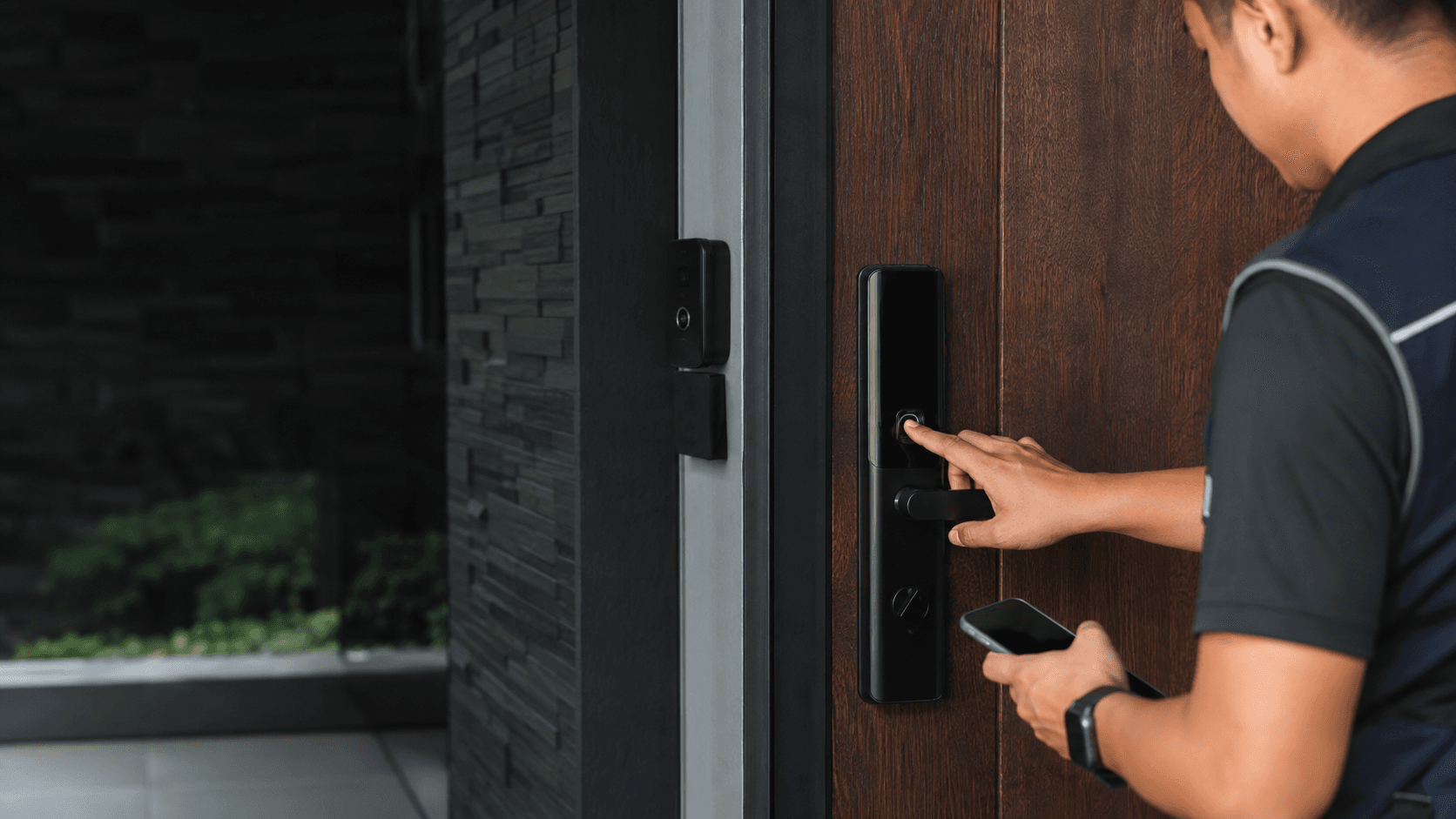
The exact-match phrase describes a behaviour rather than a single product. Yale publishes a support page titled "How to Enable Auto-Lock" under its Yale Access app documentation, which confirms that automatic relocking is a setting rather than a fixed trait of every Yale lock. That distinction matters in Malaysia, where the same lock body may sit on a timber door in a Kuching terrace house, a glass office entrance, or a shop lot shutter frame, and each of those doors behaves differently once the bolt starts moving without a person watching it.
Yale Automatic Lock. what the term actually covers
Search results for a Yale automatic lock mix three different things: a lock that relocks itself after a delay, a lock that relocks when the door closes, and a lock that can be locked remotely from an app. Only the first two are automatic in the everyday sense. The third still needs a person to press something.
Yale's own support material places auto-lock inside the Yale Access app, alongside other everyday-use settings. That tells a buyer where the behaviour is controlled, but it does not tell a buyer which Yale models expose the setting, how long the delay can be, or whether the lock senses the door position or simply counts time. Those details sit in model-level documentation that varies by product, so the honest position is that auto-lock exists as a Yale feature while its exact behaviour depends on the specific lock and firmware in front of the installer.
This is why a page about a Yale automatic lock should not read like a product roundup. The useful question is not which Yale lock is best. The useful question is what has to be true about the door, the users, and the backup route before automatic relocking is a good idea on that particular opening.
How auto-lock timing and door sensing work
Two mechanisms sit behind most automatic relocking. The first is a timer. the lock waits a set period after an unlock event and then throws the bolt. The second is a door-position input: the lock or a paired sensor knows whether the door is shut, and relocking is tied to that state rather than to a countdown.
A timer is simple and predictable. It also has a failure mode that matters on a busy door. If the delay is short and someone is still moving through the opening with hands full, the bolt can extend into a person or into a closing door. If the delay is long, the door sits unlocked for longer than the household expects, which defeats part of the purpose.
Door sensing removes most of that risk because the bolt only extends once the door is actually closed. The trade-off is dependency. the sensing element has to be fitted correctly, aligned with the frame, and able to report reliably. A sensor that reads "closed" when the door is only resting against the frame will let the lock secure a door that is not really shut.
Neither mechanism is inherently safer. A timer that is set sensibly on a quiet residential door is fine. A timer on a shop entrance with constant foot traffic is a nuisance waiting to happen. The mechanism has to match the traffic pattern, not the marketing description.
Door condition and user roles to review first
Eyonic's own product review guidance states that smart locks work best when the door condition, user roles and backup method are reviewed before installation, and that for business use the usual check is whether a standalone smart lock or an access-control panel is more appropriate. That is the correct order of operations, and it applies directly to any Yale automatic lock decision.
Door condition covers more than whether the door closes. A deadbolt needs a strike plate that lines up, a frame that does not shift with humidity, and enough clearance for the bolt to travel without binding. A door that already needs a shoulder to close will fight an automatic bolt every time it fires. On Malaysian timber doors, seasonal swelling is a real factor; on metal shop-lot frames, the issue is usually alignment after years of use rather than movement.
User roles decide whether automatic relocking helps or obstructs. A home with two or three regular users benefits from a door that re-secures itself. A shop with staff arriving in shifts, a cleaner with a temporary code, and a delivery driver waiting at the entrance needs a clear answer to who is still inside when the bolt extends. Permissions that are not planned produce the same complaint every time: the door locked itself while someone was still legitimately on the premises.
- Check the door and frame first. confirm the door closes cleanly, the strike aligns, and the existing deadbolt bore is sound before choosing any automatic locking behaviour.
- Map the users and their roles. list every person who needs entry, how often, and whether each one should be able to override or delay an automatic relock.
- Decide the auto-lock timing against real traffic: match the delay or the door-sensing behaviour to how the opening is actually used, not to how it is used on a quiet day.
- Agree the backup entry method before installation: settle how the door is opened if the lock, the app, or the power source is unavailable.
- Confirm the power and battery expectation: establish who monitors the lock's power source and what happens on the door when it runs low.
- Choose between a standalone lock and a managed system: for premises with multiple doors, staff turnover, or audit needs, compare a single smart lock against an access-control panel before committing.
Backup entry when the lock or battery fails
Every automatic locking decision needs a manual answer. If the lock relocks itself and the app is unreachable, the person at the door still needs a way in. That route is usually a physical key, a keypad code, or a second entry point, and it has to be tested while the installer is still on site rather than discovered at midnight.
Power is the second half of the same problem. A lock that depends on batteries will eventually report a low state, and the behaviour at that point varies by product. Some locks warn well in advance; others simply stop responding to app commands while still accepting a key. The practical step is to confirm, before handover, what the lock does as power drops and who is responsible for replacing the batteries on a commercial door.
There is also a physical edge case worth naming. An automatic bolt that extends while a door is obstructed can jam, and a jammed bolt on a door with no other entry is a lockout rather than a security feature. Backup entry planning is what separates the two.
Yale Automatic Lock in Malaysian homes, offices and shops
The same feature set produces different outcomes across property types. In a Sarawak terrace house, automatic relocking mainly removes the habit of checking the door at night, and the main constraints are door alignment and battery monitoring. In an office, the constraint shifts to user roles: staff, visitors, and cleaners all interact with the same door, and an automatic relock that ignores who is still inside creates friction that ends with the feature being switched off.
Shop lots sit between the two. Foot traffic is constant during trading hours, the door is often propped or held open, and an automatic bolt that fires on a timer will fight that pattern. This is the scenario where the standalone-versus-panel question becomes concrete, because a single automatic lock on a shop entrance is being asked to do access-control work it was not designed for.
Eyonic's project work in Kuching has centred on movement through entrances rather than on lock hardware alone. The Kuching Immigration Office project focused on arrival flow, staff areas, visitor movement and dependable daily operation, and the KTA Sarawak Sdn Bhd project addressed staff movement, visitor handling and clearer daily site control. Both illustrate the same principle that applies to a Yale automatic lock: the value comes from how people move through the opening, not from the lock's feature list.
Eyonic's founder, Eric Yong, has worked in technical installation of digital security solutions for commercial businesses in Sarawak for more than 10 years, and Eyonic's stated installation process runs through site survey, system proposal, installation and handover. For a lock decision, the site survey is where door condition and user roles get settled, and the handover is where backup entry and battery responsibility get confirmed.
Practical next step with Eyonic
Eyonic Sdn Bhd plans, supplies and installs security systems for homes, offices, shops and industrial sites in Sarawak, and reviews smart lock door access as part of that work. A lock decision on a real door starts with the door, the users and the backup route, which is why a survey comes before a product choice.
Share your location, property type and required system with Eyonic on WhatsApp at +60 11-5111 7959 for the next practical step.