
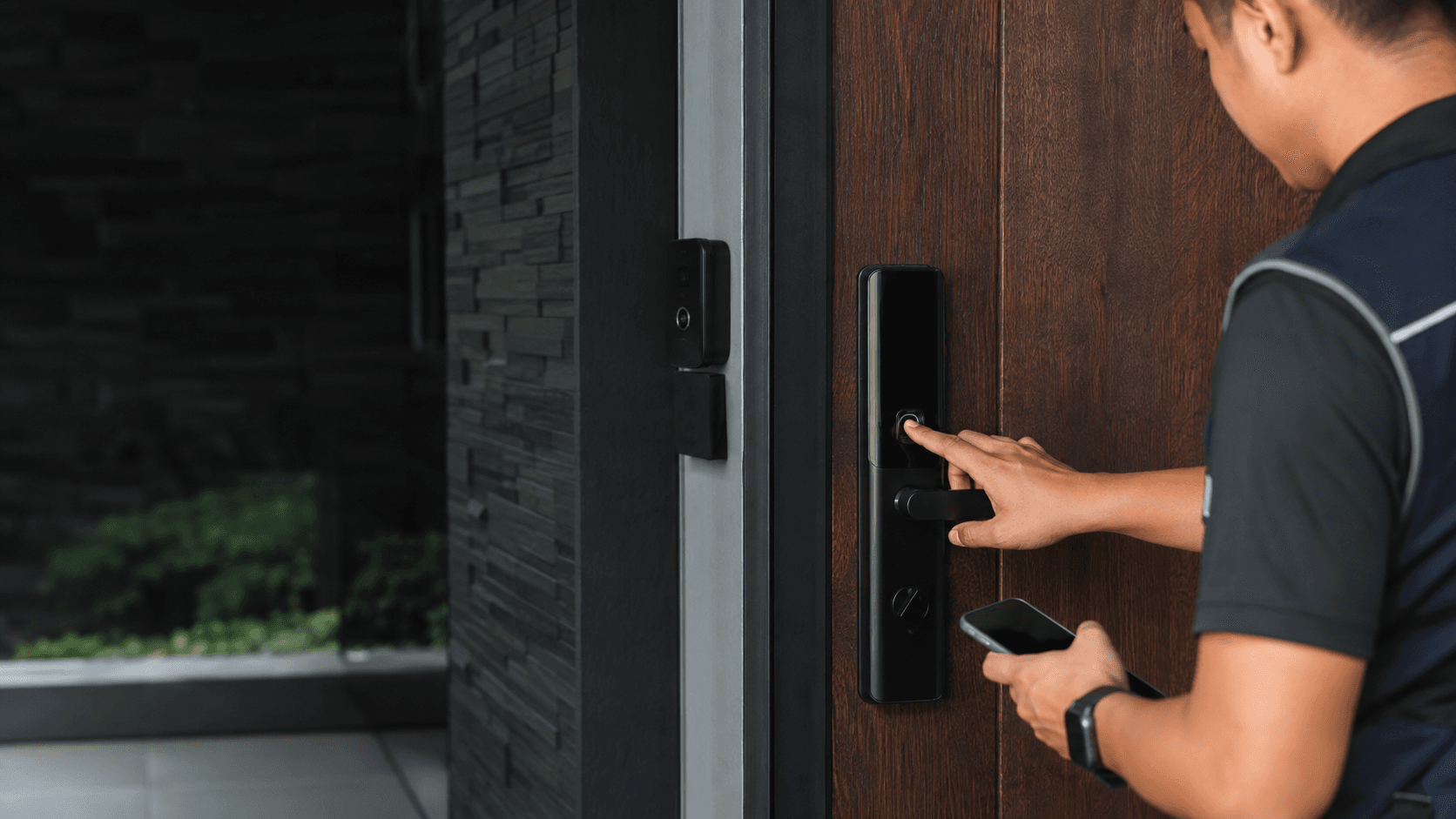
The appeal is simple. no key to carry, no code to remember, and a record of who came through. The risk is equally simple. A lock that only reads fingerprints can strand the people who rely on it when a finger is wet, dusty, cut or otherwise unreadable. That is why the practical questions are about the door, the users and the fallback, not about the sensor alone.
What a Fingerprint Key Lock Controls on a Door
A fingerprint key lock is a door-level access device. It replaces or augments the mechanical locking point on a single door and decides whether that door opens. It is not a building-wide access control system, and it does not manage lifts, gates or multiple entry points on its own.
On a residential door, the lock usually governs one entrance: the front door, a side door or a bedroom door. On a shop or office door, it governs the door it is fitted to, which may be a staff entrance, a storeroom or a server room. On an industrial door, the same logic applies, but the door itself is heavier and the daily traffic is rougher.
Eyonic's own product review guidance frames smart lock door access as good for controlled convenience when user permissions and backup entry are planned properly. That phrasing matters. The lock delivers convenience at one door; the planning around it delivers the control.
Where a site needs several doors managed together, with shared rules and a single record of movement, a standalone lock is usually the wrong tool. Eyonic's review guidance notes that for business use, the company usually checks whether a standalone smart lock or an access-control panel is more appropriate. That check happens before a model is chosen, not after.
How a Fingerprint Key Lock Reads a Finger
The reader captures an image or pattern of the finger surface, converts it into a stored template, and compares a fresh scan against that template. A match releases the lock mechanism. A non-match keeps it shut.
Two practical consequences follow from that sequence. First, the finger presented at the door must resemble the finger enrolled at setup. Second, the enrolled finger must be the one the person actually has available at that moment.
Wet hands are the common failure in Malaysian conditions. Rain, hand washing, cooking and condensation all put water between the finger and the reader. Dust and grit do the same on a site or workshop door. A cut, a bandage or worn ridges from manual work can also reduce the readable surface.
This is the hidden need behind most searches. The question is rarely whether the technology works in a demonstration. It is whether it works on a Tuesday evening in the rain, with a bag in one hand and a child in the other.
No verified sensor type, resolution, capacity or false-accept rate is available for the locks discussed here, so no accuracy figure should be quoted. The honest position is that reader performance varies by model and by the condition of the finger presented, and that variation is exactly why the backup method carries so much weight.
Fingerprint Key Lock Checks Before Installation
Most failed fittings fail at the door, not at the electronics. The checks below are the ones that decide whether a lock can be fitted at all and whether it will still be usable a year later.
- Confirm the door and frame condition, including whether the frame is solid enough to hold a strike and whether the door closes squarely without dragging.
- Confirm the door thickness and the existing lock cutout, so the replacement body matches the prepared hole rather than requiring new cutting.
- Review who needs access and at what times, covering staff, family, tenants, cleaners, contractors and visitors.
- Confirm the backup entry method, so the door can still be opened when a finger cannot be read or the lock loses power.
- Confirm the power source and how it will be maintained, including who replaces or recharges it and how that is tracked.
Door condition is the first item for a reason. A warped door, a loose frame or a misaligned strike will defeat a well-made lock. On older Malaysian shophouse doors and heavy industrial doors, this is often the deciding factor.
Door thickness and cutout come next because they determine whether the fitting is a straightforward swap or a carpentry job. A lock that does not match the existing preparation may still be installable, but the work and the cost change.
User review is where a domestic decision becomes a business decision. A home needs a handful of fingers enrolled and a simple way to add or remove one. An office or shop needs a clear answer to who is removed when someone leaves, and how quickly that happens.
Power is the quiet constraint. A lock that depends on a battery introduces a maintenance task that someone must own. If nobody owns it, the door eventually stops responding, and the backup method becomes the only way in.
Fingerprint Key Lock Backup Entry and User Roles
Backup entry is not a fallback for emergencies only. It is the everyday answer for wet hands, a forgotten enrolment and a flat battery. A lock without a workable second method puts the whole door at the mercy of one reader.
Common second methods on the market include a mechanical key, a keypad code, a card or fob, and a phone app. Which of these is present depends entirely on the model, and no verified app, Wi-Fi, Bluetooth or smart-home compatibility is available for the locks discussed here. The presence of a keyway or keypad should be confirmed on the specific unit before purchase, not assumed from the category.
User roles matter just as much. A household needs to add a new finger and remove an old one without a technician. A business needs to know who holds access, when it applies and what happens at the end of an employment or tenancy. Where that record has to stand up to scrutiny, a lock that stores entries locally may not be enough on its own.
There is a real trade-off here. More entry methods mean more convenience and more ways in. Fewer methods mean tighter control and a harder lockout when something fails. The right balance depends on how many people use the door and how much disruption a lockout causes.
Fingerprint Key Lock in Malaysian Homes and Offices
Malaysia's climate shapes the decision. High humidity, frequent rain and outdoor-facing doors put moisture on hands and readers alike. A covered porch behaves differently from an exposed gate-side door, and a fully indoor office door behaves differently again.
For a home, the usual fit is a single entrance where the household wants to stop carrying keys. The practical questions are who lives there, whether children or elderly family members can use the reader reliably, and what happens when the battery runs down.
For an office or shop, the fit is narrower. A fingerprint key lock suits a staff door, a storeroom or a room that needs controlled convenience. It does not, by itself, replace a building access policy. Eyonic's work for the Kuching Immigration Office centred on arrival flow, staff areas, visitor movement and dependable daily operation, which is the kind of environment where movement patterns and reliability are planned together rather than solved by one door device.
For an industrial site, the door is the constraint. Heavy doors, dust, grease and gloved hands all work against a fingerprint reader. Where the door is exposed to weather, no verified IP or weather-resistance rating is available for the locks discussed here, so outdoor suitability must be confirmed against the specific model rather than assumed.
Eyonic's project work for KTA Sarawak Sdn Bhd covered a practical office setup in Kuching supporting staff movement, visitor handling, tidy cabling and clearer daily site control. That pattern, staff and visitors moving through defined points, is the same pattern a fingerprint key lock has to fit into.
Fingerprint Key Lock Installation and Handover
Installation is where the earlier checks get tested. Eyonic's CCTV installation process runs through site survey, system proposal, installation and handover, and the same sequence applies to door access work: look at the actual door, propose what fits, install it, then hand it over with the users trained.
The site survey is the step that catches surprises. Door thickness, frame condition, existing cutout, cable routing and power all get confirmed on site rather than from a photograph. Eyonic applies the same principle elsewhere in its work, checking actual conditions before confirming placement rather than working from assumptions.
Handover is the step that decides whether the lock is used properly. It should cover enrolling and removing users, what to do when a finger will not read, where the backup key or code is kept, and who is responsible for the power source. A lock handed over without that briefing tends to be bypassed within weeks.
For larger sites, the handover also settles the boundary between the lock and the rest of the security setup. A door lock, a camera covering the entrance and an alarm on the same door are separate systems that need to work together sensibly. Eyonic plans, supplies and installs monitoring systems with camera placement, recording and remote viewing for homes, offices, shops and industrial sites, and door access is often specified alongside that work rather than in isolation.
Where a site needs the full picture, Eyonic's published packages cover a Hikvision CCTV package, a Hikvision alarm system and an autogate package, each at RM 1,599. Those packages cover cameras, alarms and gate motors rather than fingerprint locks, so lock pricing and lock specification should be confirmed separately for the specific door.
Share your location, property type and required system with Eyonic on WhatsApp at +60 11-5111 7959 for the next practical step.