
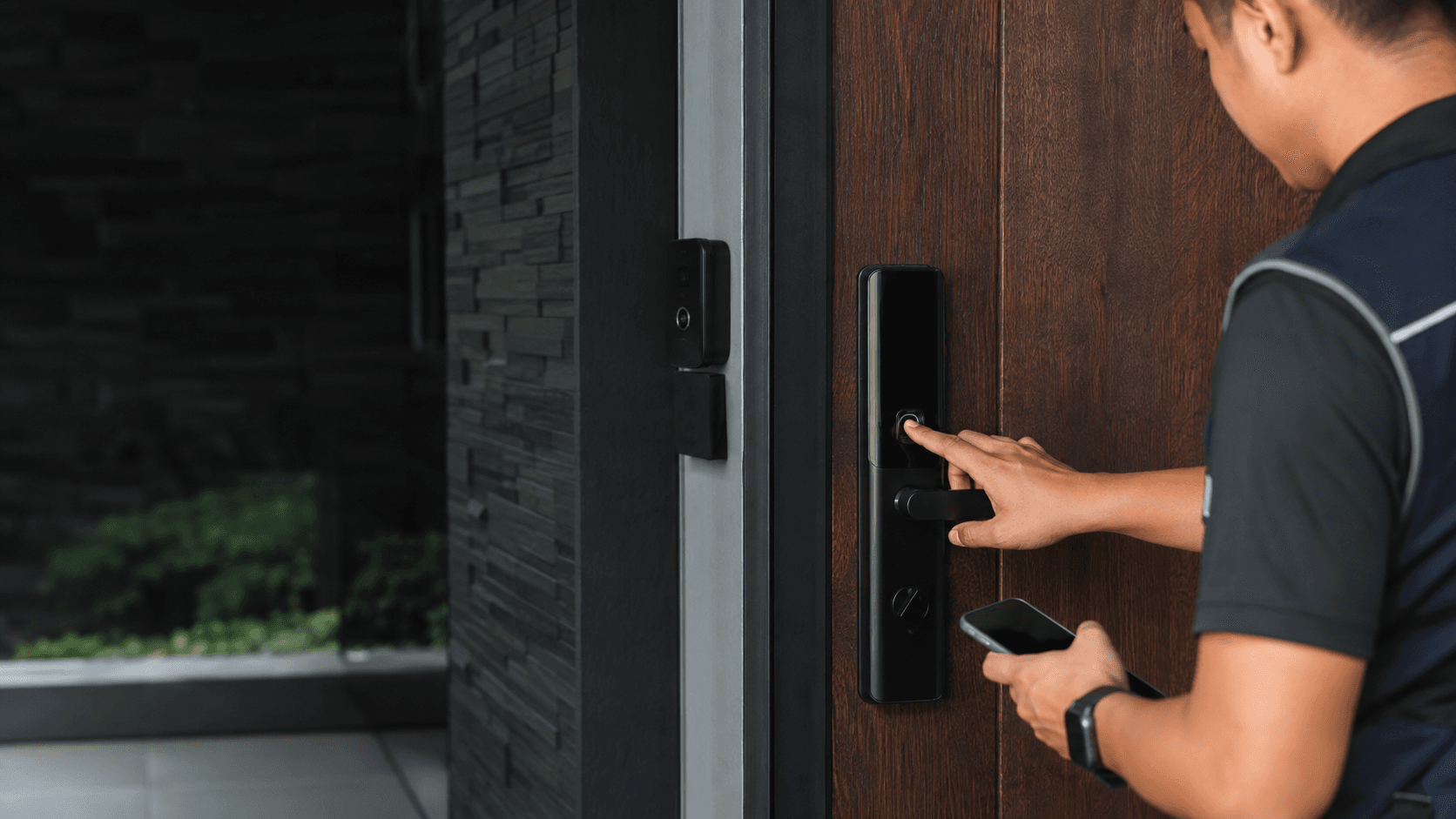
The exact-match query biometric fingerprint door lock describes a lock that reads a fingerprint to release a door. That is the simple part. The harder part is whether the door it will sit on can carry the hardware, and whether the people using it can still get in when a finger will not read.
Eyonic Sdn Bhd is a security system supplier in Sarawak that plans, supplies and installs monitoring and ELV systems for homes, offices, shops and industrial sites. Its product review notes state that smart locks work best when door condition, user roles and backup method are reviewed before installation, and that for business use the usual question is whether a standalone smart lock or an access-control panel is more appropriate.
Biometric Fingerprint Door Lock. What Has to Be Checked First
A biometric fingerprint door lock is not chosen from a catalogue alone. It is chosen against a specific door and a specific group of people who need to pass through it. The checks below are the sequence Eyonic follows, and they run in this order because each one can change the answer to the next.
- Site survey of the door, frame and surrounding wall.
- Door condition check, including how the door closes and whether the existing hardware can be replaced.
- User role mapping, covering who needs entry, how often, and whether entry should be limited.
- Backup entry method, so the door still opens when a fingerprint does not read.
- Installation of the lock and its wiring or power arrangement.
- Handover, including user enrolment, testing and a walkthrough of daily operation.
The site survey and handover stages are the same ones Eyonic uses across its installation work, where the process runs from site survey to system proposal, installation and handover. The lock-specific checks in the middle are what separate a lock that works for years from one that becomes a daily complaint.
Why the survey comes before the model
Two doors of the same width can behave differently. A door that has swollen, dropped on its hinges or never latched cleanly will fight any electronic lock, because the lock assumes the door closes to the same position every time. A survey catches that before money is spent on hardware that cannot compensate for it.
Door Condition and User Roles Decide the Hardware
Door condition and user roles are the two inputs that decide whether a biometric fingerprint door lock is the right fit at all. Everything else, including brand and finish, is secondary.
Door condition
The physical door has to accept the lock body, the latch or bolt, and any cabling or power route. A door that is thin, hollow, badly warped or fitted with hardware that cannot be removed cleanly limits the options. So does a frame that has been patched or repaired, because the strike side has to line up reliably.
Where the door is shared, glazed, or part of a fire-rated assembly, the constraint is not just mechanical. Replacing hardware on a door that carries a specific rating can change what the door is approved to do, and that is a question for the party responsible for the building, not for the lock supplier alone.
User roles
User roles decide how much control the lock has to provide. A home with three or four regular users has a simple requirement: the same people come and go, and everyone knows everyone. An office, a shop or a rental unit has a different requirement, because people join, leave, and need access at different times.
Once a site needs per-person access that can be added or removed on a schedule, the conversation moves from a lock to a system. That is the point where an access-control panel starts to make more sense than a standalone unit, and it is the check Eyonic applies for business use.
How Eyonic Reviews a Biometric Fingerprint Door Lock Before Installation
Eyonic's review of a biometric fingerprint door lock starts with the door and the users, not the product page. The review answers three questions in sequence: can this door take the hardware, do the users need individual permissions, and what happens when a fingerprint fails.
If the door can take the hardware and the users are a small, stable group, a standalone lock is usually the simpler answer. If the users change often, or if access has to be recorded or restricted by time, the review usually points toward an access-control panel instead. That distinction is stated directly in Eyonic's smart lock door access review, which notes that for business use the company usually checks whether a standalone smart lock or an access-control panel is more appropriate.
Eric Yong, founder of Eyonic Security Systems, has worked in the industry for more than ten years and is experienced in the technical installation of digital security solutions for commercial businesses in Sarawak. That experience matters most at the survey stage, where the door is assessed in person rather than from a photograph.
What the review does not cover
The review does not produce a fingerprint capacity figure, a recognition speed, a false-accept rate, a battery life or an IP rating, because those values belong to a specific model's specification sheet. They should be read from the manufacturer's documentation for the exact unit being considered, not assumed from the category.
Backup Entry and Daily Operation
Backup entry is the part of the decision that gets the least attention and causes the most frustration. A fingerprint reader will occasionally fail to read: a wet hand, a dry hand, a cut finger, a cold morning or a reader that needs cleaning can all cause a rejection. The door still has to open.
Every site should have at least one method that does not depend on a fingerprint. That may be a keypad code, a physical key, a card or a remote release, depending on the lock and the door. The method has to be available to the right people and stored somewhere that is not the same place as the door it opens.
Daily operation then settles into a rhythm. Users enrol their fingerprints during handover, the site confirms that each enrolled user can actually open the door, and someone is named as responsible for adding and removing users afterwards. Without that last step, a lock that was set up correctly on day one slowly stops matching the people who need to use it.
Power and failure behaviour
Battery-powered locks need a plan for what happens when the battery runs down, and mains-powered locks need a plan for what happens during a power cut. Both cases should be tested during handover rather than discovered on a night when the site is empty. The correct behaviour for a given model is defined by that model's documentation.
Where a Standalone Lock Stops and Access Control Starts
A standalone biometric fingerprint door lock controls one door for a small group of people. An access-control panel controls multiple doors, multiple users and the rules between them. The line between the two is drawn by the site's requirements, not by the hardware's price.
Signals that a site has crossed that line include more than one controlled door, users who need different levels of access, a need to know who entered and when, and a need to remove access immediately when someone leaves. Any one of those is usually enough to justify looking at a panel-based system rather than adding more standalone locks.
Public and commercial premises add another layer. Eyonic's work for the Kuching Immigration Office focused on arrival flow, staff areas, visitor movement and dependable daily operation, and its work for KTA Sarawak Sdn Bhd supported staff movement, visitor handling, tidy cabling and clearer daily site control. Both are examples of the same underlying question: who moves through the space, and how is that movement managed. A single door lock answers only a small part of that question.
Cost expectations
Eyonic's published package pricing covers a Hikvision CCTV package, a Hikvision alarm system and an autogate package, each at RM 1,599. Those packages describe camera supply and setup, control panel and sensor work, and motor recommendation with remote-control setup and safety testing. They are not lock pricing, and no verified price for a biometric fingerprint door lock or its installation is available here. Budget figures for larger security work, such as the RM 12,000 to RM 28,000 range noted for the Kuching Immigration Office project and the RM 8,000 to RM 18,000 range noted for the KTA Sarawak Sdn Bhd project, describe whole-site scopes rather than a single lock.
Questions Buyers Ask in Malaysia
Is a suitable for a Malaysian home
It can be, when the door is in good condition, the household is a small stable group, and a backup entry method is in place. The deciding factor is usually the door rather than the climate, because a door that does not latch cleanly will cause problems regardless of how the lock reads a finger.
When is an access control panel the better choice
When more than one door is involved, when users need different levels of access, when entry needs to be recorded, or when access has to be removed quickly. Those requirements exceed what a standalone lock is designed to do.
What should be confirmed before installation
The door condition, the list of users and their roles, the backup entry method, and who will manage user changes after handover. Confirming those four points first prevents most of the problems that appear after the lock is fitted.
Does a fingerprint lock remove the need for keys entirely
Not necessarily. Many installations keep a physical key or a code as the fallback, and that is a deliberate choice rather than a compromise. The fallback should be tested at handover so it is known to work before it is needed.
Share the location, property type and required system with Eyonic on WhatsApp at +60 11-5111 7959 for the next practical step.