
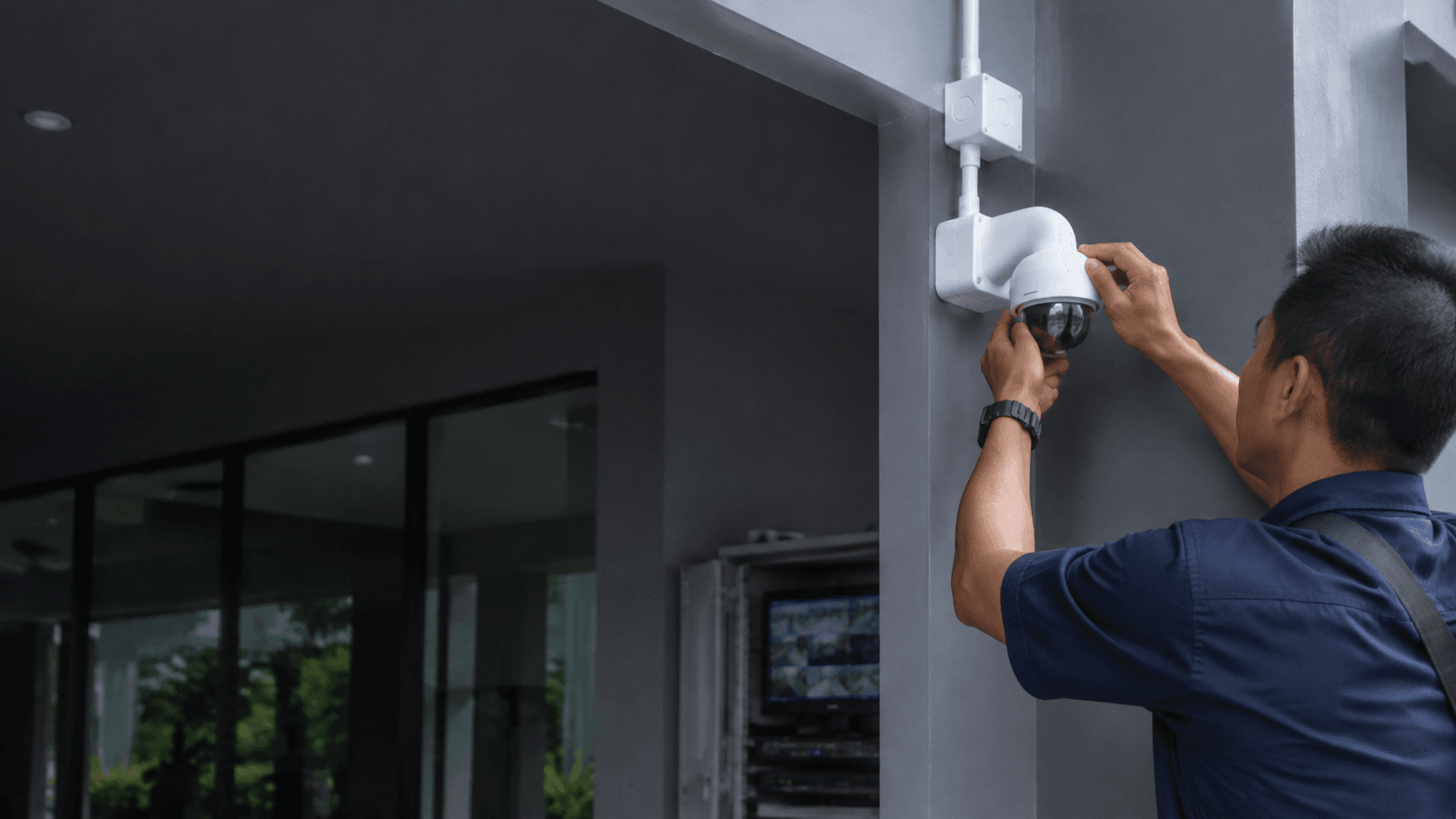
The exact-match query home video surveillance describes a complete working arrangement rather than a single product: cameras positioned around a property, a recorder storing the footage, and a way to view it remotely. Eyonic Sdn Bhd handles that arrangement end to end in Sarawak, from the first site survey through to handover.
What follows is a practical account of how home video surveillance is scoped in Malaysia, what a survey actually decides, and where the honest limits sit before anyone commits to a specification.
Home Video Surveillance. What a Practical Setup Covers
A working home video surveillance setup has four parts that must agree with each other: the cameras, the recorder, the network path between them, and the viewing method. Weakness in any one part shows up as a gap in coverage or a recording that cannot be retrieved when it matters.
Eyonic describes its CCTV work as planning, supplying and installing monitoring systems with camera placement, recording and remote viewing for homes, offices, shops and industrial sites. Those four elements are the practical scope of a home system as well.
Camera placement decides what the system can actually see. A camera aimed at a gate records the gate; a camera aimed at the approach to the gate records who arrived and from where. The difference is a mounting decision made during the survey, not a specification on a box.
NVR setup covers how footage is stored and how long it remains available. Remote viewing covers how the property is checked when nobody is on site. Both depend on the recorder and the network being configured together rather than treated as separate purchases.
Wired, wireless and the middle ground
Wired cameras carry power and data over a fixed cable run, which suits permanent positions on a house where cabling can be routed tidily. Wireless cameras avoid long cable runs but still need power or a battery plan, and their reliability depends on signal reaching the mounting point.
The choice is usually made per camera position rather than for the whole property. A front gate may justify a fixed run while a rear storage area is easier to serve another way. The survey is where that gets settled.
Where home video surveillance stops being a product decision
Two houses on the same street can need different systems because of roof lines, boundary walls, tree cover and where the family actually parks. Catalogue pages cannot resolve that. A site visit can.
How Eyonic Approaches Home Video Surveillance
Eyonic's CCTV installation process runs through four stages, and each one produces something the next stage depends on.
- Site survey. The property is inspected to establish camera positions, cable routes and where the recorder will live.
- System proposal. The survey findings are turned into a proposed system covering cameras, recording and viewing.
- Installation. Cameras, cabling and the recorder are installed and configured on site.
- Handover. The system is explained and the viewing setup is passed to the property owner.
Eyonic Sdn Bhd is a security system supplier based in Sarawak, and the company's founder Eric Yong has worked in the industry for more than 10 years, with experience in technical installation of digital security solutions for commercial businesses in Sarawak.
The sequence matters because it prevents a common failure: buying cameras first and discovering during installation that the intended mounting points cannot be reached cleanly, or that the recorder has nowhere sensible to sit.
Why the survey comes before the proposal
A proposal written without a survey is a guess dressed as a plan. The survey is what allows the proposal to name positions, routes and equipment that fit the actual property.
What handover is for
Handover is where remote viewing stops being a feature and becomes something the owner can operate. A system that records correctly but cannot be checked from a phone has not finished the job.
Planning Before Camera Placement
Placement decisions are the highest-leverage part of planning, because they are the hardest to change later without re-running cable and re-drilling mounts.
Eyonic recommends checking actual lighting conditions before confirming placement for ColorVu-style cameras. That guidance exists because a position that looks adequate in daylight can behave very differently after dark, and the camera's own low-light behaviour interacts with whatever light the property already has.
Practical planning therefore starts with a walk of the property at the times that matter, not with a camera count. The questions that shape placement are concrete:
- Which approach routes lead to the house, and which of them are currently unobserved?
- Where does existing lighting already cover ground, and where is it absent after dark?
- Which mounting points can be reached with a tidy cable route?
- Where can the recorder sit with power and network access?
Answering those four questions usually produces a shorter camera list than a room-by-room count would, because it targets the routes that matter rather than every wall.
Lighting checks that change the plan
A position beside an existing outdoor light behaves differently from the same position on a dark side wall. Confirming the lighting at the actual mounting point is what separates a placement that works at night from one that only works in the afternoon.
Edge cases worth naming early
Long driveways, detached structures and shared boundary walls all create positions where a single camera cannot cover the ground usefully. Those are the cases where the survey earns its place, because the answer is usually a different position rather than a different camera.
What the Kuching Immigration Office Project Shows
Eyonic completed a project for the Kuching Immigration Office, providing practical support for a public office focused on arrival flow, staff areas, visitor movement and dependable daily operation.
The project is useful as a reference point for home planning because the underlying questions are the same shape. Arrival flow is about the approach to an entrance. Staff areas are about internal movement. Visitor movement is about who passes through which space. Dependable daily operation is about the system continuing to work without constant attention.
A house has a smaller version of each: the gate and car porch, the internal rooms, the routes visitors take, and the requirement that the system keeps recording without being nursed.
The approximate budget for that type of work was RM 12,000 to RM 28,000. That figure belongs to a public office project and should not be read as a home price, but it does show how far scope can move a budget when coverage, cabling and daily reliability requirements grow.
Eyonic also completed a project for KTA Sarawak Sdn Bhd, an engineering consultancy site in Kuching that needed a practical office setup supporting staff movement, visitor handling, tidy cabling and clearer daily site control. Tidy cabling appears in both projects because it is a real constraint, not a finishing detail.
Costs and Package Starting Points
Eyonic lists three packages at RM 1,599 each, and they cover different jobs rather than tiers of the same job.
The Hikvision CCTV Package at RM 1,599 covers camera supply and setup, basic recording configuration, and mobile viewing handover. For a household wanting a working starting point rather than a full property design, that package defines the floor.
The Hikvision Alarm System at RM 1,599 covers a control panel and sensors, siren and zone setup, and user testing and handover. The Autogate Package at RM 1,599 covers motor recommendation, remote-control setup, and safety testing and handover.
These are separate systems that can be planned together. A household thinking about home video surveillance may also want alarm coverage or gate automation, and the survey is the point where combining them is either sensible or unnecessary.
What moves a budget above the package floor
Camera count, cable route difficulty, recorder position and the number of viewing users all push a project past a package price. The Kuching Immigration Office range of RM 12,000 to RM 28,000 illustrates the upper end of that movement on a larger site.
No verified pricing exists for a specific home configuration before a survey, and any figure quoted without one would be invented rather than estimated.
What cannot be confirmed before a visit
Camera and recorder specifications, storage capacity, night-vision performance, installation timelines and warranty terms are not confirmed here, because the supplied evidence does not establish them. A survey and proposal are what turn those open items into stated commitments.
Next Step With Eyonic
The practical next step is a site survey, because it converts an intention into positions, routes and a proposal that can be assessed on its merits.
Share your location, property type and required system with Eyonic on WhatsApp at +60 11-5111 7959 for the next practical step.
Useful details to bring to that conversation include the property type, whether the property is in Kuching or elsewhere in Sarawak, which areas need coverage, and whether alarm or gate automation should be considered alongside the cameras. Those details let the survey be scoped to the property rather than to a generic template.
For households comparing options, the honest position is that home video surveillance in Malaysia is a planning exercise before it is a purchasing one. The survey, the proposal, the installation and the handover are what determine whether the finished system records what matters and can be checked when it counts.