
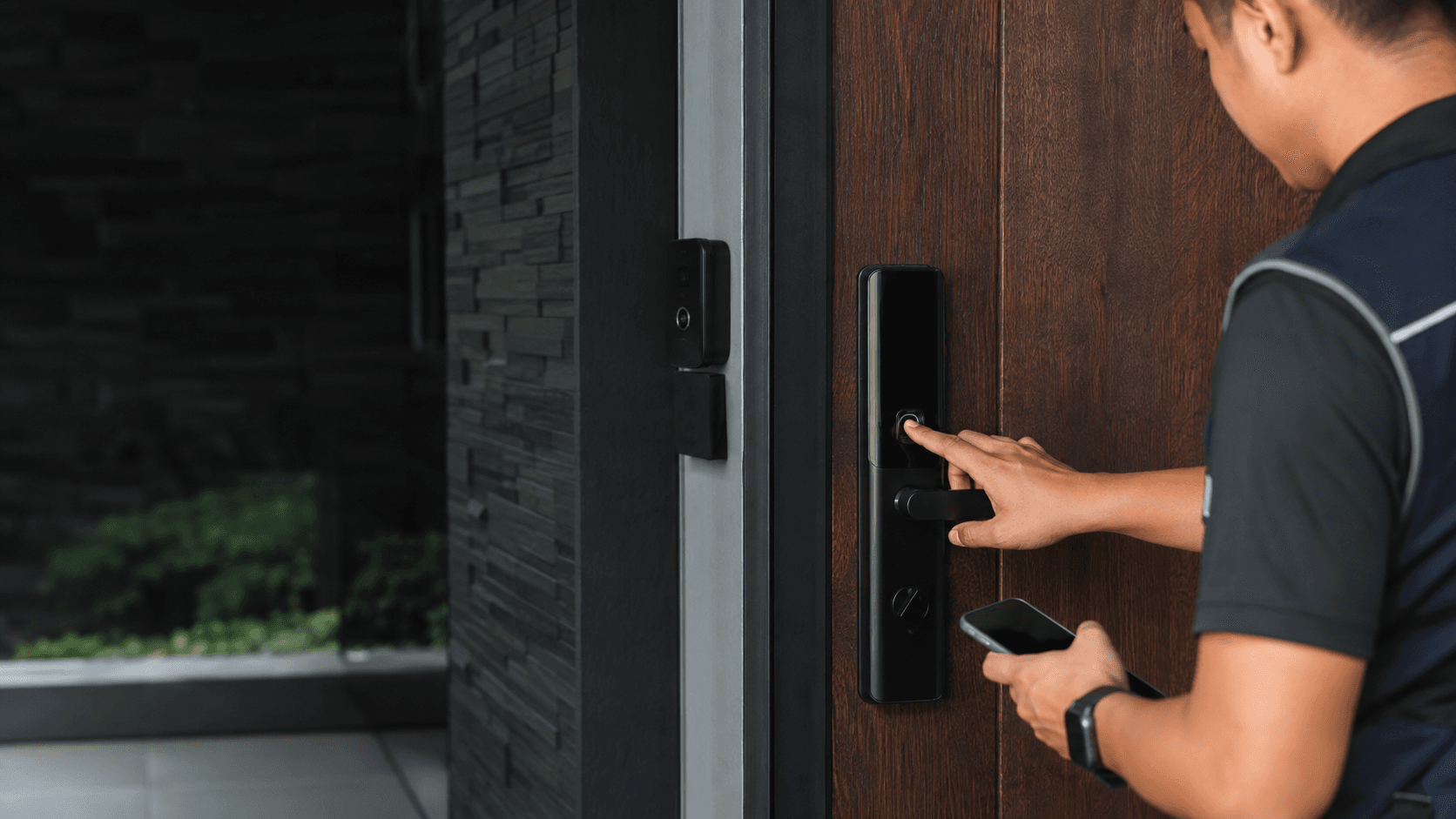
The term covers a narrow category of hardware. A fingerprint deadbolt door lock is a deadbolt — the sliding bolt that throws into the strike plate — with a fingerprint reader built into the exterior assembly. It is not a handle set, not a padlock, and not a lever latch. The bolt still does the physical work of securing the door; the reader only decides who can retract it.
Most models in this category also carry a keypad, a mechanical key override, or an app connection, because a single authentication method creates a single point of failure. That combination is what separates a practical unit from a novelty. Buyers comparing options in Malaysia usually arrive with the same three questions: will it fit the existing door, who gets access, and what happens when the fingerprint does not read.
Fingerprint Deadbolt Door Lock. what the term covers
The category sits inside keyless entry and overlaps with smart locks, but the two are not identical. A smart lock may use only a keypad, only an app, or only a card. A fingerprint deadbolt door lock adds biometric access as a primary or secondary credential.
Three components matter in any unit:
- The exterior assembly, which holds the reader, keypad, and often the key override.
- The interior assembly, which holds the motor, battery compartment, and thumb-turn or button.
- The bolt and latch mechanism, which must match the door's existing bore and backset.
Biometric access works by storing a template of the finger's ridge pattern, not a photograph. The reader compares a live scan against stored templates and releases the motor when the match passes its threshold. Because the template is stored in the lock rather than a central database, a failed reader does not lock out every user at once — but it does lock out the person standing at the door.
That distinction matters for planning. A fingerprint deadbolt door lock is a standalone device in most residential configurations. In commercial settings, the same door may be better served by an access-control panel that logs every entry and can be managed centrally. Eyonic's own product review notes that for business use, the choice between a standalone smart lock and an access-control panel is usually reviewed before installation rather than assumed.
How fingerprint access changes daily entry
The daily difference is small but consistent. A keyed deadbolt requires carrying, finding, and inserting a key. A fingerprint deadbolt door lock requires presenting a finger. For a household where several people come and go at different hours, that removes the shared-key problem: no one needs a copy, and no one needs to be home to let someone in.
Fingerprint access also changes what happens when a credential is lost. A lost key means rekeying the cylinder or replacing the lock. A lost finger is not a scenario; a departed housemate or staff member is. Removing an enrolled fingerprint is the equivalent of rekeying, and it is usually done at the lock itself or through an app, depending on the model.
Three practical effects show up repeatedly:
- Confirm the door and frame are sound, with no swelling, warping, or misaligned strike that would stop the bolt from throwing freely.
- Confirm the existing bore and backset match the replacement deadbolt, or plan for the door to be modified.
- Decide who needs access and at what level — permanent fingerprint, temporary code, or one-time entry.
- Choose the backup entry method before installation, not after the first lockout.
- Confirm the power routine. battery type, expected replacement interval, and any low-battery warning.
- Confirm installation and handover, including who tests each credential and who holds the override key.
The order matters because each step constrains the next. A door that cannot accept the bolt body makes the access plan irrelevant. An access plan with no backup method turns a dead battery into a locksmith call.
Door condition and user roles before installation
Door condition is the most common reason a fingerprint deadbolt door lock installation stalls. Deadbolts need a clean, correctly sized cross-bore and a latch bore at the right backset. Older wooden doors may have been drilled for a different lock, and metal or fire-rated doors may not accept a retrofit at all without compromising their rating.
Frame condition matters just as much. If the strike plate sits too far from the bolt, the bolt will not throw, and the lock will report a fault or refuse to arm. A door that has dropped on its hinges will show the same symptom. These are mechanical problems, and no amount of reader accuracy fixes them.
User roles determine the credential plan. A typical split looks like this.
- Residents or permanent staff. enrolled fingerprint, full access at all hours.
- Regular visitors or part-time staff: fingerprint or a recurring code limited to working hours.
- One-off visitors. a single-use or time-limited code, issued and revoked without touching the lock.
- Emergency or maintenance access. a mechanical key or an administrative code held separately.
For a business, the same door may need to distinguish between staff movement and visitor handling. Eyonic's work at the Kuching Immigration Office centred on arrival flow, staff areas, visitor movement, and dependable daily operation — the same categories that shape a door access plan, even though that project is not a lock installation.
Backup entry and access permissions
Every fingerprint deadbolt door lock needs at least one fallback that does not depend on the reader. The common options are a mechanical key override, a keypad code, a mobile app over Bluetooth or Wi-Fi, or an external power terminal for a jump-start when the battery is flat.
Each has a trade-off. A mechanical key override is the most reliable but reintroduces a physical key that can be copied or lost. A keypad code is convenient but can be observed or shared. An app depends on a working phone, a charged battery, and often a hub or network connection. An external power terminal is a recovery method, not a daily one.
Permissions deserve the same scrutiny. If the lock supports multiple user slots, decide in advance how many are reserved for permanent users and how many for temporary ones. If it supports schedules, decide whether access should be limited by time of day or day of week. If it supports audit logs, decide who reviews them. A lock that cannot answer these questions will be managed by workaround, which usually means a shared code that never gets changed.
Practical checks for Malaysian homes and premises
Malaysian doorways vary more than product pages suggest. Condominium units often have a main door and a metal gate, and the gate may already carry its own lock. Terrace houses and shop offices may have timber, metal, or glass doors, each with different bore and reinforcement characteristics. A fingerprint deadbolt door lock that suits one may not suit another.
Three checks are worth doing before committing:
- Measure the existing door thickness and the distance from the door edge to the centre of the bore. These two numbers decide whether a replacement deadbolt fits without modification.
- Check whether the door is fire-rated or forms part of a managed building's approved door set. Some buildings restrict what can be fitted to the main door.
- Check the environment. An outdoor or semi-outdoor door faces humidity, heat, and rain splash, which affects both the electronics and the finish over time.
For premises with staff or tenants, the access plan should also account for turnover. A lock that makes it easy to add and remove users reduces the temptation to share a single code. That is a management benefit rather than a hardware one, but it is usually the reason a business replaces a keyed deadbolt in the first place.
Where a site already runs CCTV, alarm, or intercom systems, door access is often planned alongside them rather than in isolation. Eyonic's installation process for its security systems follows site survey, system proposal, installation, and handover, and the same sequence applies to door hardware: the survey establishes what the door can take, the proposal sets out the access plan, and the handover confirms every credential works before the installer leaves.
Where Eyonic fits for supply and installation
Eyonic Sdn Bhd is a security system supplier based in Sarawak, Malaysia, working across CCTV and ELV systems for homes, offices, shops, and industrial sites. Its product range includes smart locks alongside Hikvision cameras, and its published review of smart lock door access states that these locks work best when door condition, user roles, and backup method are reviewed before installation.
That review position is the practical starting point. A fingerprint deadbolt door lock is a good fit when the door is sound, the user list is stable enough to manage, and a backup method is agreed in advance. It is a poor fit when the door cannot accept the bolt, when dozens of transient users need entry, or when the site requires central logging and remote administration — in which case an access-control panel is the more appropriate route.
Eyonic's founder, Eric Yong, has worked in technical installation of digital security solutions for commercial businesses in Sarawak for more than 10 years. The company's completed projects include the Kuching Immigration Office and KTA Sarawak Sdn Bhd, both of which involved staff movement, visitor handling, and daily operational reliability rather than lock hardware specifically.
Pricing for door locks is not published. Eyonic's listed RM 1,599 packages cover Hikvision CCTV, alarm systems, and autogate, and those figures do not apply to fingerprint deadbolt door locks. Any lock supply or installation cost would need to be confirmed against the actual door and access plan.
For a next step, share the location, property type, and required system with Eyonic on WhatsApp at +60 11-5111 7959. A site survey is the point at which door condition, bore dimensions, and user roles can be checked against a specific unit rather than a general description.