
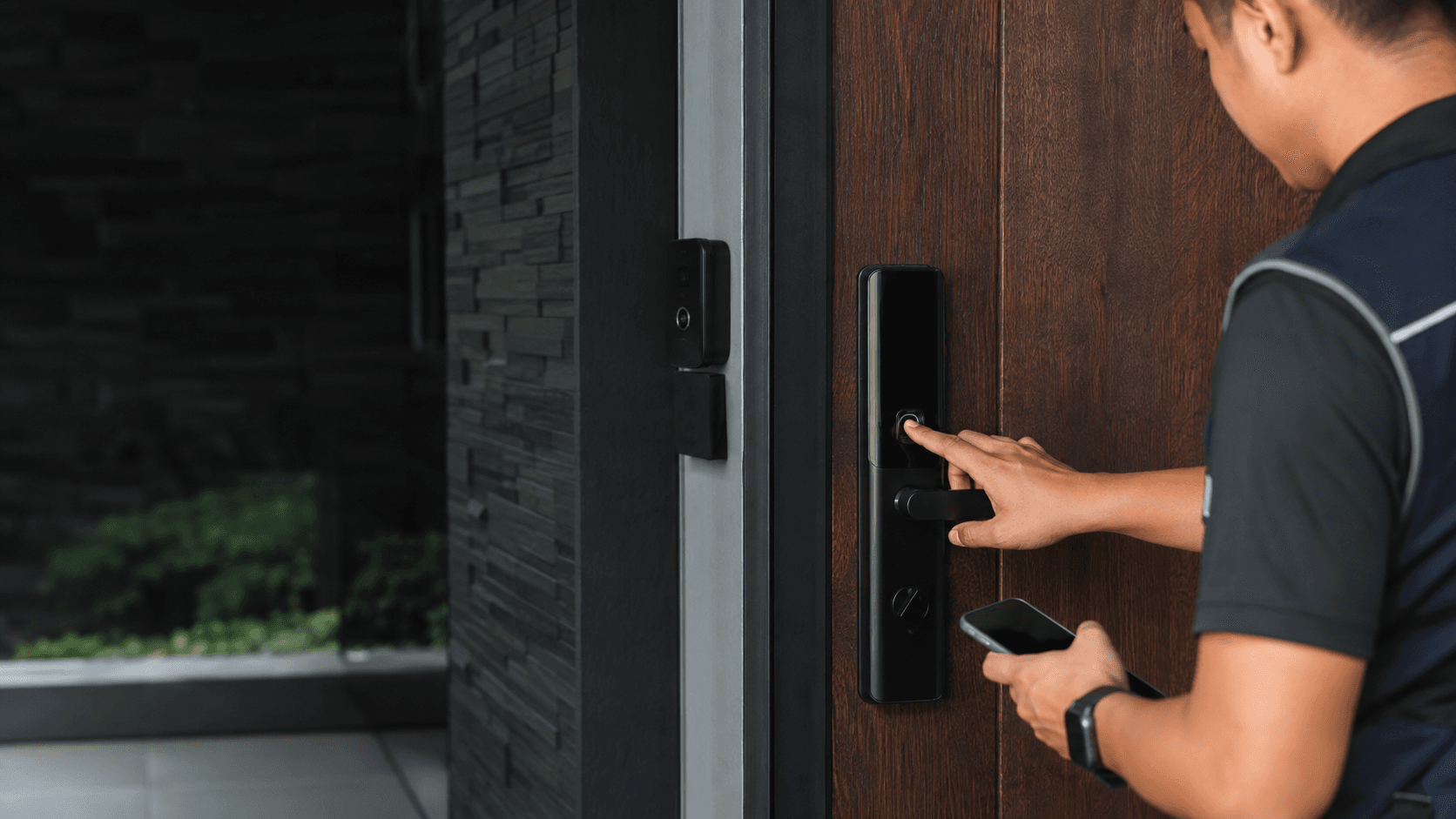
The term covers two different builds. One is a self-contained lock with its own radio receiver and fob. The other is a powered lock wired to an access control panel, where the remote is one trigger among keypads, intercoms, and push buttons. Both are sold as an electronic door lock with remote, and the difference decides what has to be installed around the door.
Electronic Door Lock With Remote: What the Term Covers
Remote entry is an access method, not a product category. A lock earns the label when a signal from outside the door releases it. That signal can come from a key fob, a phone app, a gate-style transmitter, or a receiver wired into a controller.
Three build types appear in practice:
- Standalone lock with fob. The lock body holds the electronics, the reader, and the receiver. Nothing else is needed at the door.
- Powered lock on a controller. The lock is a strike, latch, or magnetic unit fed by a power supply and switched by an access control panel. The remote is a transmitter paired to that panel.
- Smart lock with app control. The lock joins a network, and the phone becomes the remote. This overlaps with the standalone type but depends on network and account access rather than a fob.
Each type fails differently. A standalone lock with a flat battery stops responding to the fob. A controller-based lock loses remote release when power or the panel drops, which is why fail-safe and fail-secure behaviour matters at the specification stage.
How Remote Entry Works on a Door Lock
A remote release is a short chain: transmitter, receiver, controller, lock. The transmitter sends a coded signal. The receiver validates it. The controller decides whether that code is allowed at that time. The lock then releases for as long as the controller holds it open.
Two details decide daily behaviour. The first is whether the lock is fail-safe or fail-secure. A fail-safe lock releases when power is lost, which suits a main exit. A fail-secure lock stays locked when power is lost, which suits a store, plant room, or perimeter door. The second is release time, the number of seconds the lock stays open after a valid trigger. Too short and people are still pulling the handle when it relocks. Too long and the door is open to anyone walking past.
Remote range is a real constraint, not a marketing number. Walls, metal doors, and reinforced frames all cut effective range, so a fob that works across an open car park may not work from inside a concrete stairwell. Range should be confirmed at the actual door, not from a datasheet.
Remote entry versus keypad, card, and fingerprint
A keypad needs a code remembered or shared. A card needs a credential carried. A fingerprint needs the person present and enrolled. A remote needs a fob carried and a receiver in range. For a guard opening a gate for a visitor, the remote is the fastest option. For a door used by many staff with changing shifts, a card or code system usually tracks better because each entry is tied to a person rather than a shared fob.
Where an Electronic Door Lock With Remote Fits in Malaysia
Malaysian properties split into a few patterns that suit remote release well and a few that do not.
Terrace houses and semi-detached homes with a gate and a main door often want one trigger for both. A remote that releases the pedestrian gate and a second that releases the main door is a common arrangement, and it pairs naturally with an autogate installation where the motor and remote setup are already part of the job.
Shops and offices in Sarawak typically have a front entrance, a back door for deliveries, and a staff area. Remote release on the delivery door lets staff open it without walking to the front. This is the same logic Eyonic applied at the Kuching Immigration Office, where the work focused on arrival flow, staff areas, visitor movement, and dependable daily operation.
Industrial and plant sites usually need the opposite of convenience. A remote that opens a perimeter door from a distance is a risk unless the controller logs the event and the door is watched. On those sites, remote release is normally restricted to one door and paired with recording.
Condominiums and apartments are the awkward case. The unit door is usually a fire-rated or metal door in a shared corridor, and drilling it or changing the locking hardware can conflict with building rules. Remote release on the unit door is often better handled through the building's own access system than through a lock fitted to the door leaf.
What to Compare Before Choosing an Electronic Door Lock With Remote
Comparison starts with the door, not the lock. A lock that fits a timber door with a standard bore may not fit a metal frame, a glass door, or a door with a narrow stile. Door thickness, frame material, existing hardware, and whether the door closes flush all decide which lock types are even possible.
After the door, the questions are about people and failure. Who needs to open this door, and does each person need their own credential or is one shared remote acceptable? What happens when the battery is flat, the power is out, or the controller is offline? Is there a mechanical key, a manual release, or a second entrance that still works?
For business use, the choice between a standalone smart lock and an access control panel is the main fork. A standalone lock is simpler and cheaper to install. A panel costs more but supports multiple doors, per-user permissions, time zones, and an entry log. Eyonic's own product guidance notes that smart locks work best when door condition, user roles, and backup method are reviewed before installation, and that for business use the standalone-versus-panel question is checked first.
Five checks cover most of the decision:
- Confirm the door condition. material, thickness, frame, existing hardware, and whether the door closes and latches cleanly today.
- List the user roles. who opens the door, how often, whether each person needs a separate credential, and whether entry needs to be logged.
- Choose the backup entry method. mechanical key, manual release, or a second door that stays usable when the lock does not respond.
- Decide the power arrangement. battery inside the lock, or a power supply and controller for a wired lock, plus what happens on power loss.
- Agree who performs installation and handover, including testing of every credential and a walkthrough of the failure cases.
Installation Checks for Doors, Power and Backup Entry
Installation is where most remote lock problems are created. A lock fitted to a door that does not close squarely will bind, and a binding lock draws more current, drains batteries faster, and eventually stops releasing on command.
Power is the second check. Battery locks need the battery compartment reachable without dismantling the door. Wired locks need a supply that is protected and, ideally, backed up, because a fail-secure lock on an unbacked supply becomes a locked door with no way in during an outage.
Backup entry is the third. Every remote lock should have a way in that does not depend on the remote, the network, or the battery. That can be a mechanical key override, a manual release inside the secure side, or a separate door. The point is that the backup is tested before handover, not discovered during a failure.
Eyonic's installation process runs through site survey, system proposal, installation, and handover, and the same sequence applies to door access work. The site survey is where door condition and cable routes are confirmed. Handover is where each user credential is tested and the failure cases are demonstrated.
Two limits are worth stating plainly. Remote range cannot be guaranteed from a datasheet because building materials vary, so range should be verified at the door. And no remote lock removes the need for a working mechanical or manual backup, because electronics, batteries, and power supplies all fail at some point.
Questions that come up during specification
Can a remote lock be fitted to an existing door? Often yes, but it depends on door material, thickness, and frame. A timber door with standard preparation is the easiest case. Metal, glass, and narrow-stile doors usually need a different lock type or a frame-mounted strike rather than a lock in the leaf.
Does remote entry work during a power failure? That depends on the lock type and whether the supply is backed up. A battery-powered standalone lock is unaffected by mains power. A wired lock on a controller behaves according to its fail-safe or fail-secure setting, which is why that setting is chosen deliberately rather than left to default.
Is one remote enough for a household or a small office? Multiple remotes can usually be paired to the same receiver, but a shared remote cannot show who entered. Where entry needs to be attributed to a person, a per-user credential on a controller is the more useful arrangement.
What does a remote lock cost in Malaysia? Pricing depends on the lock type, the number of doors, and whether a controller and power supply are part of the scope. Eyonic publishes package pricing for CCTV, alarm, and autogate work at RM 1,599 per package, and comparable door access work is quoted from a site survey rather than a fixed list.
Practical Next Step With Eyonic
Eyonic Sdn Bhd plans, supplies, and installs security and ELV systems in Sarawak, including door access work alongside CCTV, alarm, autogate, and intercom systems. The founder, Eric Yong, has worked in technical installation of digital security solutions for commercial businesses in Sarawak for more than ten years.
For a property in Kuching or elsewhere in Sarawak, the useful starting information is the door itself, the number of people who need access, and whether entry needs to be logged. That is enough to decide between a standalone lock with a fob and a powered lock on a controller, and to identify whether the existing door can take either.
Share the location, property type, and required system with Eyonic on WhatsApp at +60 11-5111 7959 for the next practical step.