
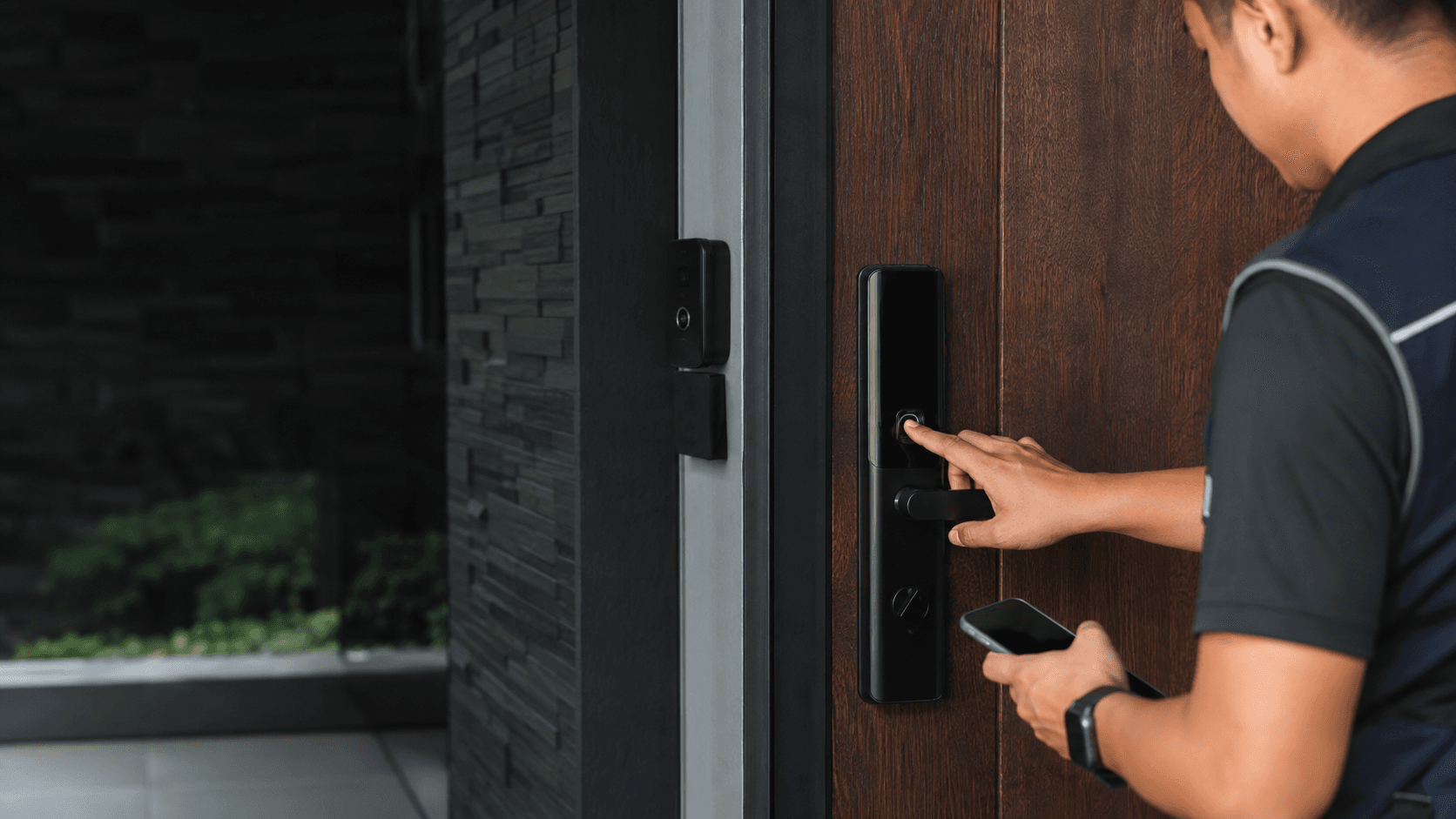
The term describes hardware families rather than one product. Kwikset groups its exterior hardware by function, and the keyed entry function is the clearest example: a keyed cylinder faces the outside of the door while a thumbturn sits on the interior face, so the door can be locked from inside without a key and unlocked from outside with one. That split between exterior keyed access and interior thumbturn operation is the organising idea behind most Kwikset exterior door locks.
Three hardware types appear repeatedly across Kwikset's own product structure and across retailer listings: keyed entry locks, handlesets, and deadbolts. A fourth category, electronic keypad hardware, sits alongside them. Each type answers a different question about the door, and the choice usually follows from whether the door already has a deadbolt bore, whether a matching handle is wanted, and whether keys or codes should control entry.
Kwikset Exterior Door Locks. What the Term Covers
Kwikset exterior door locks is a category label, not a single model. It gathers the hardware Kwikset sells for doors that face outside, and the category is organised by function rather than by finish or price. Kwikset's own product navigation separates products by category and by function, which is why the same visual style can appear as a keyed entry knob, a keyed entry lever, or part of a handleset.
Retailer listings describe the same spread in plainer terms. One distributor describes a selection of handlesets, levers, deadbolts, and knobs for interior or exterior entryways, with multiple lock functions designed for residential and light commercial projects. Another describes Kwikset door hardware as covering handlesets, deadbolts, knobs, levers, SmartKey locks, and electronic entry hardware for residential doors.
Two distinctions matter when reading any listing. The first is function. what the lock does and how it is operated. The second is format. whether the hardware is a standalone deadbolt, a combined handle and deadbolt, or a knob or lever with an integrated lock. A listing that names only a finish and a style has not yet told the reader which of those it is.
Keyed entry, handlesets, and deadbolts for an exterior door
Keyed entry is the function Kwikset describes most precisely. Locks with this function have a keyed cylinder facing the outside of the home and a thumbturn on the interior, and the door can be locked with a push button on the inside or with a key on the outside. That combination is what makes the function suitable for an exterior door rather than a bedroom or bathroom door.
Handlesets combine a handle with a deadbolt in one unit. Kwikset describes handlesets as ideal for front entries because they carry both a secure deadbolt and a handle, and notes that they come in styles ranging from traditional to modern. For a reader replacing a mismatched handle and separate deadbolt, a handleset is the format that resolves the mismatch in one purchase.
A deadbolt on its own is the third format. It provides the locking bolt without the handle, which suits a door that already has a handle the owner wants to keep, or a door where the handle is being replaced separately. The practical difference between the three formats is not security philosophy but how much of the door face is being replaced at once.
Kwikset exterior door locks and SmartKey re-keying
SmartKey is Kwikset's re-keying technology, and it appears in Kwikset's own site navigation alongside door locks, door hardware, and smart locks. Re-keying means changing which key operates a lock without replacing the lock body. For an exterior door, that matters at two moments: after moving into a property where previous keys may still exist, and after a key is lost or lent out.
The practical value is that re-keying keeps the existing hardware and the existing door preparation. A reader who has just taken over a house or office does not need to remove a working lock to change who can open it. The limit is that re-keying changes the key, not the hardware format, so it does not convert a keyed entry lock into a keypad lock or add a deadbolt where none exists.
SmartKey sits alongside electronic entry hardware in the same product structure. A keypad lock removes the need to carry a key for everyday entry, while a mechanical keyed lock removes the need for a power source or a code. Those are different trade-offs, and a door can carry one of each.
What to Check Before Buying Kwikset Exterior Door Locks in Malaysia
The checks below are about fit and function rather than brand preference. They apply to any exterior lock purchase, and they are the points where a purchase most often goes wrong after the box is already open.
- Confirm the door thickness and the backset, which is the distance from the door edge to the centre of the bore hole. These two measurements decide whether the latch and bolt will sit correctly in the existing preparation.
- Confirm the door is genuinely an exterior door and that the hardware is intended for exterior use, rather than a privacy or passage function meant for interior rooms.
- Confirm the handing and the bore spacing, especially if a handleset is replacing a separate handle and deadbolt, because the two bores must line up with the new unit.
- Confirm whether re-keying or a keypad is wanted, since that choice decides between a mechanical keyed lock, a SmartKey lock, and electronic entry hardware.
- Confirm a backup entry method before installation, so that a failed battery, a lost key, or a forgotten code does not leave the door as the only way in or out.
Two of these deserve more than a checklist line. Door thickness and backset are the measurements that determine whether hardware fits at all, and they are not visible from a photograph of the door. Bore spacing matters most when a handleset is going onto a door that previously carried two separate fittings, because the new unit has to match the holes already cut.
Local supply is a separate question from fit. The evidence available here does not establish which Kwikset exterior door lock models are stocked in Malaysia, what they cost locally, or who distributes them, so those points need checking with a supplier rather than assumed from an overseas listing. A model shown on a United States retailer page is not evidence of local availability.
Fitting and Backup Entry for Kwikset Exterior Door Locks
Fitting an exterior lock is a door-preparation task before it is a hardware task. The existing bore, the backset, and the door thickness decide how much work is needed, and a door that has never carried a deadbolt needs a new bore rather than a swap. That is the point where a straightforward replacement becomes a carpentry job.
Backup entry is the part most often left until after installation. A keyed entry lock with a thumbturn allows exit from inside without a key, which is a safety property rather than a convenience one. A keypad lock depends on a working power source and a remembered code. A door that is the only route into a property should not depend on a single entry method, whichever format is chosen.
Eyonic's own product review guidance on smart lock door access makes the same point in a broader context: smart locks work best when the door condition, user roles, and backup method are reviewed before installation, and for business use the choice between a standalone smart lock and an access-control panel is worth checking first. That reasoning applies directly to exterior door hardware, because the door condition and the backup method are the two variables that decide whether an installation is simple or disruptive.
For properties where the door is one part of a wider access and monitoring setup, the same site survey discipline used for other security work applies. Eyonic's installation process runs through site survey, system proposal, installation, and handover, and a door hardware change is easier to plan when it is assessed on site rather than ordered from a description. Eyonic has completed work for the Kuching Immigration Office, focused on arrival flow, staff areas, visitor movement, and dependable daily operation, which is the kind of setting where entry hardware and movement through a building are considered together.
Kwikset Exterior Door Locks. Evidence Gaps and Next Checks
Several details a buyer would reasonably want are not established by the evidence available here, and it is more useful to name them than to fill them in.
No verified Kwikset exterior door lock model names, finishes, or function codes are present in the available evidence. No verified technical specifications are present either, which means door thickness ranges, backset figures, bore dimensions, durability ratings, and warranty terms cannot be stated here. No verified Kwikset pricing, Malaysian retail availability, or local distributor information is present, and no Malaysia-specific installation or door-type guidance for this hardware is present. Comparison data between Kwikset exterior door locks and other brands sold in Malaysia is also absent.
Those gaps point to a short list of checks that resolve them. Confirm the model and function code with a supplier before ordering. Measure the door thickness, backset, and bore spacing on the actual door rather than from a listing. Ask the supplier to confirm local stock and price rather than converting an overseas figure. Decide the backup entry method before installation rather than after. Where the door sits inside a wider access or monitoring requirement, have the door assessed on site alongside the rest of the entry route.
For readers in Sarawak working through door hardware as part of a broader security setup, Eyonic can be reached on WhatsApp at +60 11-5111 7959 with the location, property type, and required system.