
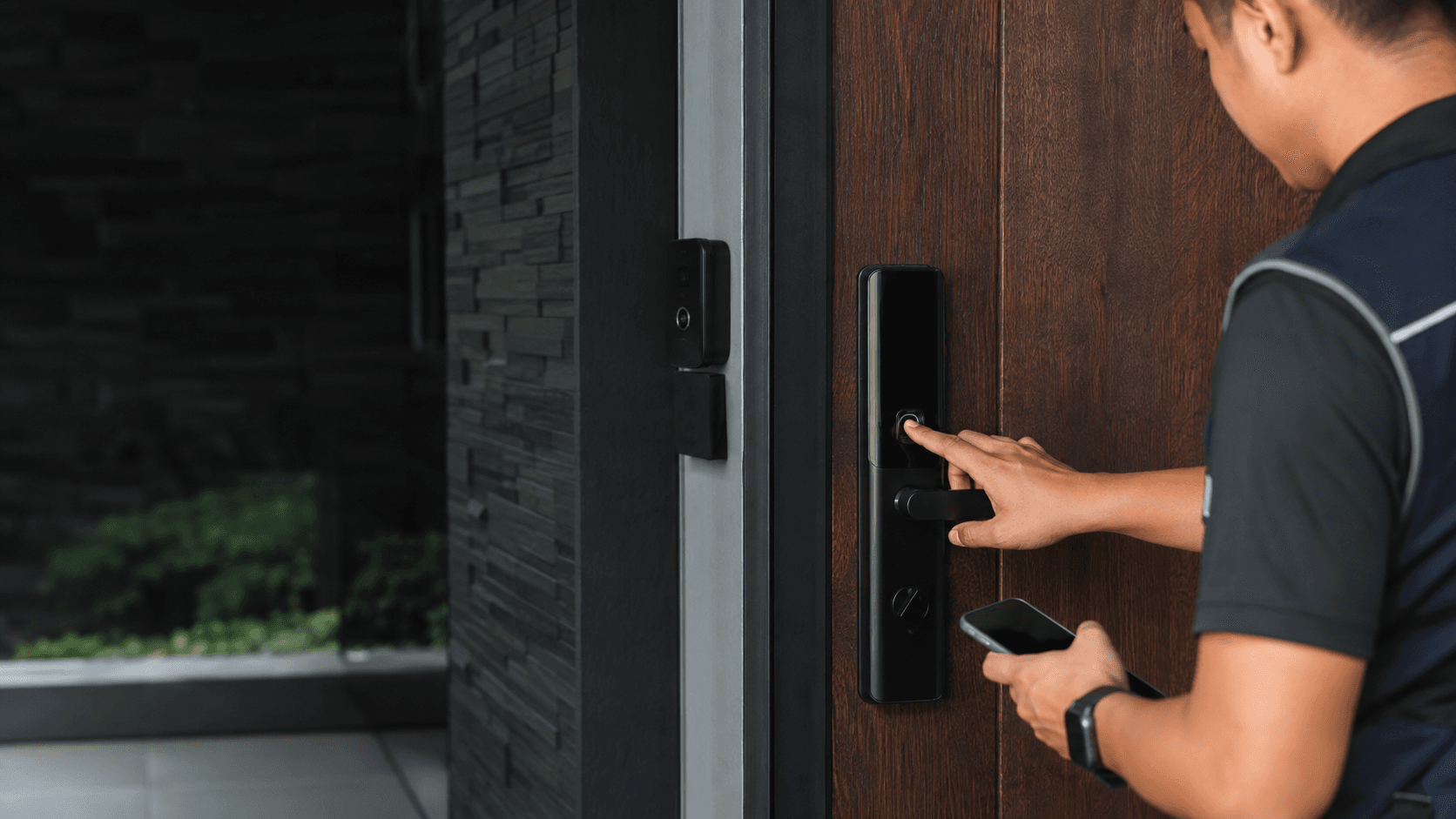
The appeal is simple. no key to carry, no code to share out loud, and a record of who came through. The catch is equally simple. Bluetooth is a short-range radio, so the lock only talks to a phone that is close to it, and everything else about the installation depends on the door it is fitted to.
Eyonic Sdn Bhd plans, supplies and installs security and extra-low-voltage systems in Sarawak, and its published review of smart lock door access notes that smart locks work best when door condition, user roles and backup method are reviewed before installation. That is the order this guide follows.
Bluetooth Front Door Lock. What to Check First
Four checks decide most of the outcome, and they are worth completing before any model is chosen.
- Inspect the door and frame. confirm the leaf is solid enough to carry the lock body, that the existing cutout or mortise can be adapted, and that the door closes squarely enough for the bolt to throw without binding.
- Map the user roles. list who needs permanent access, who needs time-limited access, and who only needs occasional entry, because that list determines whether a standalone lock is enough or an access-control panel is the better fit.
- Agree the backup entry method. decide how the door opens when a phone is flat, lost or left behind, and confirm that method is mechanical rather than another app.
- Plan power and battery handling. identify who replaces cells, how a low-battery warning reaches someone, and what happens between the warning and the lock failing.
Each of these is a physical constraint rather than a preference. A door that cannot accept the hardware will not be rescued by a better app, and a user list that keeps growing will eventually outgrow a lock that was bought for a household.
How a Bluetooth Front Door Lock Is Operated
Operation splits into three layers: the radio link, the credential, and the fallback.
The radio link is the part people underestimate. A phone pairs with the lock over Bluetooth, which is a short-range connection, so the phone has to be within range of the door for app-based unlocking to work. Standing at the gate or in the car park is outside that range. This is the single most common mismatch between what buyers expect and what the hardware does.
The credential layer is what the lock actually accepts. Depending on the model, that can be the paired phone, a keypad code, a card or tag, a fingerprint, or a mechanical key. The lock does not care which one is used; it only checks whether the credential is valid and whether the current time falls inside any schedule attached to it.
The fallback layer is what happens when the first two fail. A mechanical keyway, an external power point for a flat battery, or a second entrance are the usual answers. A lock with no fallback turns a dead battery into a locksmith call.
What the app does and does not do
Within range, the app is the configuration tool. It is where codes are created, schedules are set, users are added or removed, and activity is reviewed. Outside range, the app is a record rather than a remote control, unless the lock is paired with a separate bridge or gateway that extends it onto a network. That distinction matters when someone expects to unlock a door for a delivery from another state.
What a Bluetooth Front Door Lock Depends On
Five dependencies decide whether the installation behaves well over years rather than weeks.
Door condition. The leaf, frame, existing cutout and closing alignment all have to suit the hardware. A door that has swollen, dropped or been patched is a poor candidate until it is corrected.
Power. The lock runs on batteries. Battery type, how often the door is used, and how cold or humid the location gets all affect how long they last. A low-battery warning is only useful if someone acts on it.
User permissions. Households need a short list. Offices, shops and industrial sites need roles, schedules and a way to revoke access the day someone leaves. Eyonic's published guidance notes that for business use it usually checks whether a standalone smart lock or an access-control panel is more appropriate, because a growing user list is the point where a single lock stops being the right tool.
Backup entry. The plan for a flat phone, a forgotten code or a failed reader. This should be decided before installation, not after the first lockout.
Support. Someone has to be reachable when a lock misbehaves, a user is removed, or a door needs adjustment. That is a local question, not a product question.
Where Bluetooth fits against other options
Bluetooth suits a door where the person unlocking is standing at it. It is a poor fit for a gate or a remote entrance where the person is far away, and it is a poor fit for a site that needs central control across several doors. In those cases the practical answer is usually a different access method rather than a stronger Bluetooth lock.
Door, User and Backup Checks Before Buying
The checks below are the ones that change the buying decision rather than the ones that confirm it.
On the door. measure the leaf thickness, photograph the existing lock and cutout, and note whether the door is timber, metal or glass. A glass door and a solid timber door rarely take the same hardware, and a metal door may need different preparation again. None of these can be judged from a product listing.
On the users. write down the number of people who need access, how many need it permanently, and how many need it for a fixed period. A short, stable list is comfortable for a standalone lock. A long or changing list points towards an access-control panel, which is the comparison Eyonic makes for business premises.
On the backup. decide the mechanical route in and confirm it will be available to the right people. A backup that only one person holds is not a backup.
On the power. decide who owns battery replacement and how a warning is noticed. On a rental property or a shop with rotating staff, that ownership is easy to lose.
Questions that come up during the checks
Does the lock still work when the phone is out of range? App unlocking does not, because Bluetooth is short-range. Keypad, card, fingerprint or mechanical key entry still works if the lock supports it.
What happens when the battery runs flat? Behaviour depends on the model. Some provide an external power contact, some retain a mechanical keyway, and some do neither. This is a question to settle with the supplier before purchase rather than after.
Can one lock cover a whole business? It can cover one door with a manageable user list. Once roles, schedules and revocation across several doors matter, a panel-based access-control approach is the more practical structure.
Where a Fits in Malaysia
Malaysian properties vary enough that the door, not the product, usually decides the answer. Terrace houses, shoplots, offices and industrial units commonly mix timber, metal and glass doors on the same premises, and each type brings its own preparation and fixing questions.
Climate adds a second variable. Heat and humidity are hard on batteries and on any hardware that is exposed to rain, so an entrance that is sheltered behaves differently from one that is not. A lock on a covered porch and a lock on an exposed gate should not be planned the same way.
Usage patterns matter too. A family home with a stable list of users is a straightforward fit. A shop with rotating staff, a clinic with visiting contractors, or an office that needs a record of who entered and when is closer to an access-control requirement, and the honest answer there may be that a single Bluetooth lock is the wrong shape for the problem.
Installation and Support in Sarawak
Eyonic's installation work follows a defined sequence: site survey, system proposal, installation, and handover. The same sequence applies to door access work, because the survey is where door condition, user roles and backup method get settled.
The company's completed projects include the Kuching Immigration Office, where the work focused on arrival flow, staff areas, visitor movement and dependable daily operation, and KTA Sarawak Sdn Bhd, an engineering consultancy office in Kuching that needed support for staff movement, visitor handling, tidy cabling and clearer daily site control. Both are examples of the same principle: the access decision follows how people actually move through the building.
Eyonic Sdn Bhd is based in Sarawak and works across homes, offices, shops and industrial sites, with founder Eric Yong bringing more than ten years in technical installation of digital security solutions for commercial businesses in Sarawak. Published package pricing covers a Hikvision CCTV package at RM 1,599, a Hikvision alarm system at RM 1,599, and an autogate package at RM 1,599; door access work is quoted separately because the door and user requirements vary too much for a fixed figure.
For a property in Sarawak, the practical next step is to share the location, the property type and the required system with Eyonic on WhatsApp at +60 11-5111 7959, so the door and user checks can be worked through against the actual entrance rather than a product listing.