
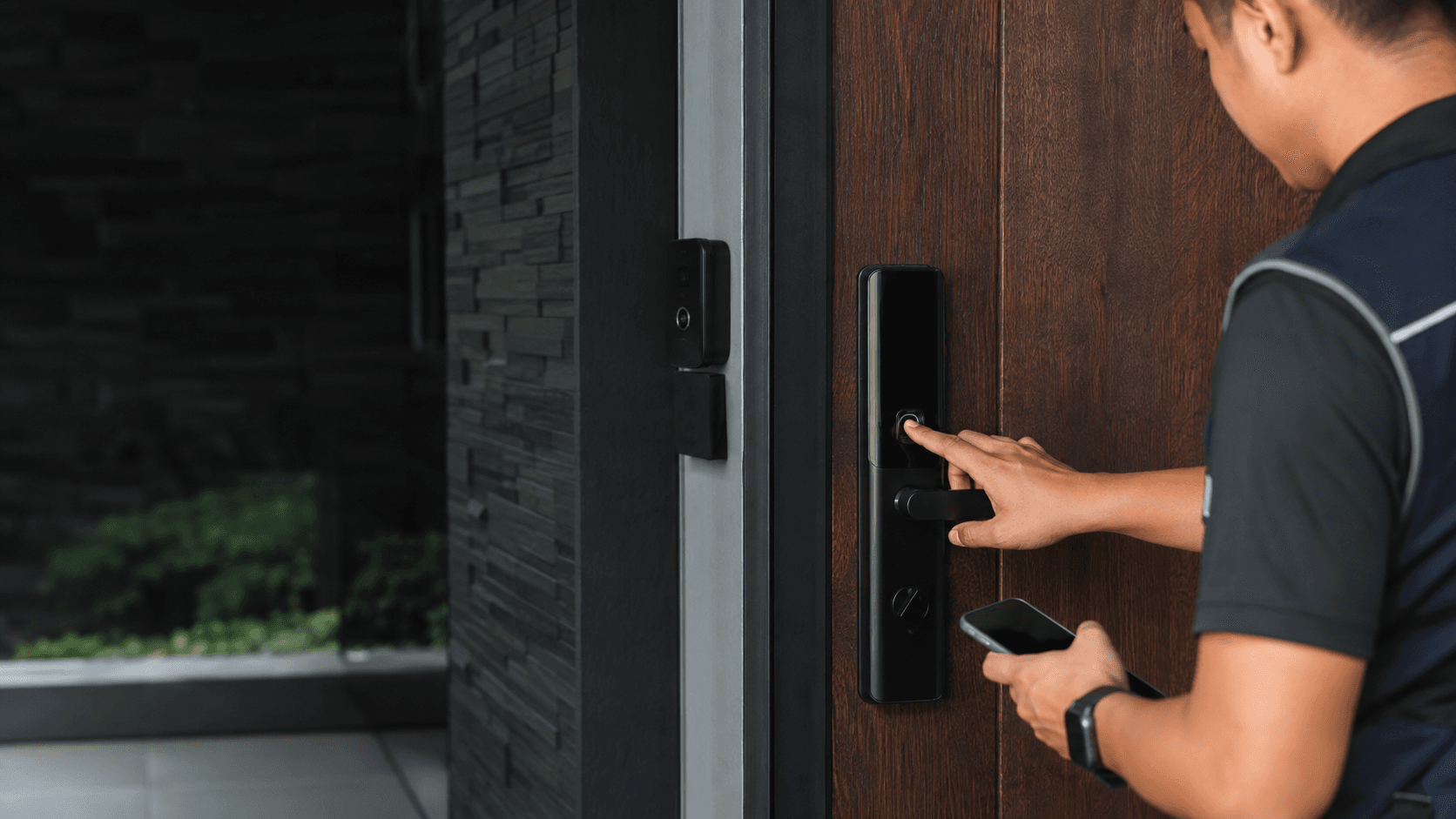
Lever handles suit doors where a knob or lever already turns a latch rather than throwing a deadbolt. That single mechanical difference shapes everything else: how the lock mounts, who can enter without a key, and what happens when power or connectivity fails. The sections below cover the entry methods, the door and user checks that matter before purchase, and the backup planning that keeps a lever smart lock usable when the phone is flat or the network is down.
Ultraloq Smart Lever Lock. what the lever format changes
A deadbolt smart lock replaces the bolt above the handle. A lever smart lock replaces the handle itself, so the latch that holds the door closed is the same mechanism the electronics control. That means the lock body sits where the lever was, and the door keeps its existing deadbolt or none at all.
For a home or office door that already has a separate deadbolt, a lever smart lock adds convenience without removing the mechanical security of the bolt. For a door with only a lever and no deadbolt, the smart lever becomes the primary lock, which raises the stakes on battery life and backup entry.
Lever format also changes the user experience. A lever is easier to operate with a full hand, an elbow, or limited grip strength than a small thumb-turn, which is why lever smart locks appear in accessibility discussions and in households with children or older residents. The trade-off is that a lever protrudes further from the door face than a deadbolt keypad, so door frames, closets, and screen doors need clearance checks.
Fingerprint, code, phone, and key entry on one lever
Lever smart locks typically combine several entry methods on one device. Fingerprint access reads a stored print and releases the latch. A keypad accepts a numeric code. A phone app unlocks over Bluetooth or Wi-Fi. A physical key provides mechanical override. Not every model includes every method, and the mix matters more than the count.
Fingerprint entry suits daily users who want fast, key-free access without carrying anything. Codes suit visitors, cleaners, or contractors who need entry for a defined period. Phone unlocking suits remote or hands-free situations. A physical key suits the edge case where electronics fail entirely.
Each method carries a constraint. Fingerprint readers can struggle with wet, worn, or very dry skin. Codes can be shared beyond the intended person. Phone unlocking depends on a charged device and, for remote access, a working network. A key depends on someone actually carrying it. Planning entry around two independent methods reduces the chance that a single failure locks out the people who need in.
Who needs daily entry, and who needs occasional access
Daily users and occasional visitors need different treatment. A household or office team that enters every day benefits from fingerprint or code access tied to named users, so access can be removed when someone leaves. Occasional visitors, such as delivery staff or short-term guests, are better served by temporary codes that expire.
This distinction drives the choice between a standalone smart lock and a wider access-control setup. A standalone lever lock manages a single door and a modest user list. A site with many doors, staff turnover, or audit requirements usually needs an access-control panel that logs every entry and centralises permissions. Eyonic's own product guidance notes that smart locks work best when door condition, user roles, and backup method are reviewed before installation, and that for business use the choice between a standalone smart lock and an access-control panel should be checked first.
Door condition and user roles before choosing an Ultraloq Smart Lever Lock
Door condition decides whether a lever smart lock fits at all. The checks below are the ones that most often change the answer, and they are worth completing before any model is chosen.
- Confirm the door and lever condition: check that the door closes squarely, the existing lever turns freely, and the latch lines up with the strike plate without force.
- List who needs daily entry. separate people who enter every day from visitors who need access once or for a short period.
- Decide temporary versus permanent access: match each person to a method that can be added and removed cleanly, such as a named code or a fingerprint slot.
- Confirm the backup entry method. agree on the mechanical or secondary route that works when the battery is flat, the phone is unavailable, or the network is down.
- Confirm who handles installation and handover: decide whether the lock is fitted by the supplier or by an installer, and who tests every entry method before the door goes into daily use.
A door that sticks, a latch that needs a shoulder to close, or a lever that has worn loose will not improve with a smart mechanism. Those faults usually need correcting first, because an electronic lock cannot compensate for a misaligned frame.
Door thickness, backset, and lever clearance
Lever smart locks are built around specific door preparations. Door thickness, the backset distance from the door edge to the handle centre, and the shape of the existing cut-out all affect whether a lock drops in or needs modification. A door with an unusual preparation may need additional work before any smart lever will sit correctly.
Clearance is the other practical check. A lever that swings toward a wall, a cabinet, or a second door can foul on contact. Measuring the swing before purchase avoids a lock that fits the cut-out but cannot be operated comfortably.
Battery, network, and backup entry planning
Every electronic lock depends on power. Battery type and rated life vary by model, and the honest planning assumption is that the battery will eventually run flat at an inconvenient moment. A low-battery warning helps, but it only helps if someone acts on it.
Network dependency is separate. A lock that unlocks over Bluetooth works at the door without any network. A lock that depends on Wi-Fi for remote unlocking or code changes needs a working connection for those functions. If the network drops, local entry methods should still work, and that is the behaviour worth confirming before purchase.
Backup entry is the part most often left vague. A physical key is the simplest mechanical fallback, but it only helps if the key is stored somewhere reachable and not locked inside. A second code held by a trusted person is another option. The point is to decide the fallback deliberately rather than discover it during a lockout.
What happens when the phone or network is unavailable
When a phone is lost, discharged, or replaced, access should not depend on it. Fingerprint and code entry keep the door usable in that situation, provided those methods were set up in advance. When the network is unavailable, local unlocking should continue while remote functions pause.
This is why the entry mix matters more than any single feature. A lock with fingerprint, code, and key entry has three independent routes to the same door. A lock that relies on one method has one point of failure.
Installation and handover checks for a lever smart lock
Installation quality decides whether a smart lever lock feels reliable or erratic. A lock fitted to a poorly aligned door will report errors, drain batteries faster, and frustrate users, even when the hardware is sound.
Eyonic's installation process follows a site survey, a system proposal, installation, and handover. That sequence applies to door hardware as much as to cameras: the survey confirms the door and frame condition, the proposal sets out what will be fitted, installation mounts and configures the lock, and handover tests every entry method with the people who will use it.
Handover is where most problems surface early. Testing fingerprint reads, codes, phone unlocking, and the mechanical key before daily use begins catches configuration mistakes while the installer is still on site. Adding and removing a test user also confirms that permissions behave as expected.
For a wider site, the same discipline applies to the surrounding system. Eyonic's work for the Kuching Immigration Office focused on arrival flow, staff areas, visitor movement, and dependable daily operation, which is the same question a door lock answers on a smaller scale: who moves through, when, and how that movement is managed.
Where an fits in a wider access plan
A lever smart lock is one component in a broader access picture. On a single home door, it may be the whole system. On a commercial site, it is one door among many, and the question becomes whether that door should stand alone or report into a central access-control panel.
Standalone locks suit small sites with few users and simple needs. They are quick to fit and easy to manage. Their limit appears when a site needs entry logs, central permission changes, or integration with alarms and cameras. At that point, a panel-based system usually fits better, and a standalone lock may become a secondary door rather than the main control point.
Integration with other security systems is worth considering early. A door lock, an alarm system, and a camera system can operate independently, but coordinating them gives a clearer picture of who entered and when. Eyonic supplies and installs CCTV, alarm, autogate, keyphone intercom, and Starlink systems across Sarawak, so door access is usually planned alongside those systems rather than in isolation.
Budget planning follows the same logic. Eyonic's published packages for a Hikvision CCTV system, a Hikvision alarm system, and an autogate setup are each priced at RM 1,599, which gives a reference point for how a single-system installation is scoped. A door access decision made alongside those systems is easier to cost than one made separately.
For readers weighing a lever smart lock against a deadbolt smart lock, the deciding factors are usually the existing door preparation, the number of daily users, and whether the site needs central control. A lever lock wins on ease of use and accessibility. A deadbolt lock wins where the bolt is the primary security element and the handle is secondary. Neither is universally better; the door and the user list decide.
Share your location, property type and required system with Eyonic on WhatsApp at +60 11-5111 7959 for the next practical step.