
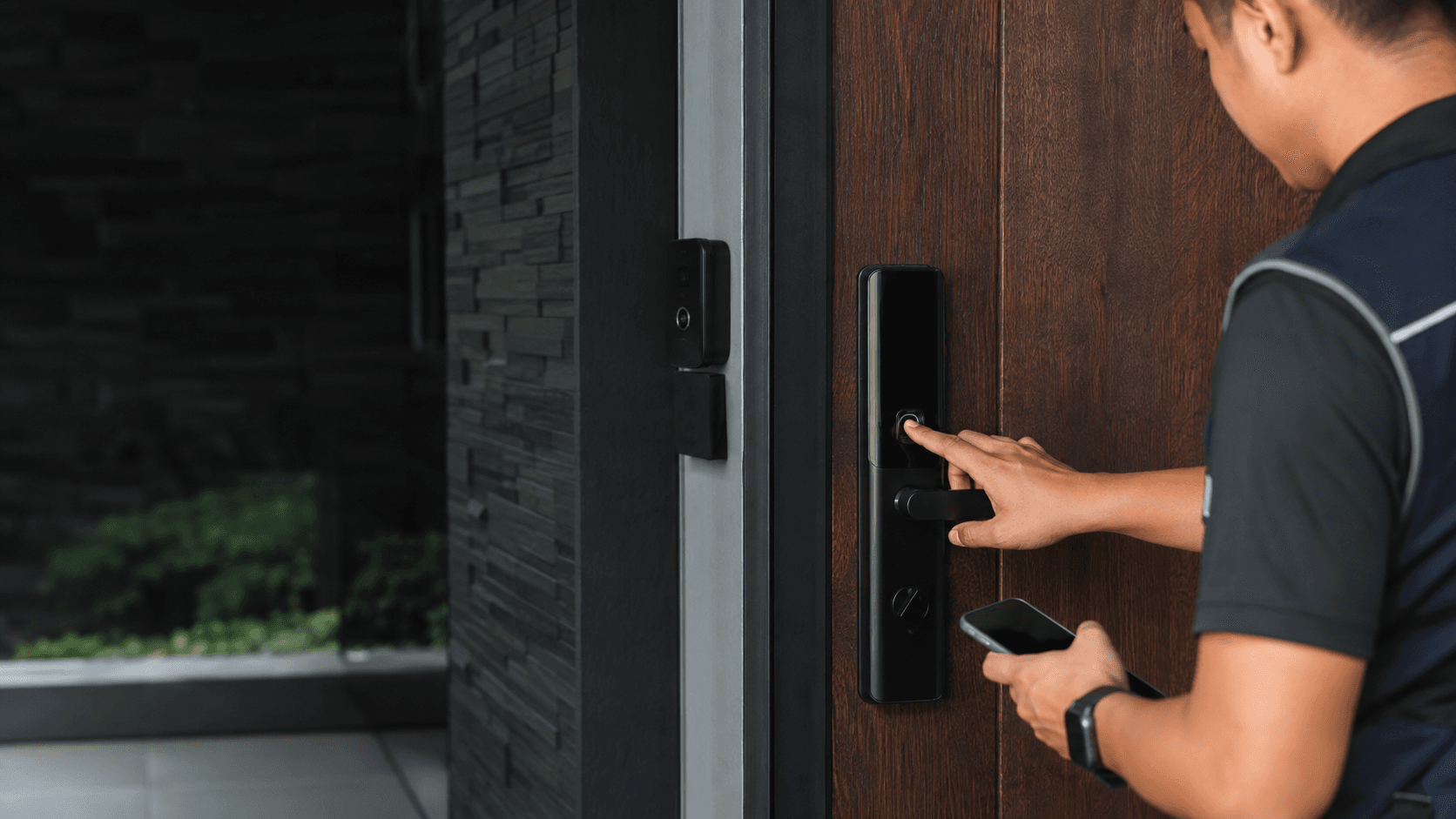
The device itself is small and unglamorous. It sits near the door, stays powered, and quietly relays commands between the lock and the internet. What matters is whether the lock, the app, and the network all agree before anything is mounted.
What a G2 gateway does for a Bluetooth lock
A Bluetooth smart lock talks directly to a phone over a short range. That works at the door. It does not work from an office, a different state, or a hotel front desk. The gateway closes that gap by holding a Bluetooth connection to the lock and a Wi-Fi connection to the network at the same time.
Once paired, the lock appears in the app even when no phone is nearby. Commands travel from the app to the cloud, down to the gateway, and across Bluetooth to the lock. Status travels back the same way. This is the mechanism behind remote lock control, and it is the reason a gateway is a bridge rather than a lock component.
Three practical results follow from that bridge:
- Remote unlock and lock commands reach the door without a phone in Bluetooth range.
- Event records and lock status can be read from elsewhere.
- Time-limited access and user changes can be pushed to the lock without standing at it.
A gateway does not add a second lock, a second key, or a second power source at the door. It also does not upgrade a lock that has no app support. If the lock cannot be managed in an app, a gateway has nothing to relay.
Where a gateway fits in a Malaysian property
Malaysian homes, shophouses, and offices often share a pattern: the door that needs remote control is not the door where the router sits. A gateway placed near the lock solves the Bluetooth distance problem, but it still needs Wi-Fi coverage at that spot.
Concrete and brick walls, metal grilles, and multiple floors all weaken both signals. A gateway tucked inside a metal cabinet or behind a reinforced door will struggle. Placement is a physical decision, not a software one.
Property type changes the answer:
- Single home or apartment. A gateway is useful mainly for remote unlocking, checking whether a door is locked, and letting family members in without sharing a physical key.
- Shophouse or small office. A gateway helps when staff arrive before the person holding the app, or when the entrance needs a record of who entered and when.
- Rental or short-stay unit. Remote access changes and time-limited codes reduce the need to hand over keys, but the backup entry method still has to be settled.
- Larger commercial site. A single gateway may not cover every door. Eyonic reviews whether a standalone smart lock or an access control panel is more appropriate for business use, because the two solve different problems.
For a public office, the priorities shift again. Eyonic's work at the Kuching Immigration Office centred on arrival flow, staff areas, visitor movement, and dependable daily operation. That kind of site cares less about a single clever door and more about whether the system keeps working on an ordinary Tuesday.
Smart Lock Gateway G2 checks before installation
Most gateway problems are decided before the device is mounted. Working through the checks in order prevents the common failure where a gateway is installed and then found to be incompatible with the lock or unreachable on the network.
- Confirm the lock model and the app that manages it, and confirm the gateway supports that same app.
- Confirm Wi-Fi coverage at the intended gateway position, not just at the router.
- Confirm a power source and a mounting point near the lock, clear of metal enclosures.
- Confirm user roles and permissions, including who can add or remove access.
- Confirm the backup entry method in case the network, the gateway, or the phone fails.
The first check is the one that stops projects. A gateway is tied to an app ecosystem. If the lock runs on one app and the gateway on another, the pairing will not complete, and no amount of placement adjustment will fix it.
The last check is the one most often skipped. A smart lock with a gateway is still an electronic device on a network. A mechanical key, a physical override, or a second entry point keeps the property usable when something upstream fails.
Gateway, lock app, and network compatibility
Compatibility runs in three layers, and all three have to line up.
Lock to app. The lock must be manageable in an app that the gateway also supports. This is the layer where brand and model matter most, and it is the layer that cannot be worked around.
Gateway to network. The gateway needs a stable Wi-Fi signal at its position. A gateway that connects intermittently produces the worst outcome: a system that appears to work and then misses commands.
App to user. Permissions decide who can unlock, who can issue access, and who can review records. On a shared property, unclear permissions create more risk than an unconnected lock, because access can be granted remotely without anyone at the door.
Door condition belongs in this conversation too. Smart locks work best when the door condition, user roles, and backup method are reviewed before installation. A door that does not close cleanly, or a frame that has shifted, will cause problems that look like software faults but are mechanical.
Planning the next practical step
The useful question is not whether a gateway is a good device. It is whether this door, this lock, and this property need one. A single home with one entrance and no remote access requirement may not. A shophouse with staff arriving at different hours, or a rental unit with changing occupants, usually does.
Two things are worth settling before any purchase. First, the exact lock model and the app it uses, because that determines whether a gateway can pair at all. Second, the network and power situation at the door, because that determines whether the gateway will stay connected once installed.
Eyonic's installation work follows a site survey, system proposal, installation, and handover sequence, which is the same order that suits a gateway decision: understand the site, confirm what fits, install, then hand over with the access rules already agreed. For a property in Sarawak, that local presence matters when the door, the network, and the access rules all need to be looked at together.
Share your location, property type and required system with Eyonic on WhatsApp at +60 11-5111 7959 for the next practical step.