
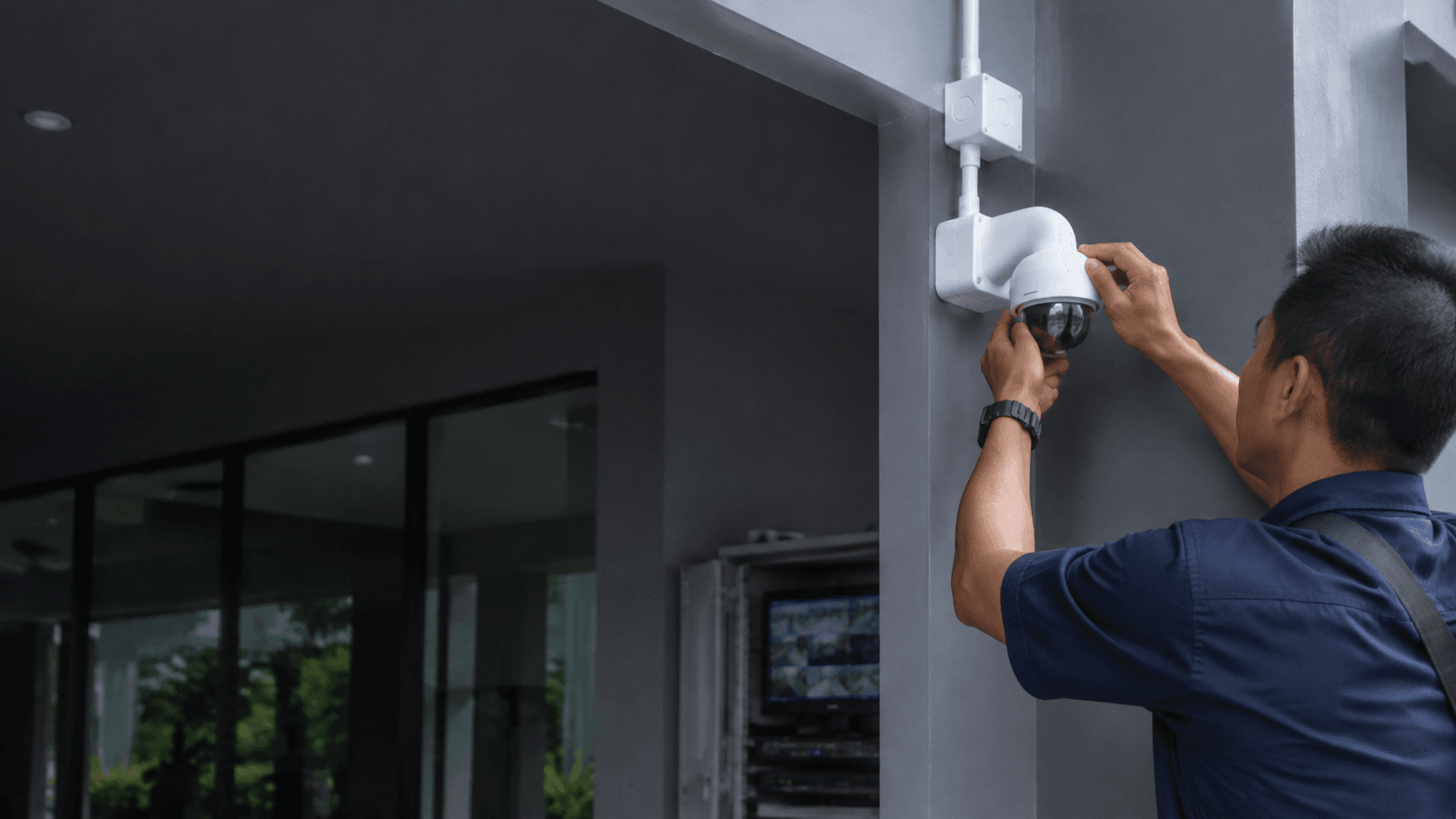
The exact-match query lorex wifi camera describes a category rather than a single product. Lorex sells indoor and outdoor Wi-Fi cameras, and the range includes pan-tilt models, spotlight models, dual-lens models and battery-powered units. Buyers in Malaysia researching a Lorex Wifi Camera usually want to know how the camera connects, where it can be mounted, and what has to be confirmed before an order is placed.
This page explains the category, the placement questions that matter in Malaysian properties, and the installation sequence Eyonic follows. It does not list resolution figures, model numbers, prices or warranty terms for Lorex products, because those details are not verified here. Any specification should be confirmed against official Lorex documentation or a local supplier before purchase.
What a Lorex Wifi Camera Does in a Home or Shop
A Lorex Wifi Camera captures video and sends it over a wireless network so it can be viewed remotely. That is the core function. The practical differences between models sit in how the camera is powered, how it is mounted, and how footage is stored.
Wireless security cameras generally fall into two connection patterns. Some connect directly to a Wi-Fi network and stream to a phone app. Others connect to a recorder that manages storage and playback. The first pattern suits small setups with a few cameras. The second suits properties that need several cameras recording continuously.
Remote viewing is the feature most buyers ask about first. A camera on a home network can be checked from a phone while the owner is at work or travelling. That convenience depends on a stable internet connection at the property and a working app on the viewing device.
Recording setup is the second decision. Footage can be stored on a memory card inside the camera, on a recorder, or in a cloud service. Each option has a trade-off. Local storage keeps footage on site and does not depend on upload speed. Cloud storage survives theft of the camera but depends on the internet connection staying up.
Where a wireless camera fits well
A wireless camera suits a shop counter, an office entrance, a house gate, or a room where running cable is difficult or expensive. It also suits rented premises where permanent cabling is not practical.
A wireless camera is a weaker fit where the Wi-Fi signal is already poor, where the camera must record continuously at high quality across many units, or where the property has no reliable power at the mounting point.
Indoor and Outdoor Placement for a Lorex Wifi Camera
Placement decides whether a Lorex Wifi Camera is useful or decorative. A camera pointed at a blank wall records nothing of value. A camera placed too high records the tops of heads rather than faces.
Indoor placement usually targets entry points, cash counters, corridors and stock areas. The camera should face the direction people approach from, not the direction they leave. Height matters. a camera mounted well above head level captures movement but loses facial detail.
Outdoor placement adds weather, lighting and power to the decision. An outdoor camera needs a housing or rating suited to rain and heat. It also needs a power source, which is often the constraint that decides the final position.
Lighting is the factor most often skipped. Eyonic recommends checking actual lighting conditions before confirming placement for ColorVu-style cameras, because night performance depends on what light is already present at the site. A position that looks clear in daylight can be almost black at night if there is no street light, porch light or nearby illumination.
Questions that decide the final position
What is the camera meant to capture: a face, a plate, a doorway, or general movement? Where is the nearest power point? Is there a Wi-Fi signal at that point, or does it drop behind a wall? Does the position face direct afternoon sun, which can wash out the image? Is the camera reachable by hand, which affects both cleaning and tamper risk?
These questions are answered on site, not from a product page. A camera that performs well in one shop may perform poorly in the next because the lighting, wall material and network layout differ.
Power, Network and Recording Decisions
Three constraints decide whether a Lorex Wifi Camera works as intended: power, network and recording.
Power is the first constraint. A wireless camera still needs electricity unless it runs on a battery. Battery models avoid cabling but need charging or replacement, and their recording behaviour is usually different from a mains-powered unit. A mains-powered camera needs a socket or a spur at the mounting point, which may mean an electrician is involved before the camera is installed.
Network is the second constraint. Wi-Fi signal strength drops through reinforced concrete, thick walls and metal. A camera mounted at the far end of a shop may sit at the edge of coverage. In that case the options are to move the camera, add a wireless access point, or use a camera that connects by cable to a recorder.
Recording is the third constraint. Continuous recording uses more storage than motion-triggered recording. A property that wants 24-hour footage needs enough storage for the retention period it wants. A property that only needs event clips can use less. The right answer depends on how far back the owner needs to look after an incident.
How the three constraints interact
A battery camera with cloud storage needs strong Wi-Fi and no local power. A mains camera with a memory card needs power and no continuous internet. A multi-camera setup with a recorder needs cabling to the recorder but less dependence on Wi-Fi. Choosing one constraint usually changes the others, which is why the decision is best made together rather than model by model.
How Eyonic Plans a Camera Installation
Eyonic plans, supplies and installs monitoring systems with camera placement, recording and remote viewing for homes, offices, shops and industrial sites. The process follows four stages.
- Site survey. the property is reviewed for camera positions, lighting, power points, network coverage and cabling routes.
- System proposal. the survey findings are turned into a recommended camera and recording setup for the property.
- Installation. cameras are mounted, cabling is run, and the recorder or app is configured.
- Handover. the system is tested and the user is shown how to view footage and manage recordings.
The site survey stage exists because placement decisions cannot be made reliably from a floor plan alone. Lighting, wall construction and existing network coverage all affect the result. A survey also identifies where cabling can be run tidily, which matters for offices and shopfronts where exposed cable is unacceptable.
Eyonic has completed work for the Kuching Immigration Office, focused on arrival flow, staff areas, visitor movement and dependable daily operation. The company has also completed a practical office setup in Kuching for KTA Sarawak Sdn Bhd, supporting staff movement, visitor handling, tidy cabling and clearer daily site control. These projects show the type of requirement the process is built around: coverage that supports daily operations rather than a single camera pointed at a door.
Eyonic is based in Sarawak and works across Malaysia. The founder, Eric Yong, has more than 10 years in the industry and focuses on technical installation of digital security solutions for commercial businesses in Sarawak.
What to Confirm Before Ordering a
Several details should be confirmed before an order is placed, because they determine whether the camera can be installed as planned.
Confirm the power arrangement at the intended mounting point. Confirm the Wi-Fi signal strength at that point, not at the router. Confirm how footage will be stored and for how long. Confirm whether the camera is rated for outdoor use if it will be mounted outside. Confirm the app works on the phone or tablet that will be used for remote viewing.
Confirm local availability and support. A camera bought from overseas may be difficult to service or replace locally, and warranty claims can involve shipping the unit back. A locally supplied unit is easier to support if something fails.
Confirm the total cost of the installation, not just the camera. Mounting, cabling, power provision and configuration all carry cost. A camera that appears inexpensive can become expensive once the installation work is included.
Where the property needs more than a few cameras, or where continuous recording is required, a recorder-based system is usually more practical than a set of standalone wireless cameras. Where the property needs one or two cameras and the network is already strong, a wireless camera is often the simpler choice.
For readers who want a practical next step, Eyonic can review a property's location, type and required system. Share those details on WhatsApp at +60 11-5111 7959 and the next step can be scoped against the actual site rather than a product listing.