
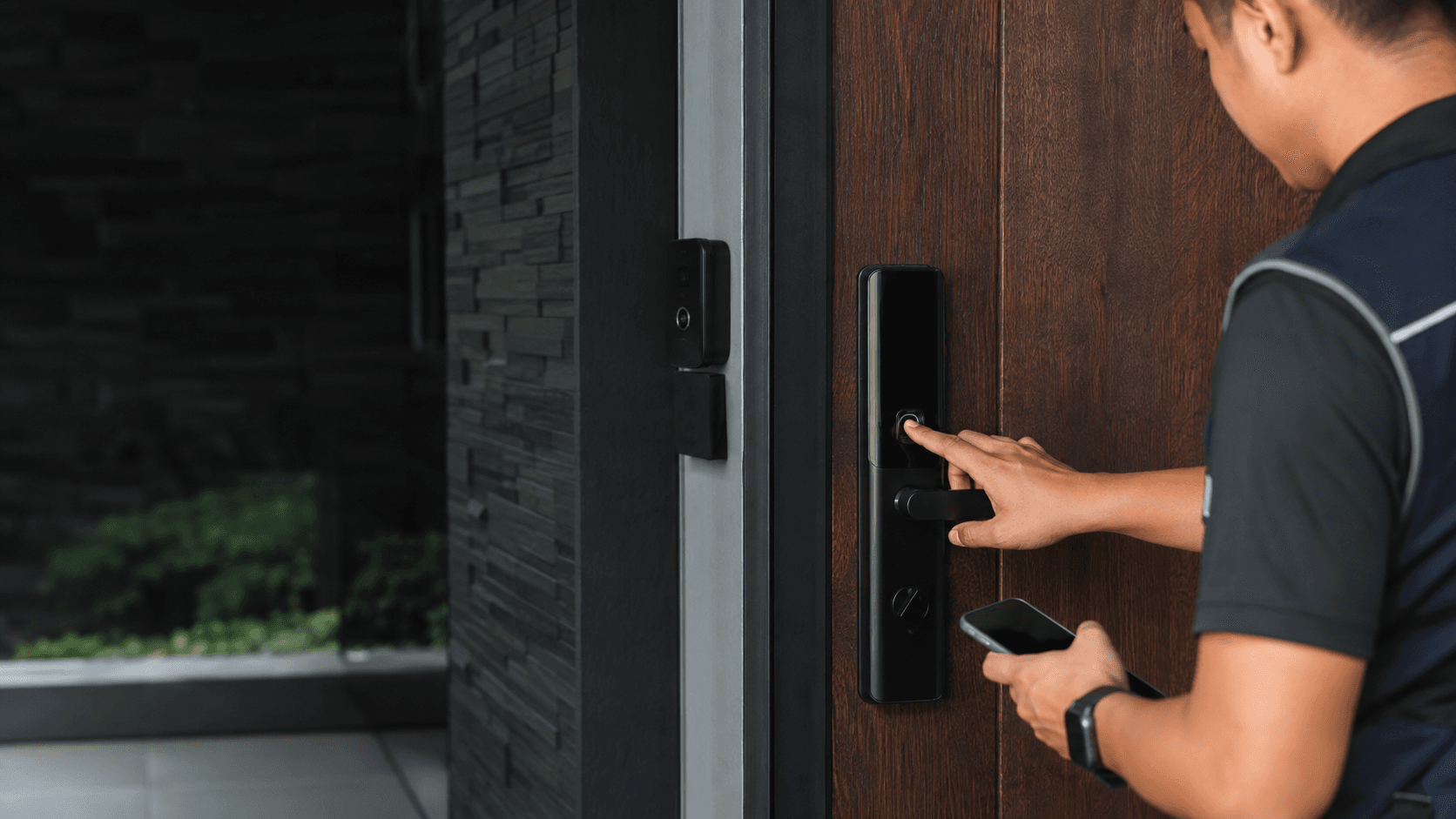
The phrase top rated electronic door locks describes locks that earn their reputation through consistent daily behaviour rather than a single headline feature. A lock that reads a fingerprint in the rain, keeps working when the Wi-Fi drops, and still opens with a key during a power cut is doing more for a property than one with a longer feature list.
Eyonic Sdn Bhd is a security system supplier in Sarawak that plans, supplies, and installs CCTV and ELV systems, and its product range includes smart locks alongside Hikvision cameras. The company's own review guidance notes that smart locks work best when door condition, user roles, and backup method are reviewed before installation, and that business premises sometimes need an access-control panel instead of a standalone lock.
Top Rated Electronic Door Locks. What Matters Before You Choose
Ratings and review scores are useful starting points, but they rarely describe the door the lock will sit on. A deadbolt that scores well in a lab still fails on a gate that swells in monsoon humidity or a glass office door with no mortise cavity.
Four practical questions separate a good purchase from a frustrating one:
- What door is it going on — a timber main door, a metal gate, a glass office door, or an interior room?
- Who needs entry, and does each person need a separate credential that can be revoked?
- What happens when the battery dies, the network drops, or the app is unavailable?
- Is a standalone lock enough, or does the site need a managed access-control panel with logging?
Those four answers determine the shortlist far more reliably than a star rating. A lock that suits a rented apartment may be the wrong choice for a shop with staff turnover, and a lock built for heavy commercial traffic may be overkill for a bedroom door.
Choosing the Right Rated Electronic Door Locks
Electronic door locks generally fall into three physical categories, and the category matters more than the brand.
Full deadbolt replacements remove the existing deadbolt and install a complete unit with the keypad, reader, or motor built in. They offer the cleanest appearance and the strongest integration, but they require a door with a compatible bore hole and enough internal cavity depth.
Retrofit or adapter locks keep the existing deadbolt and motorise the thumb turn from the inside. They suit rented properties and doors where the exterior hardware should not change, and they are usually the fastest to install.
Lever and handle locks replace the whole handle set rather than just the deadbolt. They suit office doors and interior rooms where a handle is the primary latch.
Access method is the second decision. Keypads suit shared entry where codes can be changed between tenants or staff. Fingerprint readers suit individuals who want to leave keys and phones behind. App and remote control suit owners who want to check or release a door from elsewhere, and some locks work through a smart home hub while others connect directly without one.
What Is Rated Electronic Door Locks?
Rated electronic door locks are locks that carry a published performance rating, most commonly an ANSI/BHMA grade, alongside their electronic entry features. The rating describes mechanical durability and resistance under repeated use, which is separate from how well the app or fingerprint sensor performs.
This distinction matters because a lock can have excellent connectivity and a weak mechanical grade, or a strong mechanical grade and a clumsy app. Buyers comparing top rated electronic door locks should read both halves of the specification rather than treating the electronic features as the whole product.
For commercial premises in Malaysia, the rating question often leads to a second question: whether a standalone smart lock or a managed access-control panel is the better fit. Eyonic's own product guidance raises exactly this check for business use, because a panel handles multiple doors, user groups, and audit trails in ways a single lock cannot.
The Best Smart Locks of 2026
Published roundups through 2026 consistently group recommendations by use case rather than by a single overall winner. The recurring categories across major review sites include best overall, best budget, best retrofit, best for Apple Home, best fingerprint model, and best lock with Matter support.
That structure is a useful signal in itself. It suggests there is no single lock that wins on every axis, and that the honest answer to which lock is best depends on the door, the users, and the ecosystem already in the property.
Common named models across these roundups include the Yale Assure Lock 2, the August Wi-Fi Smart Lock, the Schlage Encode family, the Aqara Smart Lock U100, the Ultraloq U-Bolt Pro, and the Level Lock Pro. Each appears under a different use-case heading, which reinforces that fit matters more than rank.
For properties in Sarawak, availability and after-sales support carry weight that a global ranking cannot capture. A lock that is well reviewed overseas but has no local installer or spare-parts path becomes a liability the first time a motor or keypad fails.
Features That Separate Good Locks From Frustrating Ones
Battery life, backup entry, and credential management do more to shape daily experience than any single access method. A lock with a physical key override and a low-battery warning is easier to live with than one that depends entirely on a charged battery and a working phone.
Auto-lock and auto-unlock behaviour also divides opinion. Auto-lock suits doors that are frequently left open by mistake. Auto-unlock, which releases the door based on proximity, suits hands-full entry but can be unreliable in apartments where the phone lingers near the door.
Practical Considerations for Rated Electronic Door Locks
Installation conditions decide whether a well-reviewed lock performs well in practice. Door thickness, backset, bore-hole diameter, and the condition of the existing mortise all affect which models will fit without modification.
Environmental factors matter in Malaysian conditions. Exterior locks face humidity and direct rain, so weather resistance and the quality of the gasket and finish affect how long the electronics survive. Interior locks face less of that, which is one reason a single model rarely suits every door in a building.
Power and network are the other practical constraints. Battery-powered locks avoid cabling but require a maintenance routine. Mains-powered access control avoids battery changes but needs wiring and a power path to the door. Wi-Fi, Bluetooth, and hub-based connections each behave differently when the internet drops, and a lock that fails open or fails closed during an outage is a security decision, not just a technical one.
Eyonic's installation work follows a defined sequence — site survey, system proposal, installation, and handover — and the same discipline applies to door hardware. A survey confirms the door condition and user roles before a model is chosen, which is cheaper than discovering a fit problem after the lock has been ordered.
Where Eyonic Fits
Eyonic Sdn Bhd is based in Sarawak and works across homes, offices, shops, and industrial sites. Its completed projects include the Kuching Immigration Office, where the focus was arrival flow, staff areas, visitor movement, and dependable daily operation, and KTA Sarawak Sdn Bhd, an engineering consultancy office in Kuching that needed support for staff movement, visitor handling, and tidy cabling.
Those projects illustrate the pattern that matters for door hardware: entry points are part of a wider flow of people through a building, not isolated devices. A lock decision made alongside camera placement, alarm zoning, and intercom planning tends to hold up better than one made in isolation.
Eyonic's founder, Eric Yong, has worked in the industry for more than ten years and specialises in technical installation of digital security solutions for commercial businesses in Sarawak.
Making an Informed Choice About
The most reliable approach is to work backwards from the door and the people who use it, then match the lock category, access method, and rating to that reality. A shortlist built this way is usually smaller and more accurate than a list built from rankings alone.
Three checks catch most problems before purchase. Confirm the door dimensions and existing hardware are compatible with the chosen model. Confirm there is a working backup entry method that does not depend on the app or the battery. Confirm who will maintain the lock, change credentials, and handle faults after handover.
For multi-door premises, the honest comparison is often between a set of standalone locks and a managed access-control system. Standalone locks are simpler and cheaper per door. A panel costs more upfront but centralises user management and logging, which matters when staff change frequently or when entry records need to be reviewed.
Eyonic publishes package pricing for related systems, including a Hikvision CCTV package, a Hikvision alarm system, and an autogate package, each listed at RM 1,599. Door hardware is quoted according to the door and site conditions rather than as a fixed package, because fit and installation vary more than camera or alarm components do.
Share your location, property type and required system with Eyonic on WhatsApp at +60 11-5111 7959 for the next practical step.