
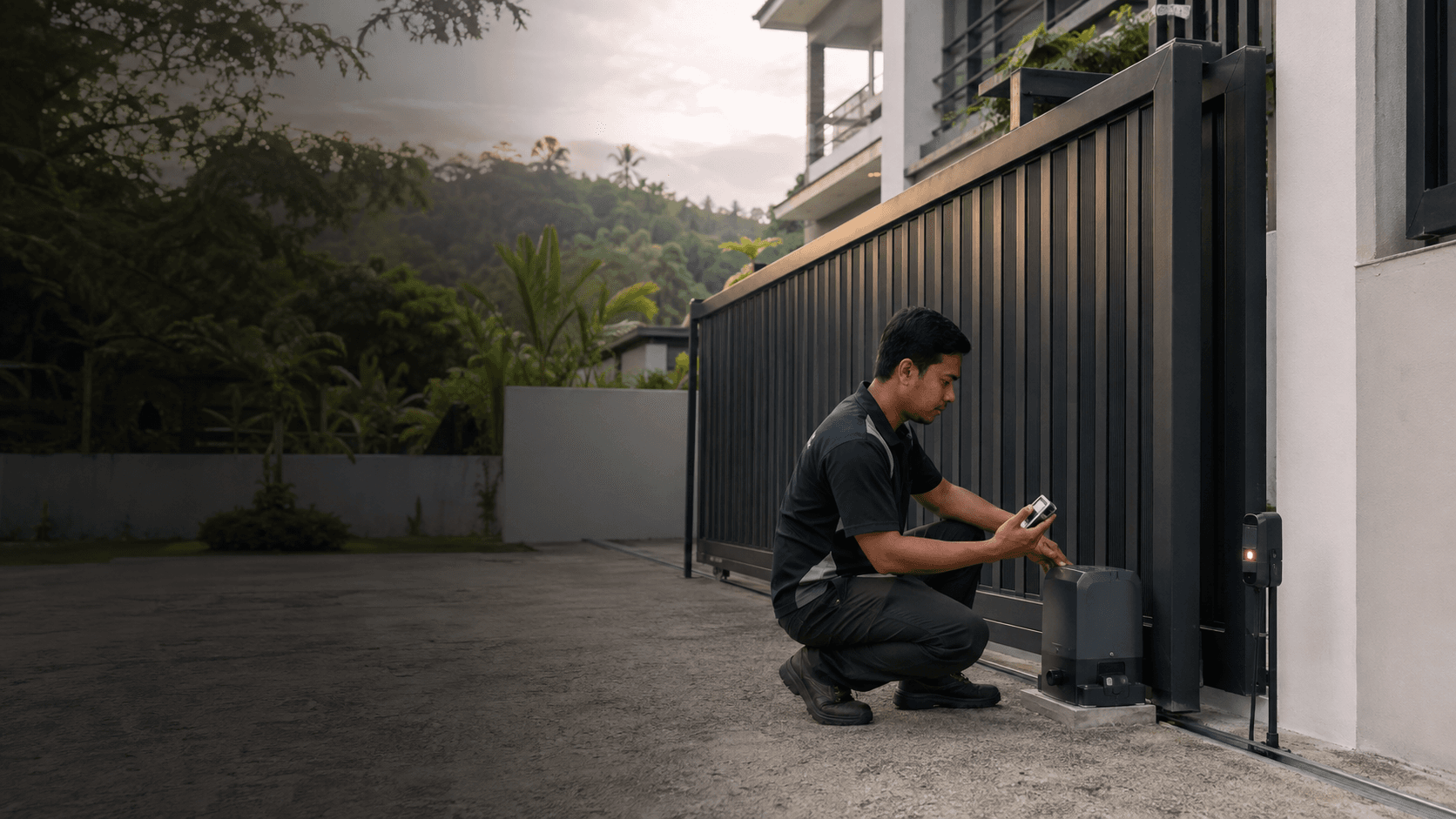
Gate Operator Installation. What Matters Before You Choose
Gate operator installation begins with a clear look at the physical gate, the power source, and the daily traffic pattern. A slide gate needs a different operator than a swing gate, and a single driveway gate differs from a dual-gate setup. The gate's weight, length, and condition determine the motor size required, while the available power supply shapes whether an AC-powered, solar-ready, or battery-backup operator makes sense.
For properties in Sarawak, Eyonic approaches gate operator installation with the same practical sequence used for its security systems: site survey, system proposal, installation, and handover. That process mirrors what the company applies to CCTV work, where checking actual conditions before confirming placement prevents avoidable problems.
Choosing the Right Gate Operator Installation
Selecting the correct operator type is the first decision in any gate operator installation. The main options break down by gate movement:
- Measure the gate leaf width and total weight, then confirm the gate rolls freely by hand.
- Identify whether the gate slides horizontally or swings on hinges, since each movement uses a different operator mechanism.
- Check the available power source at the gate location, including whether solar panels or battery backup are needed.
- Confirm the gate's daily use pattern, such as residential vehicles, staff entry, or visitor flow.
- Match the operator's rated duty cycle to that usage before purchasing any equipment.
Residential gate operators typically handle lighter use, while commercial and industrial sites need higher-duty motors. LiftMaster's residential gate operator range, for example, is built for homeowner driveways rather than constant commercial traffic. The trade-off is straightforward: an undersized operator fails early under heavy use, while an oversized unit adds cost without benefit.
What Is Gate Operator Installation?
Gate operator installation is the process of mounting a motorized unit, connecting its power and control wiring, and programming the safety and access features so the gate opens and closes reliably. The work spans mechanical mounting, electrical connections, and final testing. A complete installation includes the operator unit itself, mounting brackets, chain or arm hardware, safety devices such as photo eyes, and remote or keypad access controls.
The mechanical mounting step requires a solid foundation. Slide gate operators typically mount on a concrete pad beside the gate, while swing gate operators attach to the gate post or a dedicated mounting stand. The gate must move freely before the operator is attached; a gate that binds or drags will strain the motor regardless of how well the operator is installed.
Electrical connections carry their own constraints. Power must reach the operator location safely, and low-voltage control wiring connects the safety sensors, push buttons, and access devices. Many operators include a manual release mechanism so the gate can be opened by hand during a power failure, which is a practical feature worth confirming before installation begins.
Automatic Gate Opener Installation Video
Video guidance for automatic gate opener installation is a common resource because the mechanical steps are easier to follow visually than through text alone. Ghost Controls, for instance, publishes installation videos organized by chapter, covering topics from mounting to solar power connections. Mighty Mule offers interactive 3D instructions through the BILT app, which walks through assembly on a phone or tablet.
These video resources share a common structure. They start with gate preparation, move through operator mounting, then cover wiring, safety device installation, and final testing. The value of video is highest for the mechanical mounting steps, where seeing bracket alignment and chain tension helps avoid common errors.
Video guidance does not replace a site-specific check. A gate that looks fine on screen may have hidden binding, an uneven track, or an inadequate post that only appears during a physical inspection. Eyonic's approach of checking actual conditions before confirming placement applies here as much as it does to camera positioning.
Practical Considerations for Gate Operator Installation
Several practical factors separate a smooth gate operator installation from one that causes repeated callbacks. The gate's physical condition comes first. A gate that sags, binds, or has worn rollers will damage the operator over time. The mounting surface must be sound, whether that means a reinforced post for a swing operator or a properly cured concrete pad for a slide operator.
Safety devices are not optional extras. Photo eyes detect obstructions in the gate's path, and safety edges stop the gate on contact. These devices protect people, vehicles, and the gate mechanism itself. UL 325 standards govern gate operator safety in the United States, and installers reference these requirements when setting up entrapment protection. The Sentry gate opener installation guide from USAutomatic, for example, includes safety signs and entrapment siren checks as part of its final steps.
Power reliability matters for daily operation. A gate operator that loses power mid-cycle can leave a driveway blocked unless a battery backup or manual release is available. Solar-ready operators offer an option for locations where running AC power is difficult or expensive. The trade-off is between upfront wiring cost and ongoing battery or solar maintenance.
For commercial sites, gate operator installation often connects to broader access control. Eyonic's work at the Kuching Immigration Office focused on arrival flow, staff areas, and visitor movement, and a gate or barrier system serves a similar purpose at a property entrance. The company's project budgets for such work range from RM 12,000 to RM 28,000, reflecting the scope of a full entry-control setup rather than a single residential operator.
Making an Informed Choice About Gate Operator Installation
The decision between DIY installation and professional service depends on the gate type, the site conditions, and the available skills. DIY kits from brands like Mighty Mule and Ghost Controls are designed for homeowners with basic tools and mechanical ability. These kits include the operator, mounting hardware, and instructions, and the manufacturers provide video and app-based guidance to support the process.
Professional installation makes sense when the gate is heavy, the site has complex wiring needs, or the property is commercial. A professional team handles the site survey, concrete work, electrical connections, and safety testing as a single scope. Eyonic's installation process for security systems follows this pattern, and the same survey-propose-install-handover sequence applies to autogate work in Sarawak.
The cost difference between DIY and professional gate operator installation is significant, but so is the risk of an incorrect setup. A DIY installation that misses a safety device or misaligns the operator can damage the gate or create an entrapment hazard. The practical middle ground is to use DIY for simple residential swing gates on sound posts, and to bring in professionals for slide gates, commercial traffic, or any site where the gate does not move perfectly by hand.
Before committing to any gate operator installation, confirm the gate's measurements, the power source, and the expected daily use. Those three facts determine the operator class, the mounting approach, and the safety features required. With those details settled, the installation itself becomes a sequence of mechanical, electrical, and testing steps that any competent installer can execute.