
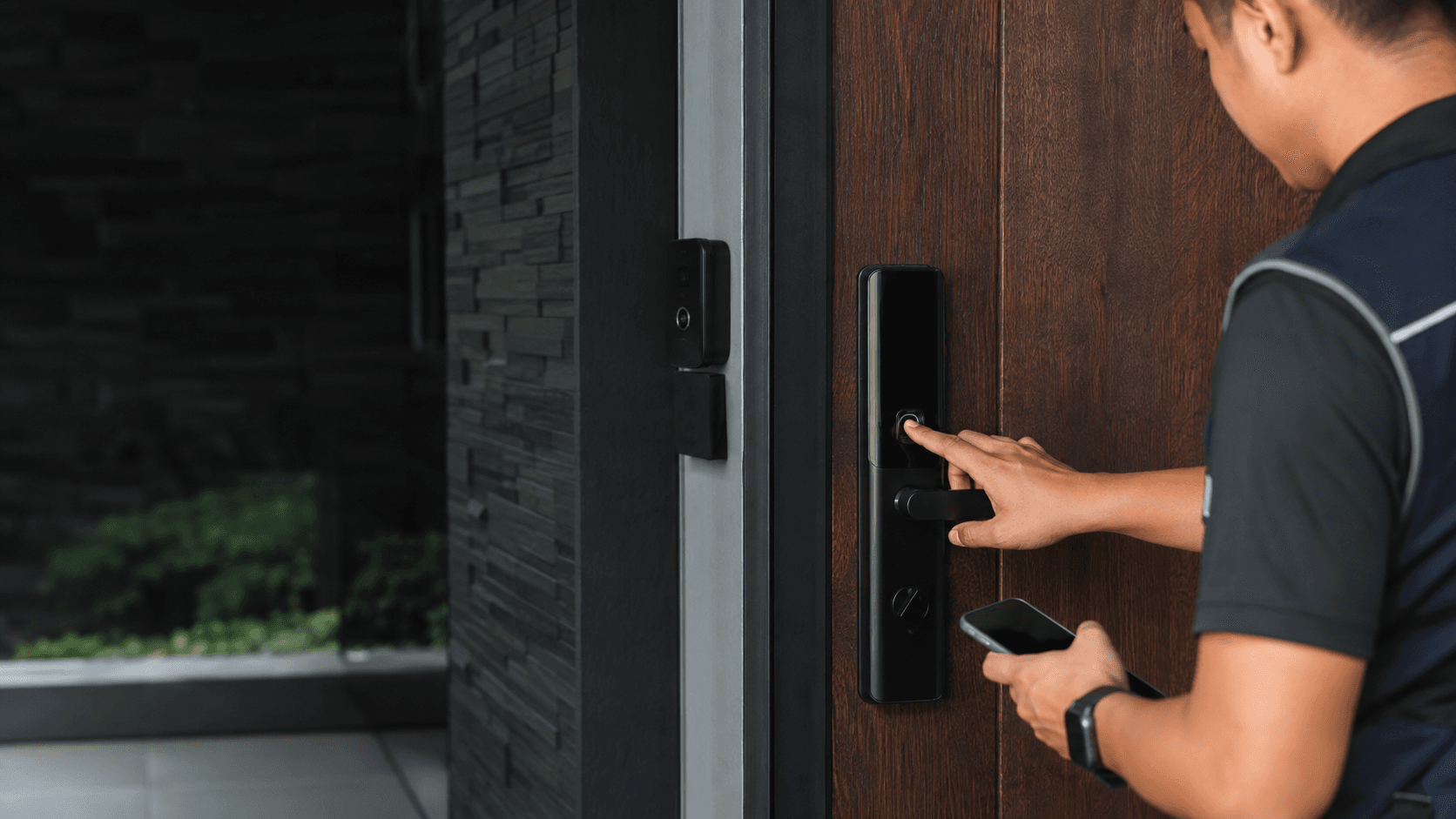
Fingerprint entry removes the daily hunt for keys, but it also changes who can enter, how fast they get in, and what happens when a finger is wet, dirty or unreadable. That is why the practical questions come before the model questions.
Yale Fingerprint Door Lock. What to Check First
Before comparing models or booking an installer, work through the door itself, the people who use it, and the fallback route when biometric entry does not work. These three checks decide whether a fingerprint lock is a sensible fit or an expensive inconvenience.
- Site survey. confirm the door type, door thickness, existing lock cutout and closing behaviour, because a lock that does not seat properly will keep failing regardless of how good the fingerprint reader is.
- System proposal. decide whether a standalone smart lock or an access control panel suits the property, based on how many people need entry and whether entry needs to be logged or restricted by role.
- Installation. fit the lock, align the latch and strike, then register fingerprints and set user permissions for each person who needs access.
- Handover. test every entry method, confirm the backup route works, and walk through how to add or remove a user before the installer leaves.
Eyonic's own installation process follows this sequence of site survey, system proposal, installation and handover, and the same order applies to door access work.
What a Yale Fingerprint Door Lock Changes About Daily Entry
The obvious change is speed. A registered finger opens the door without a key, a card or a code, which matters most when hands are full or when several people arrive at once.
The less obvious change is administration. Every person who needs entry becomes a user record that has to be added, removed and reviewed. A household with two adults barely notices this. A shop with rotating staff, a clinic with shift changes, or an office with contractors will notice it immediately, because a fingerprint that stays registered after someone leaves is an open door.
Fingerprint entry also introduces a failure mode that keys do not have. A cut or graze, wet hands after rain, or a dirty sensor can all slow down a read. That is not a reason to avoid the technology, but it is a reason to plan a second way in before the first one is needed.
Fingerprint Access Compared With Keypad and Keyed Entry
Each entry method trades convenience against control in a different way.
A keypad code can be shared, changed and issued to a visitor without that person being physically present. That makes it useful for deliveries, short stays and temporary access. The trade-off is that a shared code is only as private as the people who know it, and codes get passed on.
A physical key still works when batteries are flat and electronics fail, which is why keyed backup remains common on smart locks. The trade-off is that keys get copied, lost and lent, and there is no record of who used one.
Fingerprint access sits between the two. It cannot be lent out or guessed, and it ties entry to a specific person rather than a shared secret. It also cannot be issued remotely, so a visitor still needs a code or a key. For most properties the practical answer is a lock that offers more than one method, with fingerprint as the everyday route and a code or key as the fallback.
Door Condition, User Roles and Backup Entry
Smart locks work best when the door condition, user roles and backup method are reviewed before installation. Skipping that review is the most common reason a fingerprint lock disappoints.
Door condition covers more than the lock cutout. A door that has swollen in the wet season, a frame that has shifted, or a latch that needs a shoulder to close will fight any electronic lock. A deadbolt that drops freely and a door that closes with light pressure are the conditions where fingerprint entry feels effortless.
User roles decide whether a standalone smart lock is enough. A home needs a handful of fingerprints and little else. A business usually needs to separate staff, supervisors and visitors, and to remove access the day someone leaves. Where that separation matters, an access control panel gives clearer control than a standalone lock, and the choice between the two is worth settling before any hardware is ordered.
Backup entry is the check most often left until after installation. A mechanical key, a keypad code, or a second door that still works during a power or battery problem all count. The test is simple. if the fingerprint reader stopped responding tonight, how would the property be opened tomorrow morning?
Where Fingerprint Entry Fits in Malaysia Properties
Fingerprint entry suits a main door that a small, stable group uses every day. That covers most family homes, and it covers offices and shops where the same few people open and close the premises.
It fits less well where access changes constantly. A rental unit with short stays, a site with rotating contractors, or a gate that many people pass through in a day will usually be better served by codes, cards or a managed access control panel, with fingerprint as one option among several rather than the only route in.
Humidity and heavy rain are part of the local picture, so the door and its surroundings deserve attention alongside the lock. A sheltered entrance and a door that closes cleanly will always give better results than an exposed one that sticks. Eyonic's project work in Sarawak has covered public offices and engineering consultancy sites where staff movement, visitor handling and dependable daily operation were the priorities, and door access decisions tend to follow the same logic: what has to keep working every day, and who needs to get through it.
Installation and Handover Sequence
The numbered sequence above is the short version. In practice, the survey is where most problems are caught, because door thickness, existing bore holes and latch alignment determine whether a lock can be fitted without modification.
Handover is where the value is confirmed. Every registered user should test their own fingerprint, the backup method should be tested by someone other than the installer, and the process for removing a user should be demonstrated rather than described. A lock that nobody knows how to administer becomes a lock that keeps old fingerprints registered long after they should have been deleted.
For properties that need more than a single door covered, the same planning logic extends to cameras, alarms and intercoms, and it is worth deciding the full scope before committing to hardware. Eyonic supplies and installs security systems across Sarawak, including smart locks, and can review the door and the access requirement before a model is chosen. Share your location, property type and required system with Eyonic on WhatsApp at +60 11-5111 7959 for the next practical step.