
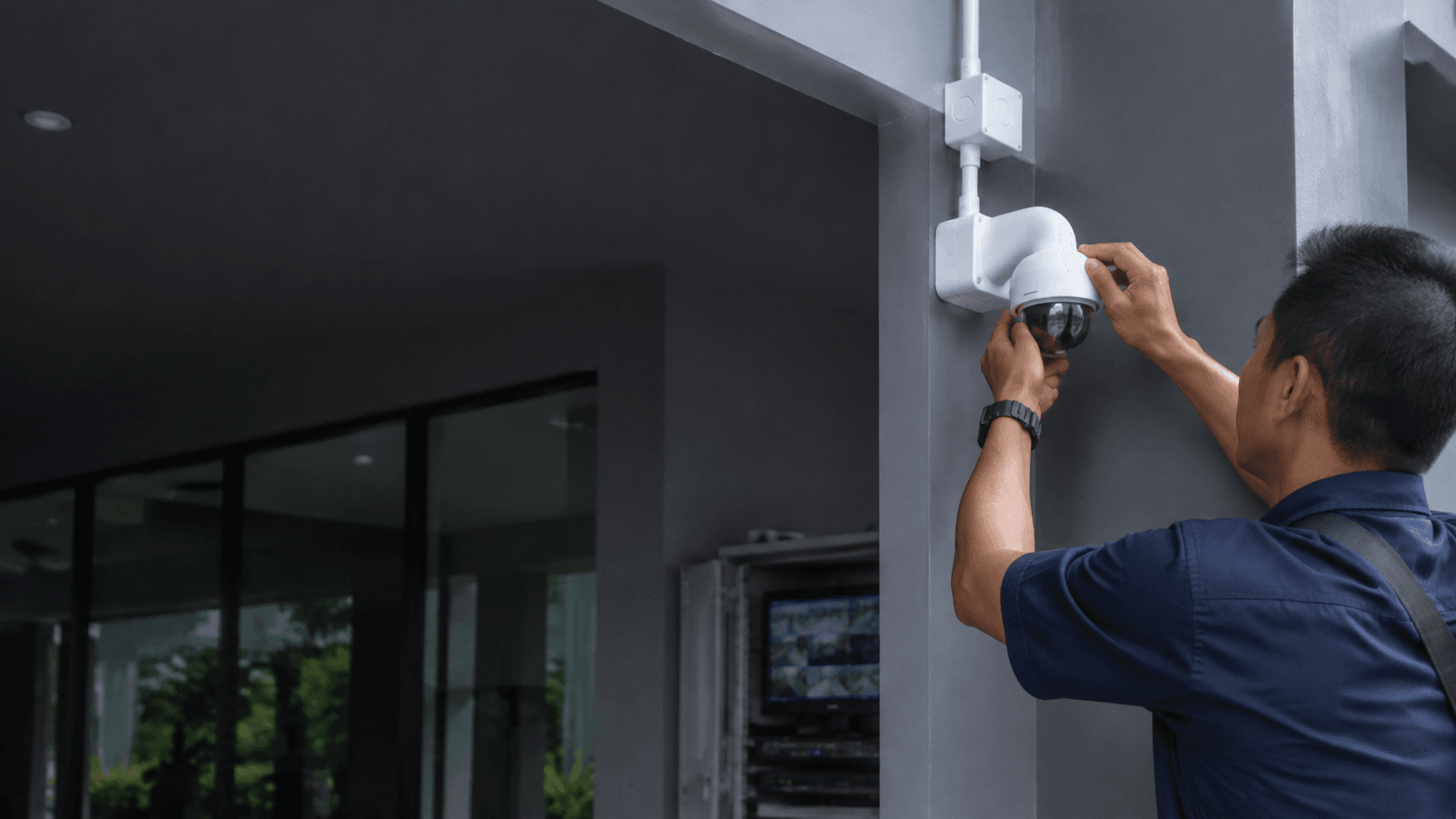
The search for the best home cameras usually returns long review roundups that rank brands by test scores. That format answers a different question. It assumes the buyer will mount the hardware, run the cable, configure the recorder and troubleshoot the app alone. For a house in Malaysia, the harder problems are rarely about which brand wins a lab test. They are about where each camera can actually see, what the light does at night, how long footage is kept, and who fixes the system when a channel drops.
This guide treats best home cameras as a planning decision rather than a shopping list. It covers where cameras usually go, what to check before buying, how a professional installation is sequenced, and what a package costs.
Best Home Cameras. What Matters in a Malaysian Home
The most useful question is not which camera is best in isolation, but which camera suits a specific wall, gate, corridor or driveway. A model that performs well in a controlled test can still fail on a Malaysian terrace house if the mounting point faces a bright road at night or if the cable run is impractical.
Three factors decide most of the outcome:
- Placement — what the lens can see, and what blocks it.
- Lighting — how the scene looks after dark, not at the time of purchase.
- Recording — where footage is stored and how long it stays available.
Eyonic, a security system supplier in Sarawak, plans, supplies and installs monitoring systems with camera placement, recording and remote viewing for homes, offices, shops and industrial sites. That combination matters because a camera bought online arrives without any of those three decisions resolved.
Why the roundup format misleads
Review sites compare cameras under standardised conditions. A home is not standardised. The distance from the gate to the front door, the height of the eaves, the direction of afternoon sun and the position of the router all change what works. A camera that ranks first in a lab can be the wrong choice for a car porch that is lit by a single bulb.
Standalone cameras also push the buyer toward self-installation. That is reasonable for a single indoor unit on a shelf. It becomes difficult once four or more cameras, a recorder and remote viewing are involved, because the work shifts from mounting hardware to designing a system.
Home Cameras and Where They Usually Go
Most Malaysian homes need coverage at a small number of predictable points. The exact count depends on the layout, but the priorities repeat.
- Front gate and car porch — the main entry point for vehicles and visitors.
- Front door — a close view of anyone arriving on foot.
- Side or back passage — the route that is usually unobserved from inside the house.
- Rear yard or kitchen door — a common service entry.
- Ground-floor interior — optional, and usually only where valuables or a home office sit.
Two constraints shape these choices. First, a camera needs a mounting surface with a clear line of sight; a wall that looks convenient may put the lens behind a pillar or an air-conditioning unit. Second, each camera needs power and a route back to the recorder, and those routes are easier to plan before installation than after.
Overlapping coverage is more valuable than a single wide view. Two cameras covering a gate from different angles are harder to defeat than one camera covering a wider area at lower detail.
Indoor and outdoor are different jobs
Indoor and outdoor positions place different demands on a camera. An outdoor unit faces rain, direct sun and insects near the lens. An indoor unit faces backlight from windows and, in some rooms, privacy considerations that make a permanently recording camera unsuitable.
The supplied evidence does not include verified indoor-versus-outdoor model comparisons or performance test data, so this guide does not rank specific models. The practical point stands regardless of brand: the position decides the requirement, and the requirement decides the model.
Lighting, Placement and Recording Before Purchase
Eyonic recommends checking actual lighting conditions before confirming placement for ColorVu-style cameras. That advice generalises. A camera that produces a clear colour image in daylight may produce a very different image at 8pm, and the difference is visible only at the site.
Three checks are worth doing before any purchase:
- Site survey — walk the property at the times that matter, including after dark, and confirm what each proposed position can see.
- System proposal — match camera positions, recorder capacity and viewing setup to the layout rather than to a package size.
- Installation — mount, cable and configure the system, including the recorder and network settings.
- Handover — confirm remote viewing works on the owner's phone and that the recording configuration is understood.
That sequence is how Eyonic structures CCTV installation work, and it applies to home cameras as much as to commercial sites.
Recording configuration decides usefulness
Footage is only useful if it is still there when someone needs it. Recording configuration covers which cameras record continuously, which record only on motion, how long footage is retained, and where it is stored. These are settings, not product features, and they are usually the part of a system that is never reviewed after installation.
The supplied evidence does not include verified subscription or cloud storage terms for home camera systems, so no storage costs are quoted here. The relevant decision is simply whether footage is kept locally on a recorder, in a cloud service, or both, and how many days of history the household actually needs.
Remote viewing is part of the system
Remote viewing is the feature most owners use daily and the one most likely to be left unverified. A camera system that records correctly but cannot be viewed from a phone while travelling has not delivered what was expected. Handover should include confirming the mobile app works on the owner's device, on the owner's network, before the installer leaves.
How Eyonic Plans a Home Camera Installation
Eyonic's process runs from site survey through system proposal, installation and handover. The order matters because each stage removes a decision that would otherwise be guessed.
The site survey establishes what needs to be seen and from where. The proposal converts that into a defined set of cameras, a recorder and a viewing setup. Installation mounts and configures the system. Handover confirms the owner can use it.
Eyonic's project work shows the same approach at larger scale. For the Kuching Immigration Office, the focus was arrival flow, staff areas, visitor movement and dependable daily operation. For KTA Sarawak Sdn Bhd, an engineering consultancy, the requirement was a practical office setup in Kuching supporting staff movement, visitor handling, tidy cabling and clearer daily site control. Both are commercial sites rather than homes, but the underlying method — decide what must be observed, then design coverage around it — is the same one applied to a house.
Eric Yong, founder of Eyonic Security Systems, has worked in the industry for more than 10 years and is experienced in technical installation of digital security solutions for commercial businesses in Sarawak.
What the survey should settle
A useful survey answers a short list of questions. Which entry points need coverage? Which positions give a clear view at night? Where can cable be routed without damaging finishes? Where will the recorder sit, and does it have power and ventilation? Which devices need to view the footage, and on what network?
If those questions are answered before purchase, the camera choice becomes straightforward. If they are answered after purchase, the household usually ends up compromising on placement.
What a Home Camera Package Costs
Eyonic lists three packages at RM 1,599 each. The Hikvision CCTV Package covers camera supply and setup, basic recording configuration, and mobile viewing handover. The Hikvision Alarm System covers a control panel and sensors, siren and zone setup, and user testing and handover. The Autogate Package covers motor recommendation, remote-control setup, and safety testing and handover.
For larger or more complex work, project budgets give a sense of scale. The Kuching Immigration Office project carried an approximate budget of RM 12,000 to RM 28,000, and the KTA Sarawak Sdn Bhd project an approximate budget of RM 8,000 to RM 18,000. Both are commercial projects, so they are not a home price guide, but they show how far scope can move a figure.
What a home camera installation costs depends on the number of cameras, the cable routes, whether a recorder is included, and how much of the work is planning rather than hardware. A single-camera setup and a full perimeter system sit at very different points on that range.
Where the money actually goes
Hardware is the visible cost. Planning, cable routing, configuration and handover are the parts that determine whether the system works in practice. A cheaper set of cameras installed in the wrong positions costs more over time than a smaller set installed correctly, because the second installation is the one that has to be redone.
. Practical Next Step
The decision that matters most is not which camera to buy but what the property needs to see. A survey and a defined proposal answer that question before any hardware is ordered, and they are the reason a planned installation tends to hold up better than a self-assembled one.
Eyonic's work is based in Sarawak, and the supplied project evidence is Sarawak-based. Households outside that area should confirm service coverage before planning around an installation visit.
Share your location, property type and required system with Eyonic on WhatsApp at +60 11-5111 7959 for the next practical step.