
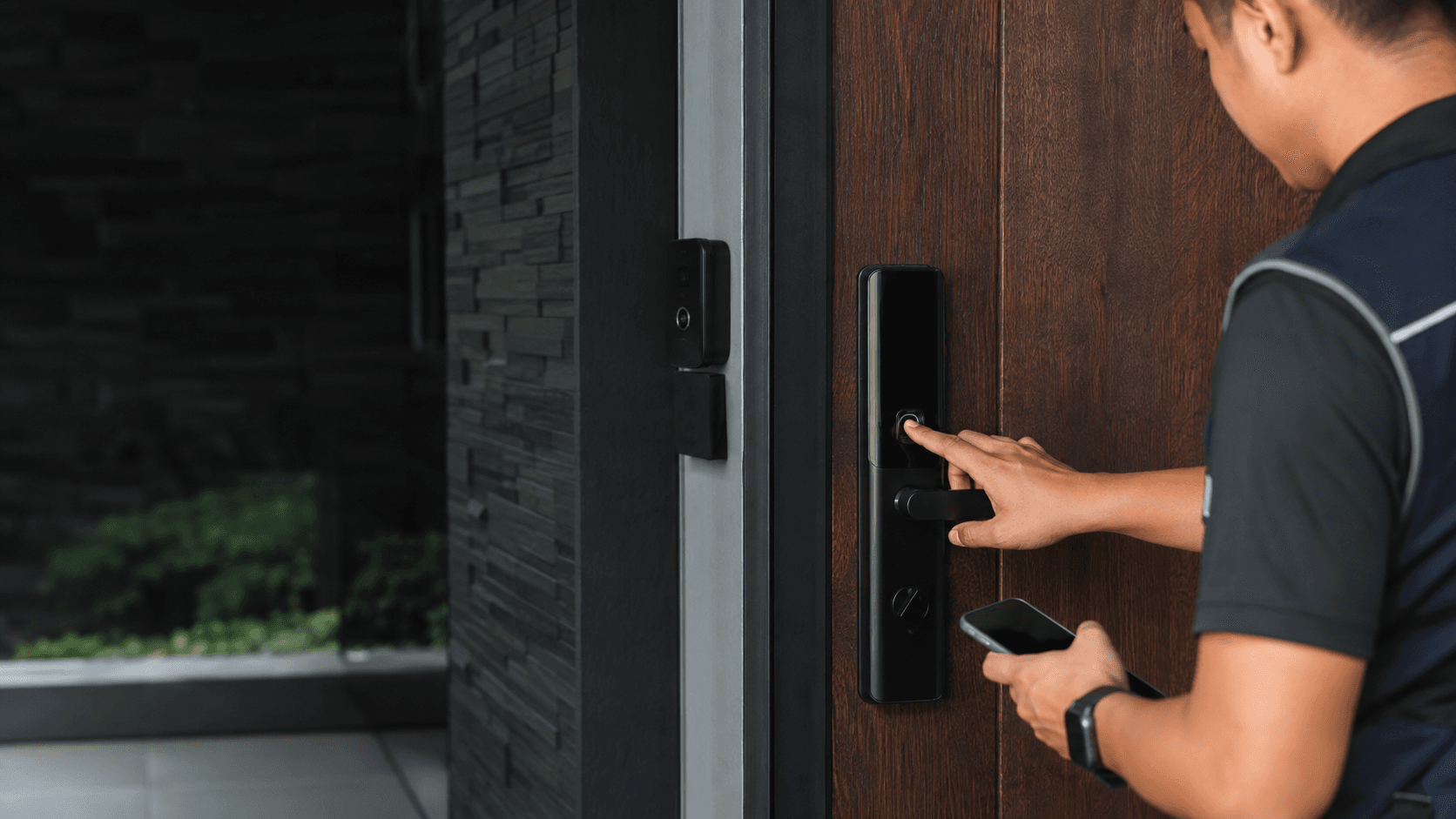
The exact-match phrase is used loosely in search, and that looseness causes most of the confusion. Buyers in Malaysia often arrive expecting one product and discover the term describes a category. The two shapes differ in what gets installed, what stays on the door, and what happens when the battery runs flat.
Yale Keypad Door Lock. what the term covers
Yale sells keypad entry in more than one form. The accessory version is a keypad that mounts near a door and sends codes to a smart lock that already exists. The standalone version is a complete deadbolt with the keypad built into the exterior assembly.
Both deliver keyless entry through entry codes. Neither is a single universal product. A buyer searching for a Yale keypad door lock is usually looking for one of these two, and the difference decides the rest of the purchase.
The accessory route keeps the existing lock and adds a code layer. The standalone route removes the old deadbolt and puts a new one in its place. That single decision changes cost, installation time, and what happens during a power or battery failure.
Keypad accessory versus keypad deadbolt
A keypad accessory is the lighter commitment. It pairs with a compatible smart lock, so the door hardware stays untouched. The trade-off is dependency. if the paired lock is unavailable or unsupported, the keypad has nothing to command.
A keypad deadbolt is self-contained. The keypad, the electronics, and the locking mechanism ship as one unit, so there is no pairing step and no reliance on a separate lock. The trade-off is that the whole deadbolt is replaced, which means the door's existing bore and backset have to suit the new unit.
For a rental property, the accessory route is often easier to reverse. For a home where the existing deadbolt is old or mismatched, the standalone route removes a weak component at the same time.
Which one fits a given door
A door that already carries a modern smart lock is a candidate for the accessory. A door with a basic mechanical deadbolt, or one where the owner wants a single integrated unit, points toward the standalone deadbolt.
Neither choice can be confirmed from a photograph alone. Door thickness, bore diameter, backset, and the position of the strike plate all affect whether a replacement deadbolt seats correctly.
Yale Keypad Door Lock compatibility and door condition
Compatibility runs in two directions. The accessory has to be compatible with the lock it pairs to, and the standalone deadbolt has to be compatible with the door it replaces.
Eyonic's own review of smart lock door access notes that smart locks work best when door condition, user roles, and the backup method are reviewed before installation. That order matters, because a door that will not accept the hardware makes every later decision irrelevant.
Door condition covers more than appearance. A door that has swollen, dropped on its hinges, or been re-drilled may not align with a new deadbolt even when the measurements match on paper. A frame that has moved can leave the bolt short of the strike.
For business premises, Eyonic usually checks whether a standalone smart lock or an access-control panel is the more appropriate fit. A single office door and a building with multiple controlled entry points are different problems, and a keypad deadbolt answers only the first.
What to confirm before ordering
- Check the door condition, including alignment, hinge movement, and whether the existing cut-outs are sound.
- Decide the user roles. who needs a permanent code, who needs a temporary one, and who should be removed later.
- Agree the backup entry method, so a flat battery or a lost phone does not lock out the people who need access.
- Confirm whether a standalone smart lock suits the door or whether an access-control panel is the better fit for the site.
Those four checks come before model selection. Skipping them tends to surface as a lock that fits but does not close cleanly, or a code list nobody maintains.
Codes, users and backup entry
Entry codes are the core function. A keypad exists so that people can enter without carrying a key or a phone, and so that access can be withdrawn without changing the lock.
User permissions decide how useful that is. A household needs a handful of codes. A shop with staff turnover needs codes that can be added and removed as people join and leave, and a record of which code was used.
Backup entry is the part most often left until it is needed. If the keypad is the only way in and the battery dies, access depends on whatever backup the product provides. That may be a mechanical key, an external power point, or a second entry route. Which of these applies depends on the specific model, and the model documentation is the only reliable source.
For a business, the backup question is a continuity question. A door that cannot be opened during a shift change is an operational problem, not a convenience one.
Power connectivity and daily use
Keypad locks are battery-powered, which is what allows them to be fitted without wiring. Battery behaviour depends on the model, how often the door is used, and whether the lock maintains a wireless connection.
Connectivity is a separate layer. A keypad can work locally without any network, while remote code management and activity records usually depend on a bridge or a connected model. Where a Wi-Fi bridge is required for remote functionality, that requirement belongs in the planning stage rather than after installation.
Daily use is where the choice shows. A keypad that is used by the same three people behaves differently from one used by rotating staff, delivery access, or short-stay guests. The second pattern needs a code process, not just a code pad.
Installation and handover in Sarawak
Eyonic's installation process runs through site survey, system proposal, installation, and handover. The same sequence applies to door access work, because the survey is what establishes whether the door and the site suit the product.
Eyonic has completed work for the Kuching Immigration Office, focused on arrival flow, staff areas, visitor movement, and dependable daily operation. That project is a useful reference point for how movement through a building shapes access decisions, even though it is not a keypad lock installation.
Handover is where a keypad lock either becomes usable or becomes a source of calls. It covers the codes that exist, who holds them, how they are removed, and what to do when the battery reports low. A lock handed over without that conversation tends to be managed by whoever remembers the original settings.
For properties in Sarawak, the practical constraints are the same ones that affect any door hardware: humidity, door movement over time, and whether the site has someone who can respond when access fails. None of those are solved by the keypad alone.
Eyonic Sdn Bhd plans, supplies, and installs security systems in Sarawak, including smart locks alongside CCTV and ELV work. Eric Yong, the founder, has worked in the industry for more than ten years, with a focus on technical installation of digital security solutions for commercial businesses in Sarawak.
Share your location, property type and required system with Eyonic on WhatsApp at +60 11-5111 7959 for the next practical step.