
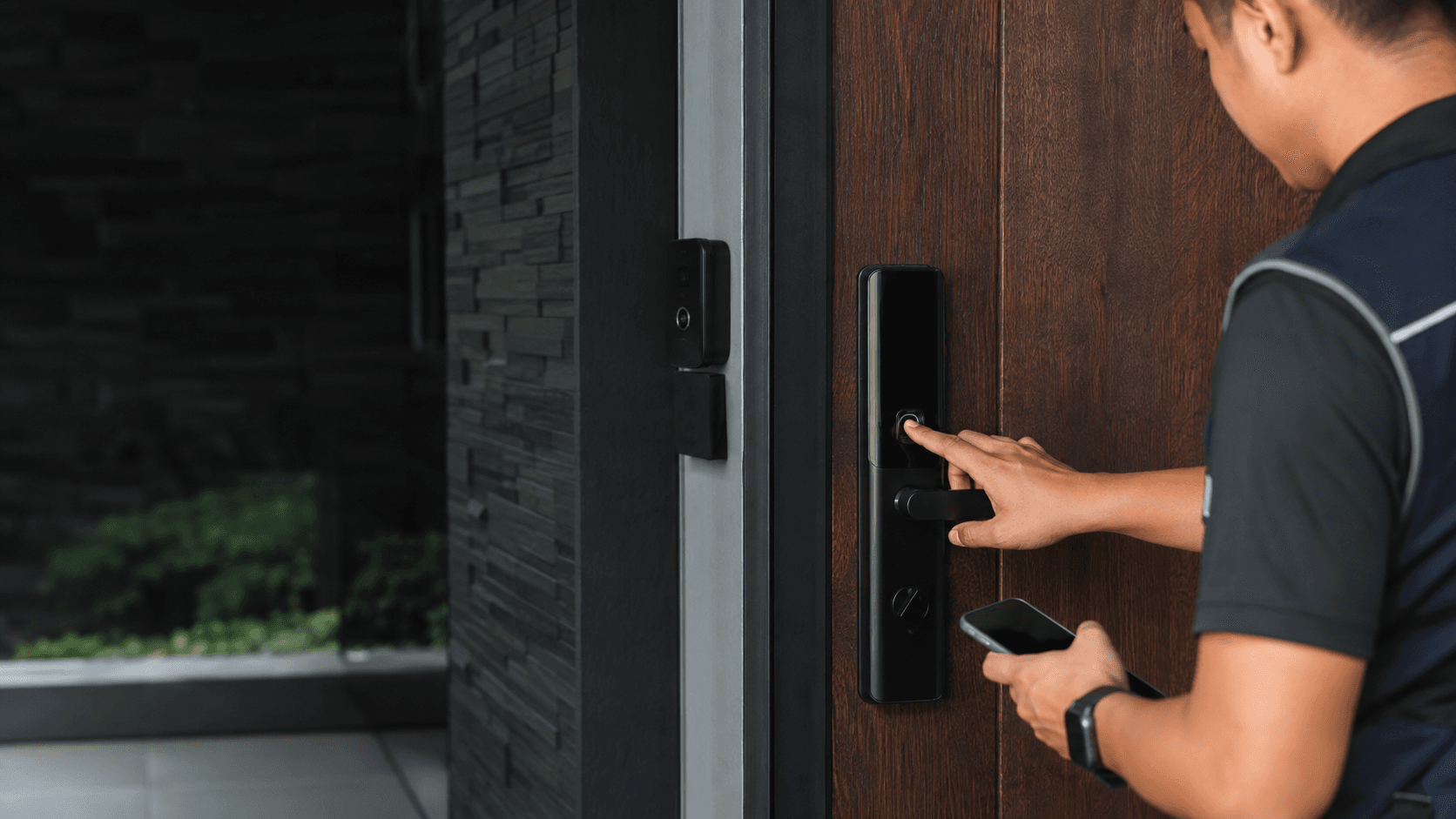
The pairing matters because it changes how a door is opened rather than how a lock looks. Level builds deadbolt replacements that keep the exterior hardware largely unchanged, and Apple Home Key adds a digital credential stored in Apple Wallet. The two together produce a tap-to-enter experience that sits alongside the Level app, a physical key, and HomeKit automations.
This guide covers what the combination does, which Level models carry it, how installation and daily use behave in practice, and where the limits sit. It also covers the questions that come up after purchase, including battery behaviour, guest access, and what happens when a phone is unavailable.
What Apple Home Key Level Lock actually means
Apple Home Key is a feature introduced with iOS 15 that stores a door credential in Apple Wallet. A compatible lock reads that credential over NFC when an iPhone or Apple Watch is held near the reader. The lock then releases the deadbolt.
Level is one of the lock makers that supports the feature. Level Lock+ and Level Lock Pro are the models most commonly associated with Apple Home Key support, and Level Lock Pro adds Matter connectivity for the Apple Home ecosystem. Level Bolt and earlier Level Lock models sit in a different position, so model confirmation matters before purchase.
The practical result is a lock that can be opened without launching an app, without typing a code, and without carrying a physical key. Express Mode allows a tap without authentication on the device, while a stricter setting requires Face ID, Touch ID, or a passcode before the door releases.
How the tap-to-unlock mechanism works
The lock contains an NFC reader. The iPhone or Apple Watch presents the Wallet credential to that reader. The lock verifies the credential and drives the motor or actuator that retracts the bolt. Because the credential lives in Wallet, it survives app deletion and does not depend on a Bluetooth connection at the moment of entry.
This differs from auto-unlock, which relies on proximity over Bluetooth and can trigger early or late depending on how the phone approaches the door. Home Key is a deliberate physical gesture: the device is brought to the lock, and the lock responds.
Choosing the right Apple Home Key Level Lock
Model selection comes down to three variables: which Level lock is being bought, what the door already has, and whether the household uses Apple devices or a mix of platforms.
- Confirm the specific Level model supports Apple Home Key, since support is not uniform across the Level range.
- Check the existing deadbolt and door preparation against the lock's compatibility guidance before ordering.
- Decide whether Matter and Thread support matter for the wider smart home setup.
- Plan a backup entry method, such as a physical key or a keypad code, before relying on a phone.
- Set up the Home Key pass in Apple Wallet and choose between Express Mode and authenticated unlock.
- Test the lock with every household device that will use it, including Apple Watch if applicable.
Step two deserves emphasis. A deadbolt replacement assumes the door already has a standard bore and that the existing bolt aligns with the strike. Doors with unusual backset, non-standard thickness, or integrated handle hardware can require additional checks before the lock will fit.
Level Lock+ versus Level Lock Pro
Level Lock+ is the model most often cited in reviews as the Apple Home Key option with a concealed design. Level Lock Pro is positioned as the newer model with Matter support, which affects how it integrates with Apple Home and other ecosystems. Buyers comparing the two are usually weighing Matter and Thread support against the maturity of the earlier model.
Both retain the same basic idea. the lock hardware replaces the interior and exterior of an existing deadbolt while keeping the visual profile close to standard hardware. That discretion is a large part of the appeal for anyone who does not want a smart lock to look like one.
Practical considerations for Apple Home Key Level Lock
Daily use is where the combination either earns its place or becomes a nuisance. Several behaviours are worth understanding before installation.
Battery life and power reserve
Level locks run on a single CR2 battery, and the company publishes guidance on expected battery behaviour. Power Reserve is the feature that allows a limited number of unlocks after the battery is depleted, which matters because a dead lock at the front door is the worst failure mode. Keeping a physical key accessible remains sensible regardless of battery claims.
Guest and family access
Home Key passes can be shared with family members through the Apple Home setup, and access can be revoked. This is more controlled than handing over a physical key, because revocation does not require rekeying the lock. For households with regular visitors, the pass model is usually simpler than managing codes.
Platform limits
Apple Home Key is an Apple feature. Households using Android phones or a mixed-device setup will not get the same tap-to-unlock behaviour on every phone. The lock may still work through the Level app, a keypad, or another ecosystem, but the Home Key experience is specific to Apple devices. That constraint should be settled before purchase rather than after.
Installation conditions
Installation is generally described as straightforward for a standard deadbolt replacement, but it assumes the door is in good condition and the existing hardware is compatible. In Malaysia, where doors vary widely between landed properties, apartments, and commercial premises, checking the actual door before ordering avoids a return. For businesses weighing a standalone smart lock against a fuller access-control setup, the decision usually turns on how many users need managed access and whether audit trails are required.
Where fits in a wider security setup
A smart lock controls one opening. It does not observe the surrounding area, record who approached, or cover a second entrance. Many properties pair a lock with cameras, an alarm system, or an intercom so that entry control and awareness work together.
Eyonic Sdn Bhd plans, supplies, and installs CCTV and ELV systems in Sarawak, including camera placement, NVR setup, and remote viewing for homes, offices, shops, and industrial sites. The company also handles alarm systems, autogate packages, and keyphone intercom installation. Smart lock door access is offered as part of that range, with the practical position that smart locks work best when door condition, user roles, and a backup method are reviewed before installation.
For business premises, the same review usually asks whether a standalone smart lock is sufficient or whether an access-control panel is more appropriate. That depends on how many people need access, whether entry needs to be logged, and whether the door is a main entrance or an internal one.
Completed work includes the Kuching Immigration Office, where the focus was arrival flow, staff areas, visitor movement, and dependable daily operation, and KTA Sarawak Sdn Bhd, an office setup supporting staff movement, visitor handling, and tidy cabling. Both illustrate the same principle: entry hardware is one part of how a site actually operates.
Cost context for related work
Eyonic's published packages for CCTV, alarm systems, and autogate work are each priced at RM 1,599. Larger project work has run in the range of RM 8,000 to RM 28,000 depending on scope. These figures describe Eyonic's own service pricing and project history, not the price of a Level lock, which is set by the lock retailer.
Making an informed choice about
The combination is strongest for Apple households that want a discreet deadbolt replacement and value tap-to-unlock over app-based control. It is weaker for mixed-platform homes, for doors with non-standard preparation, and for anyone who expects a smart lock to replace cameras or an alarm system.
Three checks settle most decisions. Confirm the exact Level model supports Apple Home Key. Confirm the door accepts a standard deadbolt replacement. Confirm a backup entry method exists for every person who needs to get in.
For properties in Sarawak that need entry control alongside cameras, alarms, or intercoms, Eyonic can review the door, the users, and the backup plan together. Share the location, property type, and required system on WhatsApp at +60 11-5111 7959 to take the next practical step.