
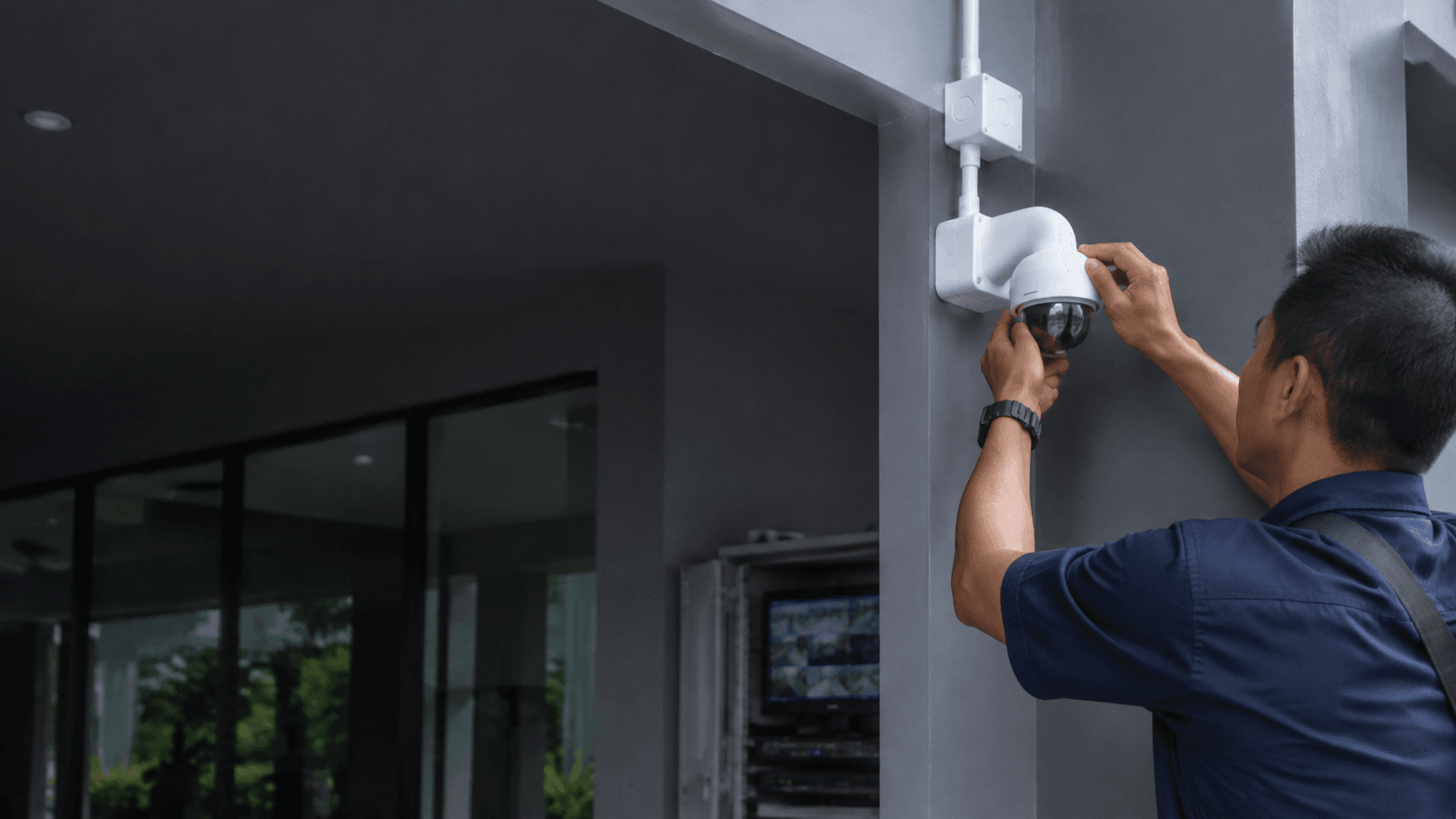
The model name tells part of the story. The rest comes from the site itself: how much ambient light reaches the camera position after dark, what the camera needs to see, and how the recorded footage will be used. Eyonic, a security system supplier in Sarawak, plans, supplies and installs monitoring systems with camera placement, recording and remote viewing for homes, offices, shops and industrial sites.
Hikvision 5mp Colorvu Camera: What Full-Colour Night Imaging Means
Full-colour night imaging describes a camera that produces colour video after dark instead of switching to black-and-white infrared. That matters when colour carries information: the shade of a vehicle, the colour of a jacket, or the difference between two similar objects in a car park or along a shopfront.
The practical question is not whether colour night video is possible. It is whether the specific position has enough light for the camera to hold colour reliably through the night. A position that looks bright during a daytime walkthrough can behave very differently at 2am, when street lighting, signage and neighbouring lights change the picture entirely.
Eyonic's own product review guidance for ColorVu-style cameras is direct on this point: check actual lighting conditions before confirming placement. That single check separates a camera that performs as expected from one that disappoints after installation.
Why Lighting Conditions Decide Placement Before the Model Does
Placement and lighting are the same decision. A camera aimed at a well-lit entrance, a covered walkway with steady lighting, or a shopfront with signage illumination has a different job from one covering an unlit back lane or a large open yard.
Three conditions shape the choice:
- Steady ambient light. Where light is present and consistent through the night, full-colour imaging has the best chance of holding.
- Mixed or intermittent light. Where light comes and goes, the camera's behaviour changes with it, and the recorded result is less predictable.
- Very low light. Where almost no light reaches the position, colour night imaging is the wrong expectation, and the conversation should move to what the site actually needs.
This is why the model should not be chosen first. Choosing a camera before walking the site risks buying capability the position cannot use, or missing a position that needed a different approach entirely.
Where full-colour night imaging fits well
Entrances, reception areas, covered car parks, shopfronts and internal corridors with lighting are the natural fit. These are positions where colour helps identify people and vehicles, and where light is already part of the environment.
Where it needs a second look
Open yards, unlit perimeter fencing, long driveways and back lanes with no lighting are the positions that need honest assessment. In these cases the answer may be additional lighting, a different camera position, or a different camera type altogether.
Hikvision 5mp Colorvu Camera Planning Steps for a Sarawak Site
Eyonic's CCTV installation process runs through four stages: site survey, system proposal, installation, and handover. The sequence matters because each stage feeds the next.
- Site survey. The property is walked to understand layout, entry points, existing lighting, cabling routes and where recording equipment can sit.
- System proposal. Camera positions, recording configuration and viewing setup are proposed based on what the survey found, not on a standard package.
- Installation. Cameras are mounted, cabling is run, and the recorder is configured.
- Handover. Recording is confirmed, mobile viewing is set up, and the system is explained so daily use is straightforward.
For a Sarawak site, two local factors shape the plan. First, lighting varies enormously between a Kuching shophouse with street lighting and a rural property with none. Second, building construction affects cabling routes and camera mounting, particularly in older premises where cable paths are not obvious.
Eyonic's completed work for the Kuching Immigration Office focused on arrival flow, staff areas, visitor movement and dependable daily operation. That project shows the pattern. the camera plan follows the movement pattern of the site, not the other way around.
What Eyonic Checks During a Site Survey
The survey is where the camera decision is actually made. Several checks happen on site before any model is confirmed.
Night-time light behaviour. The most important check. What light exists at each proposed position after dark, and does it stay consistent? This is the check Eyonic's ColorVu review guidance highlights, and it directly determines whether full-colour night imaging is the right fit.
Coverage and angle. What each position needs to see, and whether one camera covers it or two positions are needed. Overlapping coverage at entry points is often more useful than a single wide view.
Cabling and recorder location. Where cables can run, and where the recorder can sit with power and ventilation. NVR setup and remote viewing are configured around this.
Daily operation. Who will review footage, and how. A system that is easy to check gets used; one that is awkward gets ignored.
Growth. Whether the site is likely to add cameras later, which affects recorder channel count and cabling decisions made now.
Numbers That Matter Before Confirming a
Eyonic's Hikvision CCTV package is priced at RM 1,599, covering camera supply and setup, basic recording configuration, and mobile viewing handover. That figure is a package price, not a camera-only price, and it gives a realistic starting point for a small installation.
Larger sites sit in a different range. Eyonic's completed Kuching Immigration Office project carried an approximate budget of RM 12,000 to RM 28,000, and the KTA Sarawak Sdn Bhd office project carried an approximate budget of RM 8,000 to RM 18,000. Both figures reflect multi-camera office installations with cabling and configuration, not single-camera work.
Three numbers are worth confirming before committing:
- Camera count. How many positions the site genuinely needs, based on the survey rather than a round number.
- Recorder channels. How many cameras the recorder supports, including room to add one or two later.
- Retention days. How far back footage needs to be available, which drives storage sizing.
These three answers determine most of the cost difference between a small shopfront installation and a multi-floor office system.
Questions Buyers Ask Before Installation
Does full colour night imaging work with no light at all
No camera produces colour from nothing. Full-colour night imaging depends on light being present at the position. Where there is no light, the honest answer is that the position needs lighting added, a different camera position, or a different camera type.
Can the camera be added to an existing recorder
Sometimes. It depends on the recorder's supported channels and signal format, which is why the existing equipment is checked during the survey rather than assumed. Compatibility is confirmed before supply, not after.
How is footage viewed remotely
Remote viewing is configured during handover, so the system is checked on a phone before the installer leaves. That step confirms the recording, the network path and the viewing app all work together.
What happens if the site lighting changes later
Camera positions can be adjusted, and settings can be tuned. If new lighting is installed or a neighbouring light is removed, the position should be rechecked, because the original assessment was based on conditions at the time of the survey.
Is a site visit required before confirming a camera
For a single camera replacing an existing unit at the same position, a visit may not be necessary. For a new installation or a position change, the survey is what makes the recommendation reliable, because lighting and coverage cannot be judged accurately from a description alone.
Eyonic Sdn Bhd plans, supplies and installs CCTV and ELV systems across Sarawak, with founder Eric Yong bringing more than 10 years of technical installation experience in digital security solutions for commercial businesses in the state. Share your location, property type and required system with Eyonic on WhatsApp at +60 11-5111 7959 for the next practical step.