
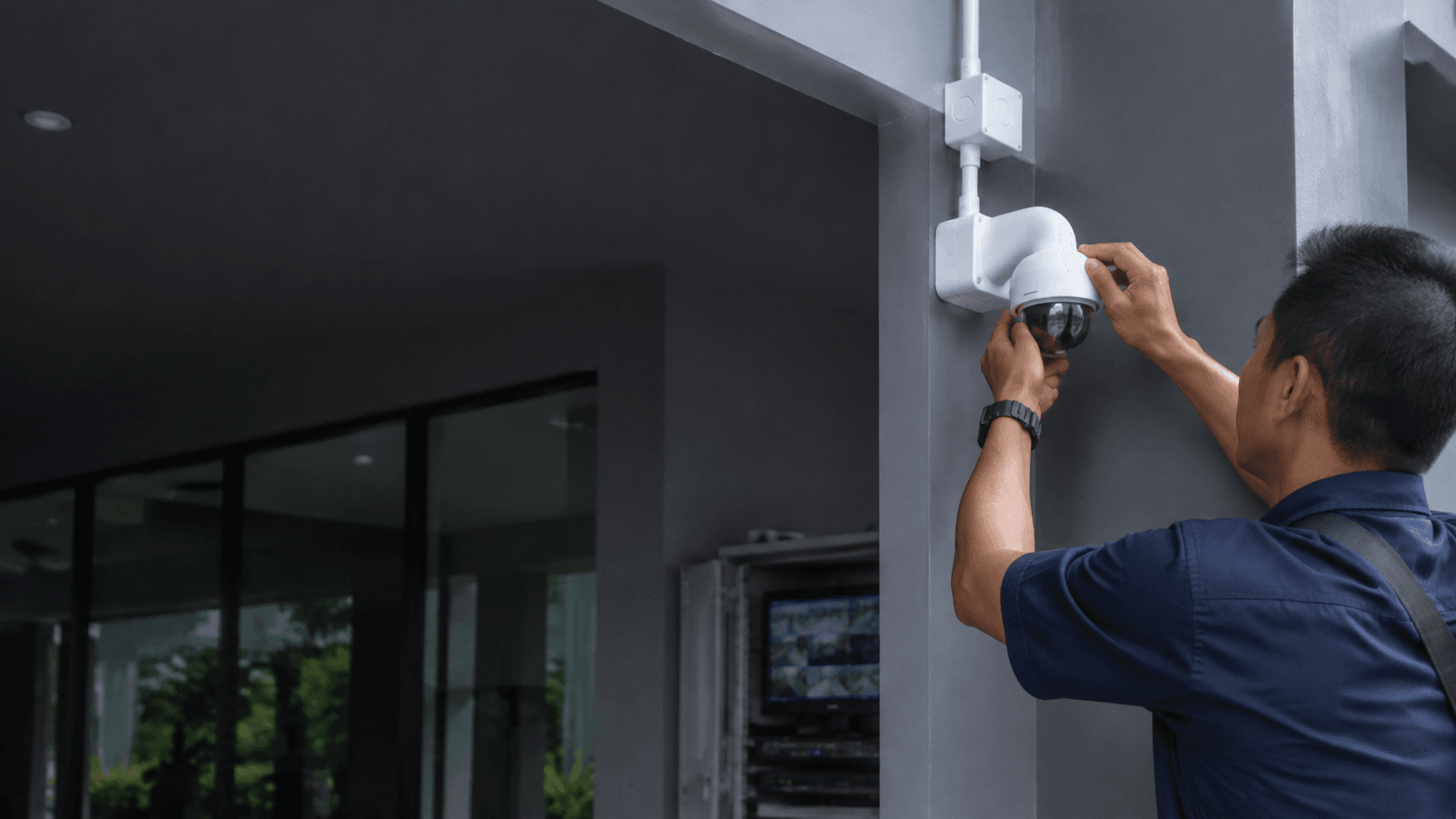
The headline number on a product listing rarely matches what a working installation costs. A solar CCTV camera price in Malaysia is shaped by how many cameras are needed, where they can be mounted, how much light the site receives, and how recording and remote viewing are configured. Eyonic, a security system supplier in Sarawak, plans and installs monitoring systems for homes, offices, shops and industrial sites, and its CCTV work follows a defined sequence from survey to handover.
Solar Cctv Camera Price: What Matters Before You Choose
A solar-powered camera removes the need to run power cable to the mounting point, but it does not remove the need for planning. The camera still needs a position with adequate sunlight, a mounting surface that holds firm, and a network path for recording and remote viewing. Each of those decisions changes the labour and materials in the quote.
Eyonic's CCTV installation process covers four stages, and the same structure applies to solar-powered work because the survey and placement decisions come before any hardware is fixed.
- Site survey to assess the property, mounting points and existing infrastructure.
- System proposal setting out the camera positions, recording approach and scope of work.
- Installation of cameras, mounting hardware and recording equipment.
- Handover covering configuration, mobile viewing and basic user testing.
Two items in that sequence carry most of the cost variation. The survey determines whether the site needs additional mounting structures, cable runs or network equipment. The proposal determines how many cameras are specified and whether recording is handled locally on an NVR or through another arrangement.
Site Survey and Camera Placement
The survey is where a solar CCTV camera price stops being a product question and becomes a site question. A camera that covers a gate, a driveway and a side entrance from one position costs less to install than three cameras covering the same area from separate points, because each additional camera adds mounting work, configuration and a recording channel.
Placement also affects whether solar power is practical at all. A camera mounted under a deep roof overhang, inside a covered walkway or on a shaded wall may not receive enough direct light to keep its battery charged. In those positions, a wired camera or a different mounting point is often the more reliable choice, and that decision belongs in the survey rather than after installation.
Eyonic's project for the Kuching Immigration Office focused on arrival flow, staff areas, visitor movement and dependable daily operation. That kind of brief shows how placement follows function: the camera positions were chosen around the movement patterns the site needed to monitor, not around a fixed template.
What changes the scope
Properties with existing cable routes, a working network cabinet and clear mounting surfaces need less preparatory work. Older buildings, long perimeter runs and sites with no existing network infrastructure add labour before a single camera is mounted. A quote that does not account for those conditions is likely to change once work begins.
Lighting Conditions Before Placement
Lighting affects two separate things: whether the camera's panel can recharge its battery, and whether the camera can produce a usable image after dark. Both need checking before placement is confirmed.
Eyonic recommends checking actual lighting conditions before confirming placement for ColorVu-style cameras, which are designed to produce colour images in low light. The same discipline applies to solar-powered units. A position that looks bright during a midday visit may sit in shadow for most of the afternoon, which matters for charging and for image quality at night.
For sites with mixed lighting, the practical approach is to identify which areas need colour night imaging and which can work with standard infrared, then match camera positions to those zones. This is a placement decision, and it is cheaper to settle during the survey than to correct afterwards.
Recording, NVR Setup and Remote Viewing
Recording is a separate cost line from the cameras. A solar camera can transmit video, but something has to store it. That means an NVR or another recording device, a storage drive sized to the retention period the site needs, and a network connection that carries the video reliably.
Remote viewing adds a further layer. Mobile access requires the recorder to be reachable over the network, and the handover should confirm that the owner can open the live view and review recorded footage on a phone before the installer leaves. Eyonic's service scope includes camera placement, recording and remote viewing, which keeps those three elements in one plan rather than split across suppliers.
Sites without a stable internet connection need this settled early. Remote viewing depends on connectivity, and a solar camera installation on a remote site may need a different approach to recording and access than one on a property with fixed broadband.
Practical Handover and Daily Operation
Handover is where the installation either becomes usable or becomes a support call. It should cover how to open the live view, how to find recorded footage for a specific time, what to do when a camera goes offline, and who to contact when something fails.
Daily operation is the test of whether the design was right. A public office handling arrival flow, staff areas and visitor movement needs cameras that stay online and footage that can be retrieved without technical help. The Kuching Immigration Office project was scoped around dependable daily operation for exactly that reason.
Solar-powered cameras add one ongoing habit: the panel surface needs to stay clear of dust, leaves and debris, because a shaded panel charges more slowly. That is a simple maintenance point, but it belongs in the handover conversation rather than in a manual nobody reads.
What the price does not include
Eyonic publishes package pricing of RM 1,599 for a Hikvision CCTV package, RM 1,599 for a Hikvision alarm system and RM 1,599 for an autogate package. Those figures cover camera supply and setup, basic recording configuration and mobile viewing handover for the CCTV package, but they are not solar CCTV camera prices and should not be read as such.
Solar-powered installations sit outside those packages because the power arrangement, mounting and site conditions differ. Project budgets for larger commercial work give a sense of scale: Eyonic lists an approximate budget of RM 12,000 to RM 28,000 for the Kuching Immigration Office project and RM 8,000 to RM 18,000 for the KTA Sarawak Sdn Bhd office setup in Kuching. Both were multi-camera commercial installations rather than single solar camera jobs, so they indicate the range that site-wide work can reach rather than a per-camera rate.
Any solar CCTV camera price quoted without a survey should be treated as provisional. The variables that move the figure most are the number of camera positions, whether mounting structures are needed, how much preparatory electrical and network work the site requires, and how recording and remote viewing are configured.
Share your location, property type and required system with Eyonic on WhatsApp at +60 11-5111 7959 for the next practical step.