
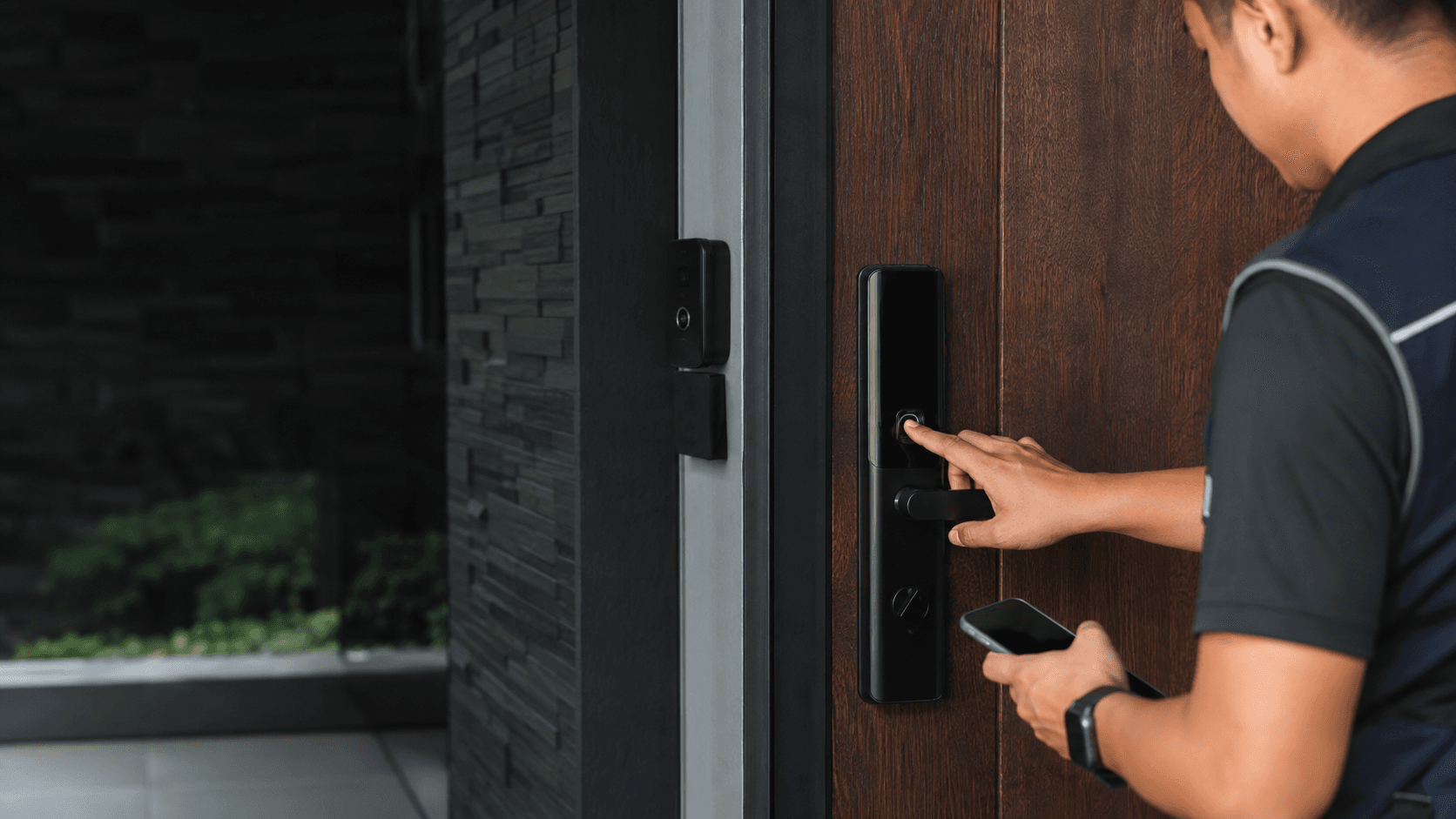
The phrase "best digital lock for main door" hides a practical question. There is no single model that suits every Malaysian entrance, because the deciding factors sit in the door itself, the people who use it, and what happens when power or a fingerprint fails. Eyonic, a security system supplier in Sarawak, reviews door condition, user roles and backup method before recommending a standalone smart lock or an access-control panel.
This guide covers the lock types that fit a main entrance, how entry and backup access work, what to inspect on the door, and what a quotation should include.
Best Digital Lock For Main Door: What Matters Before You Choose
Main entrance doors in Malaysia vary widely. A solid timber door, a metal gate, a grille-and-door pair, and an apartment fire door each accept different hardware. The lock type matters more than the brand name on the box.
Push-pull locks suit doors where the handle is a lever or bar and the user wants a single motion to enter. They typically replace the existing handle set, so the door needs enough flat surface and a cut-out that matches the body. Mortise locks sit inside a pocket cut into the door edge and usually pair with a lever handle. They offer a familiar feel and often include a mechanical key override. Rim and deadbolt-style locks mount on the door face and are common where the door already has a deadbolt position. Retrofit adapters keep the existing deadbolt and add electronic control on the inside face, which avoids cutting new holes but limits the entry methods available.
Gate-and-grille entrances create a second constraint. A digital lock on the timber door behind a metal grille may be unreachable if the grille stays locked, so the entry method has to work through the grille or the grille needs its own access control. For business premises, Eyonic usually checks whether a standalone smart lock or an access-control panel is more appropriate, because staff and visitor movement changes the requirement.
Which lock type suits which door
A solid single-leaf door with an existing deadbolt is the simplest case for a retrofit or deadbolt-replacement lock. A door with a narrow stile or glass panel may not have room for a mortise body. A double-leaf door needs one leaf fixed and the other carrying the lock, or two locks with a coordinated release. A fire-rated apartment door may restrict cutting, so a surface-mounted option is safer than a mortise pocket.
Door thickness is a common blocker. Lock bodies are built for a range of door thicknesses, and a door outside that range needs either a different model or additional preparation. Measuring the door edge, the backset and the existing cut-out before choosing a lock prevents a return trip.
Entry methods, backup access and daily use
Entry methods decide how the household or staff actually get in each day. Fingerprint access suits regular users who want to leave keys behind. Keypad entry suits family members, helpers and occasional visitors who can be given a code. A card or tag suits staff who already carry an access card. A mobile app suits remote unlocking and temporary access. A mechanical backup key covers the case where the electronics fail or the battery runs flat.
Backup access is not a minor feature. A lock with fingerprint access and keypad entry but no mechanical override leaves the entrance dependent on power and electronics. A lock with a mechanical key override keeps a physical path in, but that key has to be stored somewhere reachable and not inside the house. Some locks also accept a temporary power source from outside, which is worth confirming before purchase.
Auto-lock changes daily behaviour. A lock that re-latches after a set delay removes the habit of checking the door, but it can also lock someone out mid-task if the delay is short. Access permissions matter for households with helpers, tenants or staff: named users, time-limited codes and the ability to remove a user quickly are more useful than a long list of entry methods nobody uses.
Battery backup and power interruptions deserve a plain answer. Most electronic locks run on batteries, and battery life depends on how often the lock is used and whether it holds a wireless connection. A lock that reports low battery in advance is easier to live with than one that simply stops. Where the entrance is a business door with heavy daily traffic, battery replacement becomes a maintenance task rather than an occasional one.
Door condition, installation and support in Malaysia
Installation quality decides whether a good lock performs well. The checks below are the ones that most often change the recommendation, and they are worth completing before any model is chosen.
- Measure the door thickness, the backset and the existing cut-out, and note whether the door is solid timber, metal, glass or fire-rated.
- Confirm the entry methods required by each regular user, including fingerprint access, keypad entry, card or app.
- Decide the backup access method and where the mechanical key or external power option will be kept.
- Check whether a gate or grille sits in front of the door and whether it blocks reach to the lock.
- Review access permissions for helpers, tenants, staff or contractors, including how a user is removed.
- Confirm who installs the unit, who handles battery or electronic faults, and what support exists locally after handover.
Local support matters in Sarawak and across Malaysia because a lock that needs a replacement part or a firmware reset is difficult to manage without a supplier who can attend the site. Eyonic's installation process for its security work follows site survey, system proposal, installation and handover, and the same sequence applies to door access work. The Kuching Immigration Office project shows the pattern in a public building: arrival flow, staff areas and visitor movement were reviewed together, with dependable daily operation as the goal.
For a home, the equivalent review is smaller but similar. Who arrives first, who arrives last, whether anyone needs access while the household is away, and whether the entrance is visible from the street all shape the choice. For a shop or office, staff movement and visitor handling usually push the decision toward a lock that supports named users and an audit trail rather than a single shared code.
Costs, packages and what a quotation should cover
Digital lock pricing depends on the lock type, the door preparation required and whether the work is part of a wider security setup. Eyonic publishes package pricing for other security systems at RM 1,599 for a Hikvision CCTV package, RM 1,599 for a Hikvision alarm system and RM 1,599 for an autogate package, each covering supply, setup and handover. Those figures are for CCTV, alarm and autogate work, not for digital locks, and they are useful mainly as a reference for how a supply-and-install package is structured.
A quotation for a digital lock for main door work should state the lock model and its entry methods, the door preparation included, whether old hardware is removed, the backup access supplied, the battery or power arrangement, and what happens if the unit faults. It should also state who attends the site and how quickly. A price without those details leaves the buyer comparing numbers that cover different scopes.
Where the entrance is part of a larger setup, the lock decision interacts with other systems. A door access lock and an intercom serve different purposes, and a gate motor changes how the entrance is used. Eyonic supplies and installs CCTV, alarm, autogate, keyphone intercom and Starlink systems alongside smart lock door access, so the entrance can be planned as one arrangement rather than separate purchases.
Common questions about digital locks for main doors
Does a digital lock fit an existing main door? Often, but it depends on door thickness, the existing cut-out and whether the door is fire-rated. A retrofit option avoids new cutting; a mortise lock usually needs a pocket cut into the door edge.
What happens during a power interruption? Most electronic locks run on batteries rather than mains power, so a blackout does not stop entry. A lock that depends on mains power or a connected panel needs a backup method confirmed before installation.
Is a mechanical key still needed? A mechanical override keeps a physical entry path when electronics or batteries fail. If the lock has no key override, confirm the external power option and keep a plan for a flat battery.
Can helpers or staff be given access without a key? Yes, through keypad entry, cards or app-based permissions. Named users and time-limited codes are easier to manage than a single shared code, especially when someone leaves.
Who should install the lock? A supplier who can survey the door, supply the correct model and support the unit afterwards. Eric Yong, founder of Eyonic Security Systems, has worked in technical installation of digital security solutions for commercial businesses in Sarawak for more than 10 years.
Share your location, property type and required system with Eyonic on WhatsApp at +60 11-5111 7959 for the next practical step.