
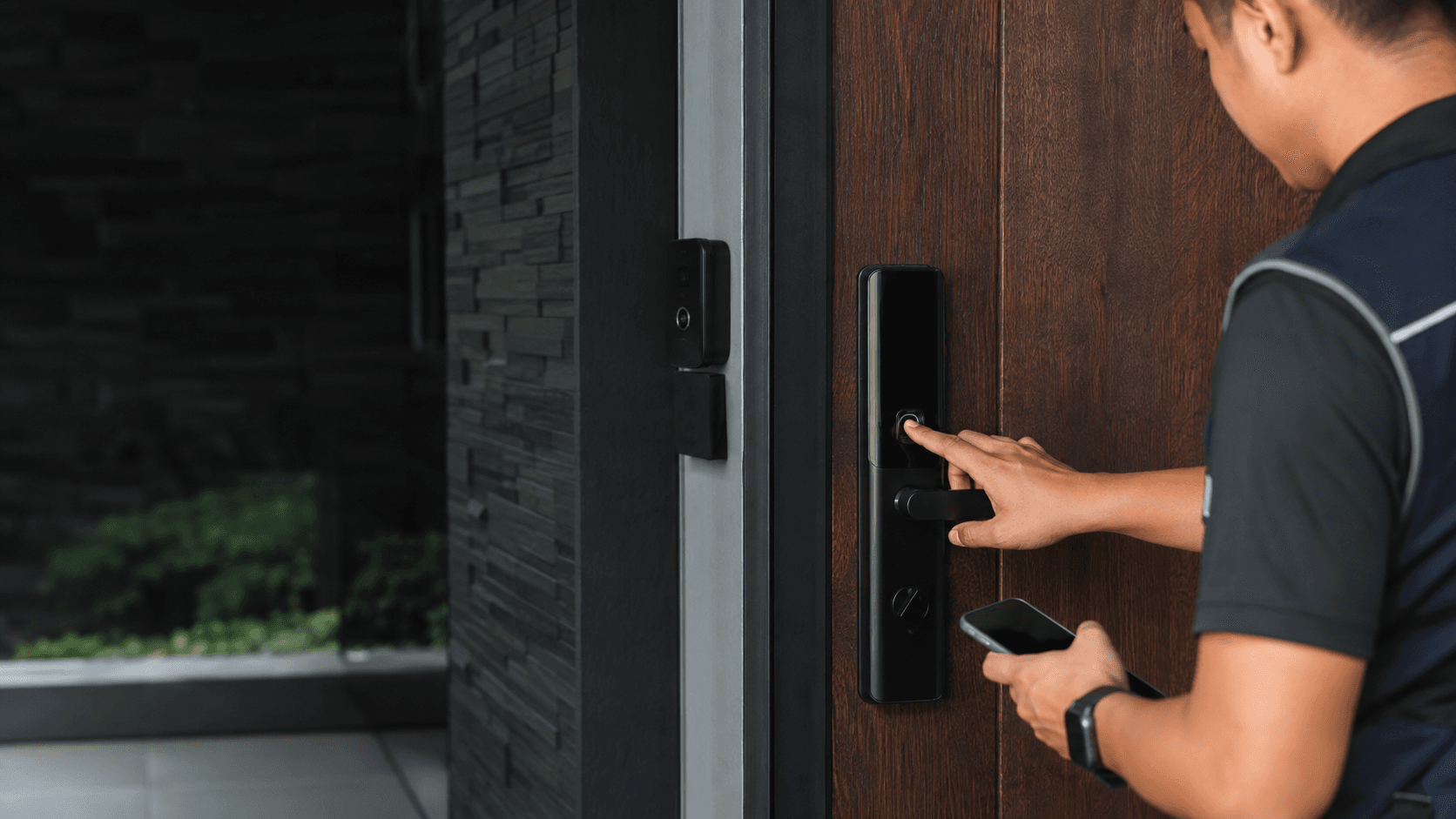
The exact-match query door locks with deadbolt describes a lock set rather than a single component. A deadbolt lock set pairs the bolt mechanism with a knob, lever or pull so one purchase covers the whole door. In Malaysia, that set is fitted to terrace houses, shophouse units, office suites and rented premises, and the buying decision usually turns on three things: how the bolt is operated, whether the door can accept it, and who holds the keys or codes.
Most of the confusion around door locks with deadbolt comes from treating every product on a shelf as interchangeable. They are not. A single cylinder deadbolt, a double cylinder deadbolt, a keypad deadbolt and a smart lock door access unit solve different problems, and each carries its own trade-off around convenience, key control and what happens when power or a key is lost.
Single Cylinder and Double Cylinder Deadbolt Lock Sets
The cylinder is the part the key turns. Its type decides how the door behaves from the inside, and that is the first fork in the road.
A single cylinder deadbolt has a keyway on the outside and a thumb turn on the inside. Anyone inside can open the door without a key, which matters for daily movement and for fire egress. The trade-off is glass. if a door or a nearby panel can be broken, a thumb turn is reachable from the opening.
A double cylinder deadbolt has a keyway on both faces. No thumb turn means the bolt cannot be released from inside without a key, which suits doors with glass panels or glazing within reach of the lock. The cost is real. A key must be within reach at all times, and in a household with children or in a shop where staff rotate, that requirement needs to be deliberate rather than assumed.
Keyed alike is a separate decision from cylinder type. Keyed alike means one key operates several deadbolts, which reduces keyring clutter across a shophouse with a front and rear entrance. Keyed different means a lost key exposes only one door. Master keying sits between the two, allowing one key to open everything while each lock keeps its own unique key.
Keyed, Keypad and Smart Deadbolt Options
Operation method is the second fork. It changes who can enter, how entry is revoked, and what happens on a flat battery.
A keyed deadbolt is the simplest and the least dependent on anything else. There is no battery, no code to share and no app. Its weakness is key control. every copy made is a copy that cannot be recalled.
A keypad deadbolt replaces the key with a code on the exterior. Codes can be issued to a cleaner, a tenant or a delivery contact and then removed, which is useful for short-term access. The constraint is the battery. A keypad deadbolt that loses power needs a mechanical override or a jump-start contact, and that override should be confirmed before purchase rather than discovered at the door.
Smart lock door access adds app control, user permissions and sometimes scheduling or audit history. Eyonic's own product review notes that smart locks work best when the door condition, user roles and backup method are reviewed before installation, and that for business use the choice between a standalone smart lock and an access-control panel should be checked first. That distinction matters in an office or shop: a standalone smart lock suits a single controlled entrance, while an access-control panel suits multiple doors, staff groups and a need to review who entered and when.
For a business with several controlled doors, a deadbolt on each door plus a separate access-control layer is often a more coherent arrangement than several unrelated smart locks. The Kuching Immigration Office project handled by Eyonic focused on arrival flow, staff areas, visitor movement and dependable daily operation, which is the same set of concerns that shapes entrance hardware in a public-facing office.
Door Locks With Deadbolt Fit. Backset, Door Thickness and Strike
Fit is where most upgrade plans fail, and it is decided by measurements taken at the door rather than by the product listing.
Backset is the distance from the edge of the door to the centre of the bore hole. It is the single measurement that determines whether a replacement deadbolt drops into an existing preparation or requires new boring. A lock supplied for one backset will not fit a door bored for another without modification.
Door thickness matters for the same reason. The bolt and the mounting hardware are sized to a thickness range, and a door outside that range needs different hardware or additional preparation. Door condition matters alongside it: a swollen timber door, a warped frame or a misaligned strike can prevent a correctly sized bolt from seating, and no amount of hardware specification fixes a door that no longer closes squarely.
The strike plate is the receiving side. It is fixed to the frame and takes the force when the bolt is pushed. A strike that is too shallow, too small or fixed with short screws gives the bolt less to hold against, so the strike is part of the security decision rather than an afterthought.
Where a door already carries a mortise lock body, a replacement deadbolt may need to match the existing preparation rather than replace it. That is a case where the door, not the product, sets the constraint.
Installation and Handover for Door Locks With Deadbolt
Installation is a sequence, and the sequence is the same whether the work is done by a contractor or by the property owner.
- Confirm the door condition, thickness and swing, and check that the frame closes squarely.
- Measure the backset and compare it against the lock set being considered.
- Decide between a single cylinder and a double cylinder deadbolt based on whether the door or nearby panel is glazed.
- Choose keyed, keypad or smart operation, and settle keyed alike or keyed different at the same time.
- Plan the backup entry method before installation, covering lost keys, a flat battery and a failed code.
- Confirm who installs the lock, what the handover covers, and that every user can operate the door before the installer leaves.
Eyonic's installation process for its security work runs through site survey, system proposal, installation and handover, and the same shape applies to door hardware: the survey establishes what the door can accept, the proposal fixes the hardware and operation method, and the handover confirms that the people who use the door every day can actually open it.
Handover is not a formality. On a keypad or smart unit, it is where codes are set, user permissions are assigned and the mechanical override is demonstrated. On a keyed unit, it is where the number of keys issued is recorded. Skipping that step is how a shop ends up with an unknown number of working keys.
Practical Checks Before Choosing Door Locks With Deadbolt
The checks below are the ones that change the answer, and they are worth completing before any product is ordered.
For a home, the usual pattern is a single cylinder deadbolt on the main entrance with keyed alike operation across the front and rear doors. The edge case is a door with glass within reach of the lock, where a double cylinder deadbolt removes the thumb turn but adds a key requirement inside the house.
For a shop, the pattern shifts toward keypad or smart operation because staff and delivery access changes often. The constraint is the backup method: a shop that cannot open because a keypad battery failed has a trading problem, not a security problem.
For an office, the question is whether one controlled entrance is enough. A single smart lock suits one door with a small user group. Several doors, rotating staff and a need to review entry history point toward an access-control panel instead, with deadbolts providing the physical bolt on each door.
For rented premises, the constraint is reversibility. A lock that requires new boring changes the door, and that change may need to be restored at the end of a tenancy. Confirming what the tenancy permits before installation avoids that argument later.
Across all four cases, the same three questions decide the outcome: what the door can physically accept, who needs to enter and how that access is revoked, and what happens on the day the primary entry method fails.
Eyonic Sdn Bhd plans, supplies and installs security and ELV systems for homes, offices, shops and industrial sites in Sarawak, and its product range includes smart locks alongside Hikvision cameras. Share your location, property type and required system with Eyonic on WhatsApp at +60 11-5111 7959 for the next practical step.