
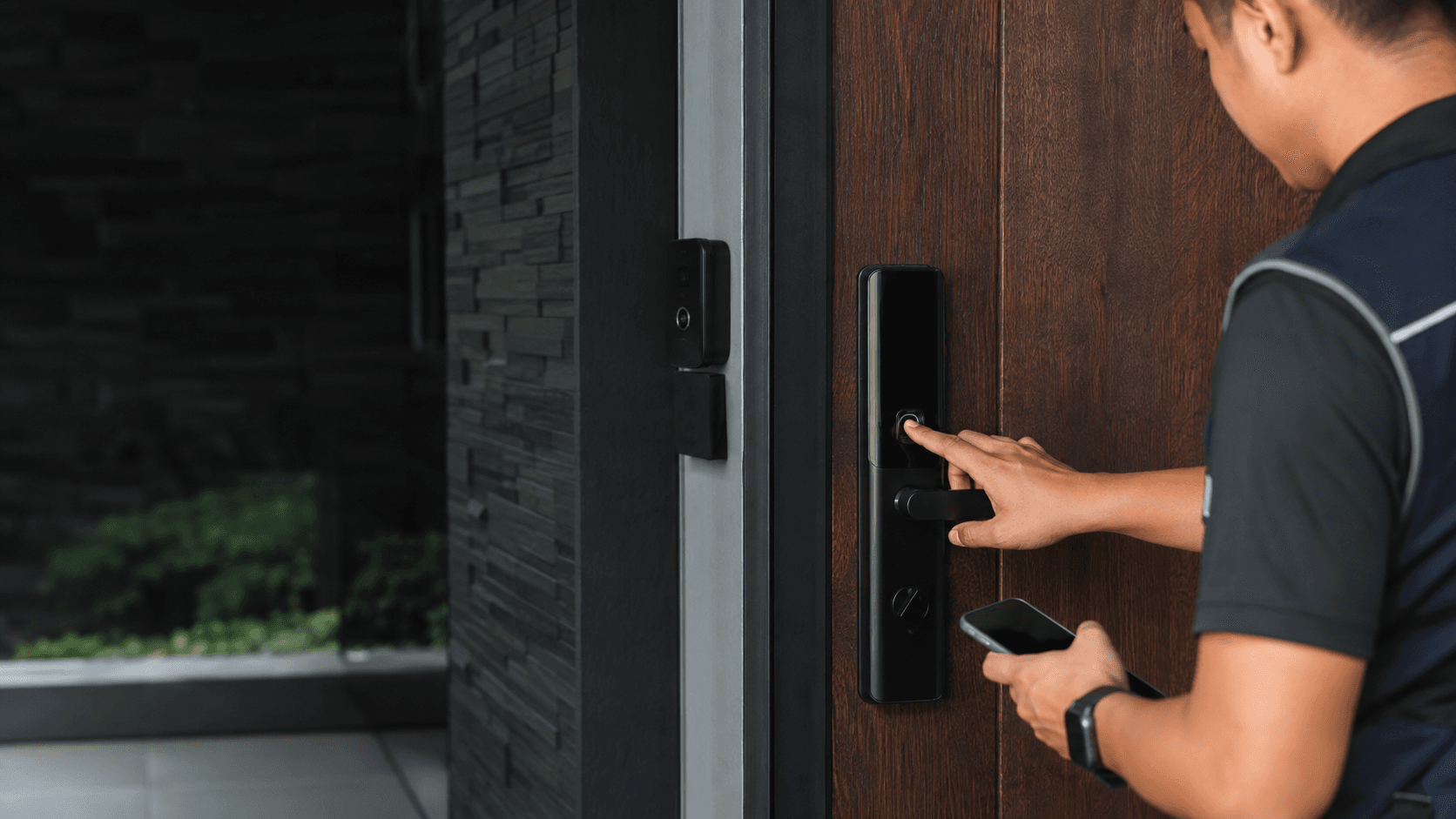
The exact-match query "airbnb door lock" describes a category of hardware, but the decision behind it is narrower. A host in Malaysia is usually asking three things at once: will the lock physically fit the door, who controls the codes, and what happens at 11pm when a guest is standing outside and the code will not work.
That third question is the one most buying guides skip. It is also the one that decides whether self check-in reduces workload or creates a phone call at midnight.
Airbnb Door Lock. What Hosts Should Check First
Before comparing brands, confirm the door itself can accept a lock and that someone owns the code list. Those two checks eliminate most unsuitable options faster than any feature comparison.
Eyonic's own review of smart lock door access states that smart locks work best when door condition, user roles and backup method are reviewed before installation, and that for business use the choice between a standalone smart lock and an access control panel should be settled first. That is the same sequence that applies to a short-term rental, because a rental door is a shared entry point with rotating users rather than a single household door.
Run these checks in order before committing to any lock:
- Inspect the existing door and frame for alignment, warping and latch depth, since a misaligned door stresses any motorised or motor-driven lock mechanism.
- Identify the current lock type and whether the door is a single-cylinder deadbolt, a lever set, or a mortise lock, because the replacement must match the cutout already in the door.
- Confirm who holds administrative rights over the lock, whether that is the host, a co-host, or a property manager.
- Decide the backup entry method before installation, not after the first lockout.
- Check whether the property is a landed home or a condominium unit, and whether the building imposes its own rules on door hardware.
- Confirm network coverage at the door if the lock depends on a connection for remote code changes.
Each item is a physical or administrative constraint rather than a preference. A lock that fails any of the first three checks is not a candidate, regardless of how it is marketed.
How guest access works on a short-term rental door
Guest access on a rental door works through a code that is created for a booking window, shared with the guest, and then expires or is deleted. The lock itself only stores and validates codes; the scheduling logic sits either in the lock's own app or in a platform that manages the listing.
Airbnb's own help documentation describes a connected smart lock feature in which eligible hosts connect one smart lock per listing so that unique codes are generated and shared with guests automatically. The same documentation lists compatible lock families and names the United States and Canada in its eligibility material. No supplied evidence confirms that this connection feature is available for listings in Malaysia, so a Malaysian host should treat platform-level code automation as unconfirmed and plan for manual or app-based code management instead.
That distinction matters for staffing. If codes are issued manually, someone must create a code before each arrival and remove it after checkout. If codes are issued through a lock app with scheduled access, the host sets the window once and the lock enforces it. Both approaches work; only one of them scales past a handful of bookings per month without a person watching the calendar.
What a guest actually experiences
A guest arrives, enters the code on a keypad or unlocks through a phone, and enters. The friction points are almost always the same: the code was sent to an old message thread, the guest typed it on the wrong keypad, or the door was already unlocked from a previous stay.
Clear arrival instructions solve more lockouts than a better lock does. A short message with the door location, the code, and the backup method covers the majority of arrival problems.
Door condition and lock type before any purchase
Door condition is the constraint that most often decides the outcome. A door that does not close cleanly, or a frame that has shifted, will cause repeated latch failures on any lock that depends on precise alignment.
Eyonic's review notes that smart locks work best when door condition is reviewed before installation. In practice that means checking three things at the door itself: whether the door swings and latches without lifting, whether the existing cutout matches a standard replacement, and whether the door is exposed to direct rain or sustained damp.
Lock type follows from the door. A single-cylinder deadbolt replacement is the simplest case because the exterior hardware is swapped and the interior thumb turn is replaced. A lever set or mortise lock involves more of the door and usually more labour. Where the door cannot take a retrofit without modification, the honest answer is that the door needs work first.
Standalone lock or access control panel
A standalone smart lock manages its own users and codes. An access control panel centralises users across multiple doors and is the more appropriate choice when a property has several entry points or when staff and contractors need access alongside guests.
For a single-unit rental, a standalone lock is usually sufficient. For a host running several units in one building, or a property with a main gate plus a unit door, centralised control avoids maintaining separate user lists that drift out of sync.
Guest codes, permissions, and backup entry
User permissions decide who can add, change, or delete a code. If every co-host and cleaner holds administrative rights, the code list becomes unmanageable and no one can say who has access.
A workable split gives one or two people administrative rights, gives cleaners and co-hosts time-limited codes, and gives guests codes that expire at checkout. The lock's own user roles determine whether that split is possible, which is why user roles belong in the pre-purchase check rather than the setup stage.
Backup entry is the second half of the same decision. Every lock needs a method that does not depend on the code working: a physical key held off-site, a second code held by a co-host, or a mechanical override. The backup method should be documented in the arrival guide and known to at least one person who can reach the property.
When a guest cannot get in
The failure modes are predictable. A dead battery, a code that was never activated, a guest who mistyped, or a lock that lost its connection and did not receive a scheduled code.
Each has a different fix, and the fix has to be reachable without the guest. A host who can issue a new code remotely resolves the problem in minutes. A host who cannot has to travel to the property. That gap is the real cost of choosing a lock without checking how remote management works.
Installation and handover in Sarawak properties
Eyonic's installation process runs through site survey, system proposal, installation and handover, and the same sequence applies to door access work. The site survey is where door condition, lock type and network coverage are confirmed on the actual door rather than assumed from a photograph.
Sarawak properties add a few practical considerations. Landed homes in Kuching and the surrounding areas often have external doors exposed to heavy rain, which affects how long exterior hardware lasts. Condominium units may have building rules about door hardware, and the management office is the place to confirm that before ordering anything. Neither point is a reason to avoid a lock; both are reasons to check first.
Eyonic's completed work in Sarawak includes the Kuching Immigration Office project, which focused on arrival flow, staff areas, visitor movement and dependable daily operation, and the KTA Sarawak Sdn Bhd project, which supported staff movement, visitor handling and clearer daily site control. Both are access and movement problems rather than lock problems, and both were resolved by matching the hardware to how people actually move through the building.
The handover stage is where the host learns the code structure, the backup method and the escalation path. A handover that ends with a working code but no documented backup method has not finished.
What to confirm before committing to a lock
Confirm the door, the code owner and the backup method before choosing a model. Those three answers determine which locks are viable, and they are all available before any purchase.
Where the property needs more than door access, Eyonic supplies and installs CCTV, alarm and autogate systems in Sarawak, with packages at RM 1,599 for the Hikvision CCTV package, RM 1,599 for the Hikvision alarm system, and RM 1,599 for the autogate package. Door access is often planned alongside those systems rather than in isolation, particularly where a gate and a unit door both need controlled entry.
Share the location, property type and required system with Eyonic on WhatsApp at +60 11-5111 7959 for the next practical step.