
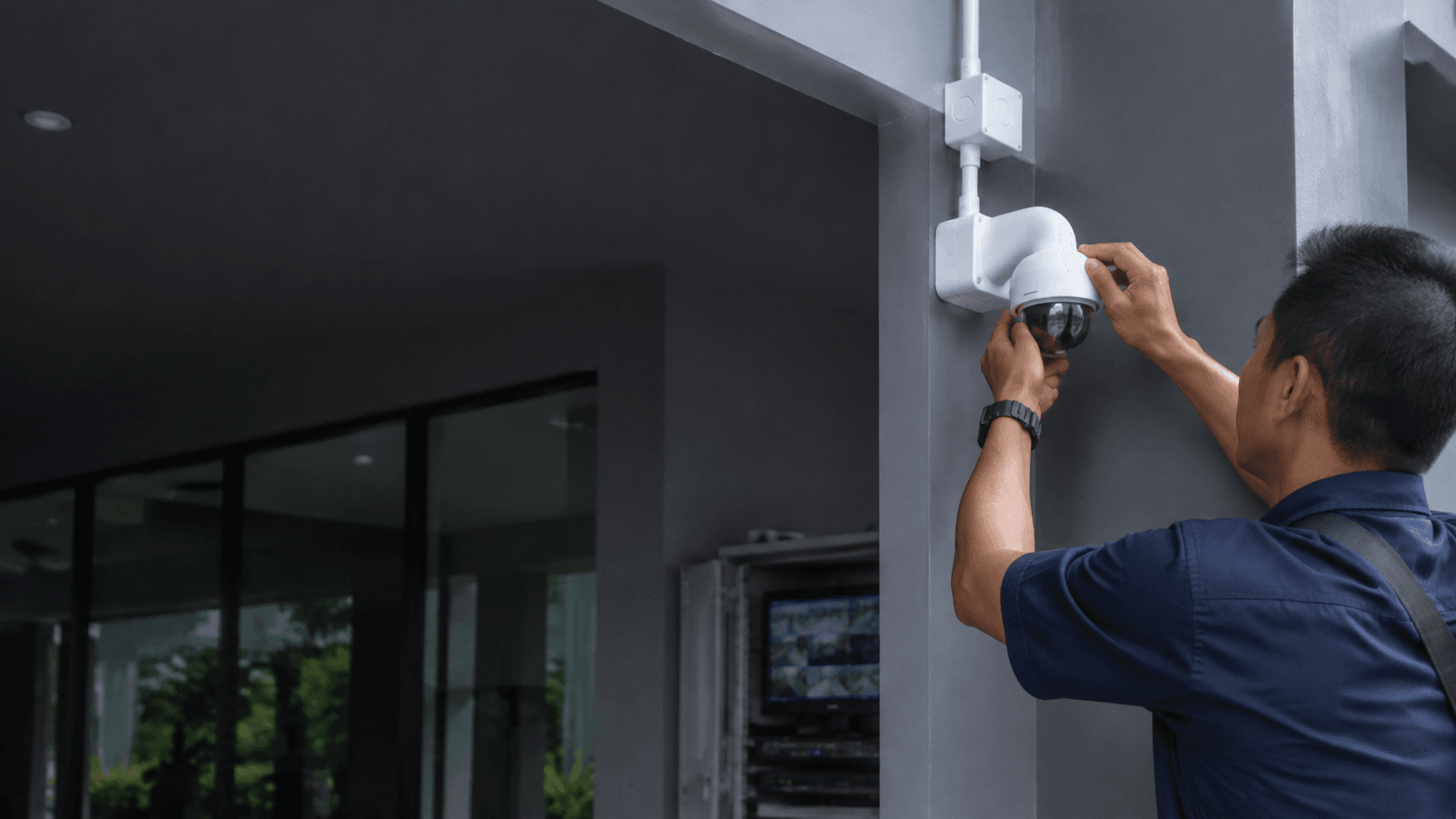
Cameras capture light. The recorder decides whether that capture becomes evidence, a live view, or nothing at all. In a working system the recorder receives video from each camera, writes it to a hard drive, and serves the same footage to a phone or monitor on demand. Eyonic plans, supplies and installs monitoring systems with camera placement, recording and remote viewing for homes, offices, shops and industrial sites.
Most buyers in Malaysia meet the recorder only after something goes wrong: a break-in with no usable clip, a hard drive that filled up months ago, or a phone app that stopped connecting. Understanding the recorder before that point is what separates a system that records from a system that merely watches.
What a cctv camera recorder does in a working system
The recorder sits between the cameras and everything else. It powers or receives camera feeds, encodes them, timestamps them, and writes them to storage. It also handles playback, search, export, and the network connection that lets a phone or office monitor pull a live or recorded view.
Three jobs matter most in daily use. First, continuous capture: the recorder must keep writing even when nobody is watching. Second, retrieval: when an incident happens, someone needs to find the right minute quickly rather than scrub through days of footage. Third, remote viewing: the same footage should be reachable from outside the premises without a technician on site.
A recorder that fails any one of those three jobs is a weak point in an otherwise sound camera layout. Camera placement can be excellent and still produce nothing useful if the recorder is undersized, misconfigured, or disconnected from the network.
Recorder types and how they match camera types
Recorders are usually grouped by the kind of camera signal they accept. The two common families are digital video recorders, which work with analog and HD-over-coax cameras, and network video recorders, which work with IP cameras over network cable. A hybrid unit accepts both.
The practical question is not which type is better in the abstract. It is which type matches the cameras already on the wall or the cameras being planned. Replacing a recorder while keeping existing coax cameras points toward a DVR. Building a new IP-based system points toward an NVR. Mixing old and new cameras on one site often points toward a hybrid.
Eyonic's service scope includes NVR setup alongside camera placement, which places the recorder decision inside the same planning conversation as the camera decision rather than after it.
Why the camera and recorder must be chosen together
A recorder and a camera that were not designed for each other can still connect and still fail in use. Resolution, compression format, and detection features may not carry across. The result is footage that looks fine in a live view but degrades, drops frames, or loses smart features once recorded.
This is why a compatibility check belongs before purchase, not after installation. Where a specific camera model is already installed, the recorder choice should follow that model's requirements.
Storage, channels and recording duration
Two numbers shape most recorder decisions: how many cameras the unit accepts, and how much footage the storage holds. Channel count is the ceiling on cameras. Storage is the ceiling on history.
Recording duration is not a fixed figure. It depends on how many cameras run, what resolution they record at, how the recorder compresses the video, whether recording is continuous or motion-triggered, and how large the drive is. A site with fewer cameras, lower resolution, and motion-only recording keeps footage far longer on the same drive than a site recording continuously at high resolution.
That relationship is the reason retention should be stated as a goal before hardware is chosen. A business that needs a month of history and a business that needs a week are buying different storage, even with identical cameras.
What to check before committing to a storage plan
Confirm the number of cameras the site will actually run, not the number planned for day one. Confirm whether recording will be continuous or event-based. Confirm who will review footage and how often. Then size storage against those answers rather than against a generic recommendation.
Retention also has an operational edge case: a drive that fills silently stops being useful. Recording configuration and storage health deserve a place in handover, not just installation.
Site survey, installation and handover
Eyonic's CCTV installation process runs through four stages, and the recorder is settled inside them rather than bolted on at the end.
- Site survey — the property is reviewed before any equipment is proposed.
- System proposal — the recommended system is put forward based on what the survey found.
- Installation — cameras, recorder and cabling are installed and configured.
- Handover — the system is passed to the user with recording and viewing set up.
The survey stage carries more weight than it appears to. Camera placement depends on what the site actually looks like at different times of day, not on a floor plan. Eyonic recommends checking actual lighting conditions before confirming placement for ColorVu-style cameras, because a position that performs well in daylight can behave differently once lighting changes.
Handover is where recording configuration and mobile viewing are confirmed with the user. A system that records correctly but cannot be reviewed by the people who need it has not finished the job.
Kuching Immigration Office. dependable daily operation
Eyonic completed a project for the Kuching Immigration Office, focused on arrival flow, staff areas, visitor movement and dependable daily operation. The emphasis on dependable daily operation is the same standard a recorder has to meet: it must keep working on ordinary days, not only when someone is testing it.
Public-facing sites add a constraint that homes and small shops do not carry. Movement is constant, areas serve different functions, and the system has to support daily operations rather than sit idle until an incident. That shapes both camera placement and how recording is configured.
Eyonic also completed work for KTA Sarawak Sdn Bhd, a practical office setup in Kuching supporting staff movement, visitor handling, tidy cabling and clearer daily site control. Both projects point to the same pattern: the recorder is one part of a layout decision, not a standalone purchase.
Choosing a in Malaysia
Buyers in Malaysia face a market split between standalone recorder listings and installed systems. Standalone listings suit someone replacing a failed unit with a known compatible model. Installed systems suit anyone who needs the recorder, cameras, cabling and configuration handled as one job.
Eyonic's Hikvision CCTV Package is priced at RM 1,599 and covers camera supply and setup, basic recording configuration, and mobile viewing handover. That package structure reflects where the recorder sits in the work: recording configuration and viewing handover are treated as deliverables, not afterthoughts.
For sites with more complex requirements, project budgets have ranged from RM 8,000 to RM 18,000 for an office setup and RM 12,000 to RM 28,000 for a public office. Those figures describe completed project scope rather than recorder pricing, and no standalone recorder price is evidenced here.
Questions that come up before purchase
Can an existing recorder be reused? Sometimes. It depends on whether the existing cameras match the recorder's signal type and whether the unit still supports the required retention and remote viewing. A survey answers this faster than a specification comparison.
Does recording need internet? Recording itself is local. Remote viewing is what depends on a network connection. A site can keep recording through an internet outage and lose only the ability to view from outside.
Who should install it? Recorder configuration, camera placement and network setup interact. Splitting them across separate parties tends to leave gaps at handover, which is where recording and viewing settings are confirmed.
Eyonic Sdn Bhd is a security system supplier in Sarawak, Malaysia, specialising in CCTV and ELV systems, with planning, supply and installation for homes, offices, shops and industrial sites. Founder Eric Yong has been in the industry for more than 10 years, working on technical installation of digital security solutions for commercial businesses in Sarawak.
Share your location, property type and required system with Eyonic on WhatsApp at +60 11-5111 7959 for the next practical step.