
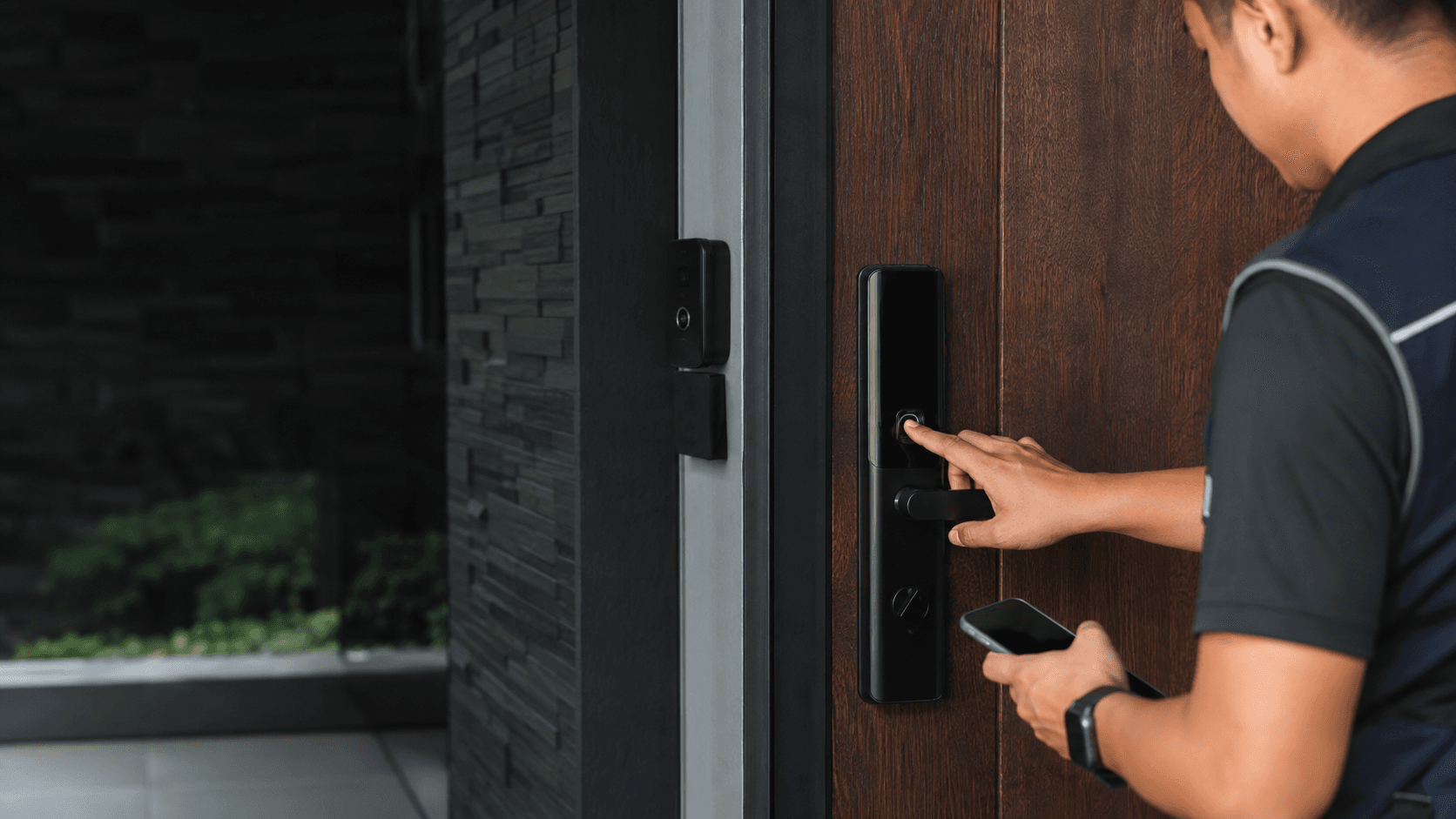
Most buyers start with the lock and treat the handle as an afterthought. That order causes problems, because the handle and the lock share the same door edge and the same mounting points. A set that looks correct in a product photo can still fail on a solid timber door with an existing bore, or on a metal frame where the lever handing runs the wrong way.
Eyonic Sdn Bhd, a security system supplier in Sarawak, notes that smart locks work best when the door condition, user roles and backup method are reviewed before installation, and that for business use the choice between a standalone smart lock and an access-control panel is usually checked first. That sequence applies to homes as well.
Front Door Smart Lock With Handle: What Matters Before You Choose
A combined set pairs an electronic locking device with a matching lever or handle on the same door. The two parts are sold together because they share a finish and a mounting footprint, not because they share electronics.
The electronic side is usually one of two arrangements. A deadbolt-style smart lock replaces the existing deadbolt and keeps the handle as a separate, purely mechanical lever. A lockset-style smart lock replaces the whole lockset, so the keypad or reader sits on the handle assembly itself. The first arrangement leaves the original handle in place; the second replaces it.
This distinction matters more than finish or brand. A deadbolt replacement is a smaller intervention on a door that already has a separate deadbolt and handle. A full lockset replacement touches the latch, the spindle and the through-bore, so the door preparation has to suit the new assembly.
Eyonic's product review page describes smart lock door access as good for controlled convenience when user permissions and backup entry are planned properly. Those two items, not the hardware finish, are what determine whether a set works in daily use.
Door preparation and fit checks before ordering
Door preparation is the set of holes, cutouts and edge mortises already present in the door and frame. A replacement lock either matches that preparation or requires new cutting. Matching is faster and reversible; new cutting is neither.
Work through these checks in order, because each one can rule out a set before the next check matters.
- Confirm door thickness and the existing bore holes, including the cross-bore through the face and the edge bore for the latch.
- Confirm the handing of the handle and lever, meaning which side the door hinges on and which way the lever must turn.
- Confirm whether the lock body is a standalone unit or part of an access-control panel, since a panel changes what the lock must connect to.
- Confirm the backup entry method, such as a mechanical key override or a second entry point, and where that key or route is kept.
- Confirm who administers user permissions, including who adds and removes codes or credentials and who holds the master access.
Handing is the check most often skipped. A lever that points the wrong way on a closed door is not a cosmetic issue; it can foul the frame or sit awkwardly for the hand that uses it most. On a pair of doors or a door with a narrow stile, the available space for a keypad or reader also narrows.
Where a door is metal or has a narrow frame, the internal cavity may not accept a larger lock body. Where a door is glass, the preparation is entirely different again. These are the cases where a site survey replaces guesswork, because the measurements that decide the outcome are the ones taken at the door.
Access roles, permissions and backup entry
User permissions decide who can open the door, when, and how that access is withdrawn. A household might need a handful of recurring codes plus a temporary one for a cleaner or a contractor. A shop or office needs the same logic applied to staff who join and leave.
The practical question is not how many users a lock supports but who holds administrative control. If one person's phone is the only device that can add or delete credentials, that person becomes a single point of failure for the whole door. Spreading administrative access across at least two trusted people avoids a lockout that has nothing to do with the hardware.
Backup entry is the second half of the same problem. Electronics fail, batteries drain, and phones are lost. A mechanical key override, a second door, or a stored physical key gives a route in that does not depend on the lock working. Eyonic's guidance places backup method alongside door condition and user roles as a pre-installation review item, which reflects how often this is decided too late.
For a rented property, the backup arrangement also affects what can be changed and what must be restored. Where a tenancy agreement or building rule constrains alterations to the entry door, that constraint belongs in the decision before a set is ordered, not after.
Installation and handover in Sarawak and Malaysia
Eyonic's installation process runs through site survey, system proposal, installation and handover. The same four stages apply to entry-door locking work, and the handover stage is where a lock stops being a product and becomes a working door.
Handover for a smart lock covers more than confirming that the door opens. It covers setting up the first administrator, adding the household or staff credentials, testing the backup entry route, and showing how a code or credential is removed when someone no longer needs access. A lock handed over without that step tends to accumulate old credentials that nobody remembers to delete.
Local context shapes the work in ways a foreign retail listing cannot address. Door construction, frame material and the age of the existing preparation vary between properties, and the fit checks above are the ones that decide whether a set is a direct replacement or a modification. Eyonic's completed work in Sarawak includes the Kuching Immigration Office project, which focused on arrival flow, staff areas, visitor movement and dependable daily operation, and the KTA Sarawak Sdn Bhd project, which supported staff movement, visitor handling and clearer daily site control. Both are examples of entry and movement planning rather than lock retail.
Eyonic's published packages cover a Hikvision CCTV package, a Hikvision alarm system and an autogate package, each at RM 1,599. Those are separate systems and do not represent smart lock and handle pricing, so they should not be read as a budget for this work.
Questions to settle before confirming a set
Four answers decide whether a front door smart lock with handle set is the right purchase. The first is whether the existing preparation matches the new lock body or needs cutting. The second is whether the handle handing and finish suit the door and the way it is used. The third is who holds administrative access and who holds the backup key. The fourth is who installs it and what the handover includes.
If the door preparation is a match and the access roles are clear, a combined set is a straightforward replacement. If the door needs new cutting, if the frame is metal or glass, or if the entry is shared and needs an access-control panel rather than a standalone lock, the decision changes before any product is chosen. Eyonic's review guidance draws that line between standalone smart locks and access-control panels for business use, and the same line applies wherever more than one person needs managed access.
Share the location, property type and required system with Eyonic on WhatsApp at +60 11-5111 7959 for the next practical step.