
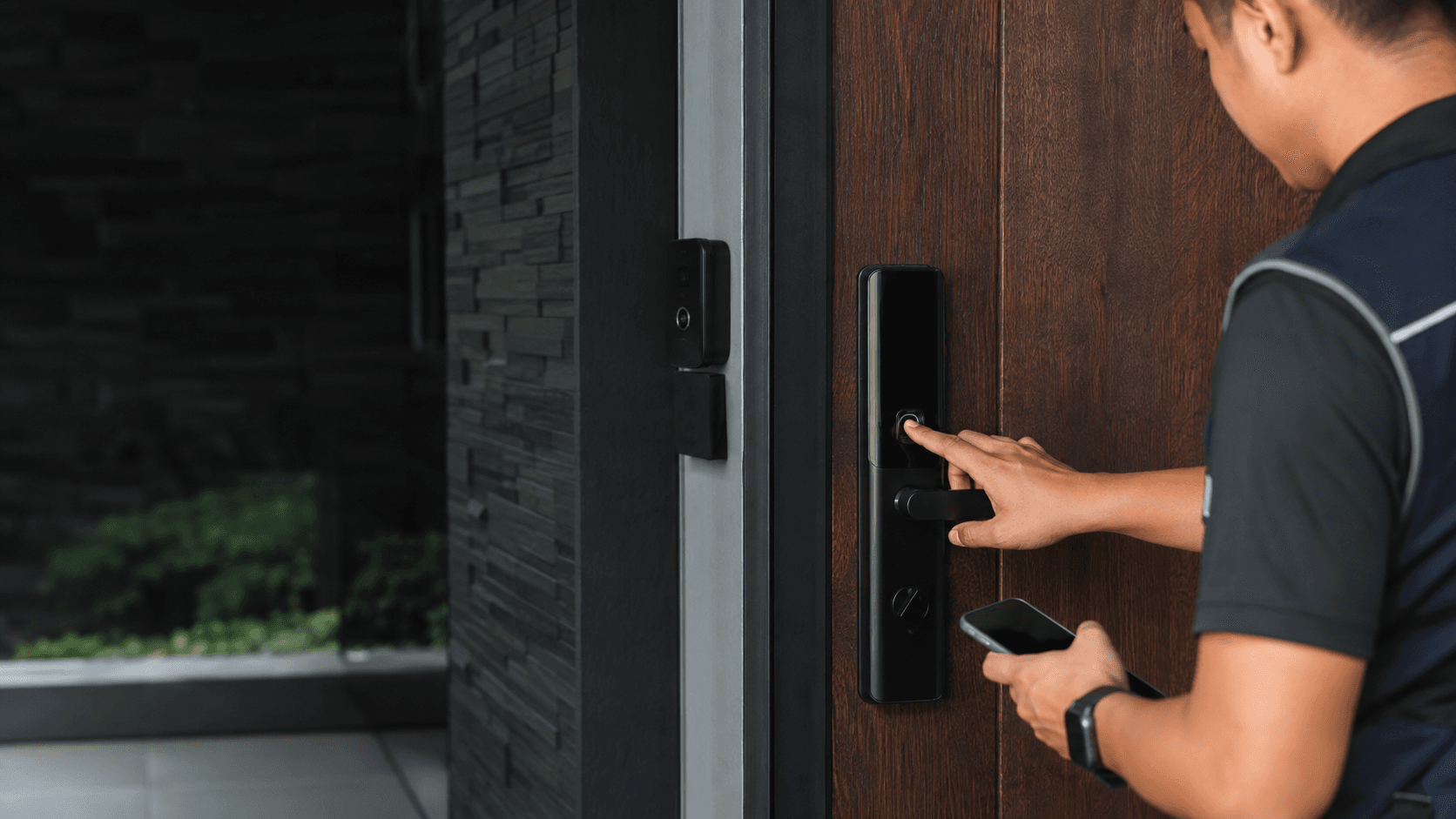
The category covers more than a single product. It spans the lock hardware on the door, the credential used to open it, the logic that decides when it locks again, and the fallback that still works when the primary method does not. In Malaysia, that last point matters because household entry habits, rented premises and multi-generation homes all shape which configuration is realistic.
Eyonic Sdn Bhd is a security system supplier in Sarawak that plans, supplies and installs CCTV and ELV systems for homes, offices, shops and industrial sites. Its published guidance on smart lock door access notes that smart locks work best when the door condition, user roles and backup method are reviewed before installation. That review-first position is the practical frame for everything below.
Automatic Door Lock System For Home: What The Category Covers
The phrase describes a lock that secures itself without a person turning a key or throwing a bolt by hand. Three parts do the work. the locking hardware, the entry credential, and the control logic that ties them together.
Locking hardware is either a full replacement unit that takes over the existing deadbolt position, or a retrofit unit that sits over the existing cylinder and turns it. The distinction decides how much of the door is disturbed during fitting and whether the original key still functions.
Entry credentials are the ways a person proves they are allowed in. Common options include a keypad code, a fingerprint, a phone app, a key fob, or a physical key retained as a fallback. A household does not need all of them; it needs the one that matches how people actually arrive.
Control logic is what makes the lock automatic rather than merely electronic. It decides the trigger for locking, which might be a timer after the door closes, a manual command, or a scheduled time of day. This is the part most likely to surprise a new owner, because the lock behaves according to a rule rather than according to memory.
Auto-lock and keyless entry are the two features buyers ask about first, and they behave differently enough in daily use to deserve separate treatment.
How Auto-Lock And Keyless Entry Behave Day To Day
Auto-lock removes the act of locking from the household's routine. The door closes, and after a set interval the bolt extends on its own. The benefit is consistency. a door that is regularly left unlocked because someone was carrying groceries or a child becomes a door that is reliably secured.
The trade-off is that auto-lock can lock a door that someone intended to leave open. A household that props the main door during daytime ventilation, or that moves between a house and a garden frequently, may find a short auto-lock delay inconvenient. A longer delay or a manual-lock mode suits that pattern better.
Keyless entry changes who can enter and how that permission is granted. A code can be issued to a family member, a domestic helper, a contractor or a short-stay guest, and withdrawn later without changing the physical key. That is the practical advantage over a keyed lock, where every copy is a permanent grant of access.
Keyless entry also introduces a dependency. A code can be forgotten, a phone can run out of battery, and a fingerprint reader can fail to read a worn or wet finger. The lock still needs a route in that does not rely on the credential that just failed.
Both features interact with the door itself. A door that does not close squarely, or a frame that has shifted, affects whether the bolt extends cleanly. This is why the physical door is reviewed before a model is chosen rather than after.
What To Compare Before Choosing An Automatic Door Lock System For Home
Comparison should start with the door, not the feature list. A lock that fits the door and the household's habits will outperform a more capable lock that fights either one.
Door condition comes first. The existing deadbolt position, the thickness of the door, the material, and whether the door closes and latches without pressure all determine which units can be fitted and which cannot. A door that already needs adjustment is a poor candidate for a lock that depends on precise alignment.
User roles come second. A household of two adults with a single main entrance has a simple permission structure. A home with domestic helpers, elderly parents, school-age children, regular contractors and occasional guests has a more complex one, and the value of keyless entry rises accordingly because permissions can be granted and revoked individually.
Backup entry comes third, and it is the question that separates a workable installation from a frustrating one. Every household should be able to answer, without hesitation, how the door opens when the battery is flat, when the network is down, or when the person holding the credential is unavailable.
Connectivity and app dependence come fourth. A lock that depends on a home network for remote features behaves differently from one that operates locally and treats the app as an add-on. Households with unstable broadband, or with members who do not use smartphones comfortably, should weigh that difference carefully.
For premises with staff, visitors or shared entrances, the choice between a standalone smart lock and an access control panel is a real one. Eyonic's published guidance notes that for business use it usually checks whether a standalone smart lock or an access-control panel is more appropriate. The same logic applies to a home with heavy traffic through one door.
Door Condition, User Roles And Backup Entry
These three factors decide most of the outcome, so each deserves a direct answer.
Door condition determines feasibility. A solid door with a sound frame and an existing deadbolt bore is the straightforward case. A hollow-core door, a door with a non-standard bore, a metal gate, or a frame that has swollen with humidity may need adjustment or a different approach before any lock is fitted.
User roles determine configuration. The number of people who need routine access, whether any of them need time-limited access, and whether access needs to be withdrawn at short notice all point toward different credential types. A single-code household and a multi-role household are not shopping for the same thing.
Backup entry determines resilience. A physical key retained alongside the electronic credential is the simplest fallback. A second independent entry route, such as a rear door, is another. What matters is that the fallback does not depend on the same failure point as the primary method.
Eyonic's smart lock door access guidance describes the category as good for controlled convenience when user permissions and backup entry are planned properly. That phrasing is deliberate. the convenience is real, and it is conditional on the planning.
Installation And Handover In Sarawak And Malaysia
Installation quality decides whether an automatic door lock system for home performs as intended over time. A lock fitted to a misaligned door will report errors, drain batteries faster and generate callbacks regardless of how good the hardware is.
Eyonic's installation process follows a defined sequence. The same sequence applies across its security work in Sarawak, including the Kuching Immigration Office project, which focused on arrival flow, staff areas, visitor movement and dependable daily operation.
- Site survey to assess the door, frame, existing hardware and how the entrance is actually used.
- System proposal covering the recommended lock type, credential options and backup entry method.
- Installation and configuration of the lock, credentials and any connected access control.
- Handover with user testing so the household can operate the lock and the backup route with confidence.
Handover is not a formality. It is the point where codes are set, permissions are assigned, and the backup method is demonstrated rather than described. A household that leaves handover without having opened the door using the fallback has not really completed the installation.
Local conditions shape the work. Humidity, frequent power interruptions and mixed-generation households all affect how a lock is configured and which fallback is chosen. A configuration that suits a single-occupant apartment in a temperate climate may not suit a family home in Sarawak.
Eyonic's wider project record includes work for the KTA Sarawak Sdn Bhd engineering consultancy sites, where the requirement was a practical office setup in Kuching supporting staff movement, visitor handling, tidy cabling and clearer daily site control. The pattern across both projects is the same: the entrance is treated as part of a flow, not as an isolated device.
Practical Next Step With Eyonic
The useful starting point is a description of the door and the household, not a product name. Door type, how many people need routine access, whether access ever needs to be time-limited, and how the door should open when the electronic method fails are the four details that shape a recommendation.
Eyonic plans, supplies and installs security systems across Sarawak for homes, offices, shops and industrial sites, and its published packages for CCTV, alarm and autogate are each listed at RM 1,599. Automatic door lock supply and installation is quoted separately because the scope depends on the door and the access structure.
Share your location, property type and required system with Eyonic on WhatsApp at +60 11-5111 7959 for the next practical step.