
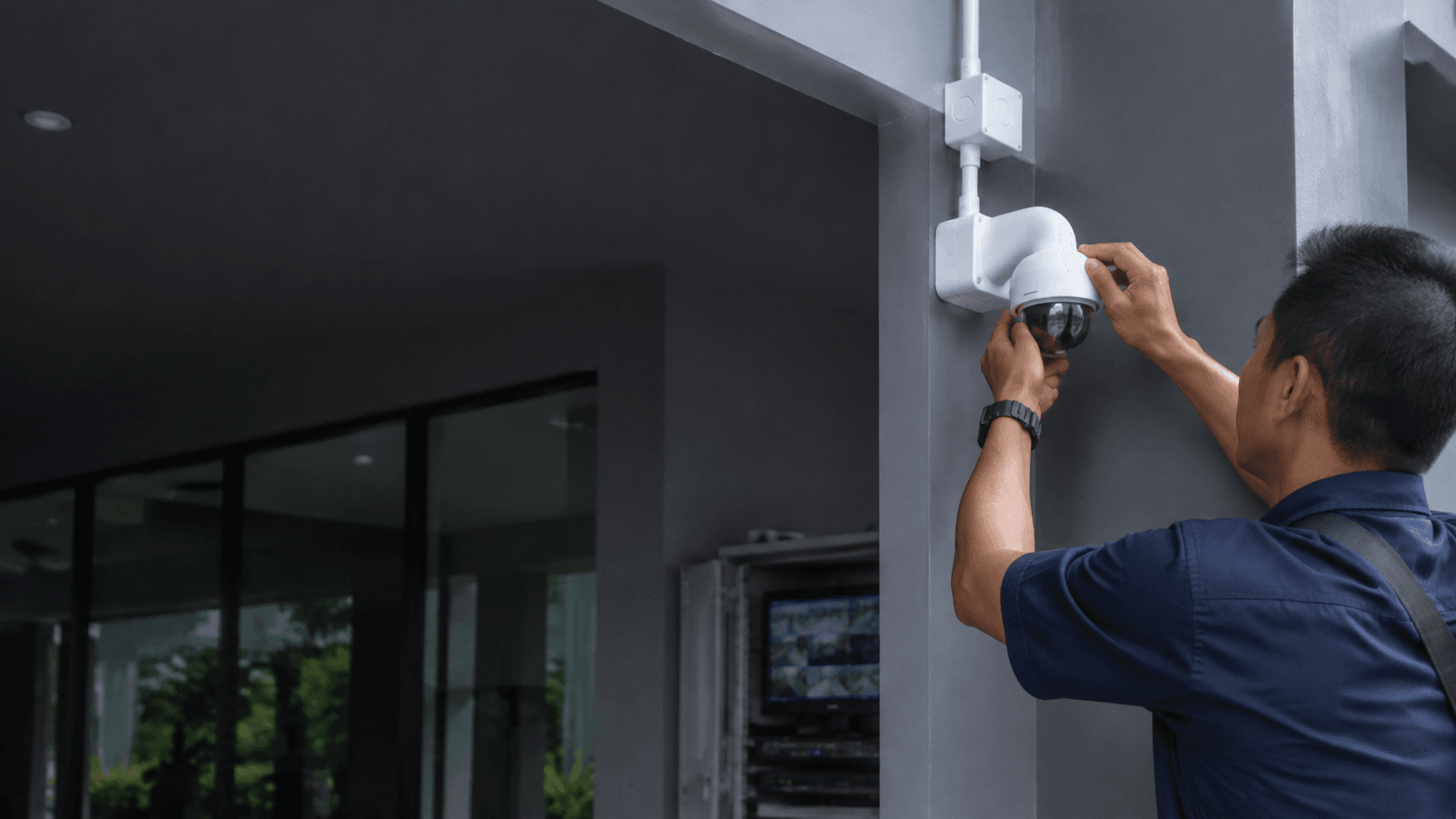
The exact-match query home surveillance system describes a complete setup rather than a single camera. In a Malaysian house, that setup has to survive monsoon rain, harsh afternoon sun, and the practical reality that most owners want to check a phone from outside the property. Eyonic Sdn Bhd, a security system supplier based in Sarawak, plans, supplies, and installs these systems for homes, offices, shops, and industrial sites.
Most buyers arrive with the same three questions: what is included, where the cameras go, and what it costs. The sections below answer those in order, using Eyonic's published service scope, its Kuching Immigration Office project, and its stated package pricing.
Home Surveillance System. What Malaysian Homes Need
A Malaysian house presents conditions that a generic product page rarely addresses. Rain arrives in heavy, wind-driven bursts. Afternoon sun hits west-facing walls hard enough to wash out a camera image. Gates, car porches, and side alleys create long, narrow sightlines that a single wide-angle camera cannot cover well.
That is why the useful starting point is not a camera model but a coverage decision. A home surveillance system should answer four questions before any hardware is chosen:
- Which entry points need continuous recording, and which only need motion-triggered clips?
- Where does the recorder sit, and is there a power point and network path to that location?
- How will footage be viewed remotely, and on how many devices?
- What happens to recordings if the internet connection drops?
Eyonic's stated service scope covers exactly these elements: camera placement, recording, and remote viewing, planned and installed for homes as well as commercial premises. The company also lists site survey and NVR setup as part of its service set, which means the coverage decision is made on site rather than from a catalogue.
For a house, the practical split usually falls into three zones. The perimeter covers gates, fences, and side passages. The entry zone covers the front door and car porch. The interior zone, if included at all, is usually limited to a hallway or a room holding valuables. Each zone has different lighting and different mounting constraints, and treating them as one uniform job is where coverage gaps appear.
What a Home Surveillance System Covers in a Malaysian House
A complete home surveillance system has four working parts, and each one can fail independently.
Cameras capture the image. Their usefulness depends on where they point, what light they face, and whether the lens angle matches the distance being watched. A camera aimed down a long driveway needs a different lens angle from one covering a porch step.
The recorder stores footage. Eyonic lists NVR setup as a service, which places recording configuration inside the installation scope rather than leaving it to the buyer. Recording settings determine how far back footage can be reviewed, and that retention window is a decision made at setup, not a fixed property of the hardware.
Cabling and power carry the signal and keep the system running. Tidy cabling matters for more than appearance. Exposed runs degrade faster in humid conditions and are easier to tamper with. Eyonic's KTA Sarawak Sdn Bhd project notes tidy cabling as part of the delivered scope for an engineering consultancy office in Kuching, which shows the company treats cable routing as a deliverable rather than an afterthought.
Remote viewing is the part most homeowners actually use day to day. Eyonic's Hikvision CCTV package includes mobile viewing handover, meaning the setup ends with the owner able to open the feed on a phone rather than with a manual and an unconfigured app.
Two named projects show how this scope adapts. The Kuching Immigration Office project focused on arrival flow, staff areas, visitor movement, and dependable daily operation, with an approximate budget of RM 12,000 to RM 28,000 for that type of work. The KTA Sarawak Sdn Bhd project supported staff movement, visitor handling, tidy cabling, and clearer daily site control, with an approximate budget of RM 8,000 to RM 18,000. Both are commercial sites, but the underlying logic, coverage by function rather than by camera count, transfers directly to a house.
Camera Placement and Lighting Checks Before Installation
Placement decides whether a home surveillance system produces usable footage or a collection of unreadable clips. Two checks matter more than any specification sheet.
The first is the lighting check. Eyonic recommends checking actual lighting conditions before confirming placement for ColorVu-style cameras. ColorVu cameras are designed to produce colour images in low light, but the result depends on what light is genuinely present at that spot after dark. A position that looks bright during a daytime survey can be almost black at 2am. Confirming the real night-time light level before drilling and mounting prevents a camera from being installed where it cannot perform as expected.
The second is the sightline check. A camera should see the approach to a point, not just the point itself. A camera mounted directly above a gate records the top of a head. A camera positioned back and angled along the approach records a face and a vehicle. This is why placement is a survey decision rather than a mounting-height rule.
Three placement constraints recur in Malaysian homes:
- Direct sun. A lens facing the afternoon sun produces glare and flare that can obscure the frame for hours each day.
- Rain exposure. Mounting under an eave or a porch soffit reduces direct water contact compared with an exposed wall position.
- Cable reach. The distance from each camera position back to the recorder determines whether the run is practical without additional equipment.
None of these can be settled from a floor plan alone. They are settled on site, which is why Eyonic's process begins with a site survey rather than a product selection.
What a Home Surveillance System Costs in Malaysia
Eyonic publishes a Hikvision CCTV package at RM 1,599. That package covers camera supply and setup, basic recording configuration, and mobile viewing handover. It is the entry point for a home surveillance system, not a ceiling.
Larger scopes cost more. Eyonic's completed projects show approximate budgets of RM 8,000 to RM 18,000 for an engineering consultancy office setup in Kuching and RM 12,000 to RM 28,000 for the Kuching Immigration Office work. Those figures describe commercial sites with wider coverage and more complex routing, so they should be read as an indication of how cost scales with scope rather than as a residential price.
What drives the number upward from the package price:
- Camera count. More positions mean more hardware and more cable runs.
- Cable distance. Long runs to a detached gate or a rear boundary add labour and materials.
- Recorder location. A recorder placed in a room without an existing power and network path requires additional work.
- Integration with other systems. Eyonic also supplies alarm systems, autogate packages, keyphone intercoms, and Starlink internet installation, each published at RM 1,599 as a package. A home combining several of these is a larger project than a standalone camera setup.
Two cost questions are worth settling before confirming anything. First, whether the quoted scope includes the recorder and its storage or only the cameras. Second, whether remote viewing setup is included in the handover. Eyonic's published package language includes both recording configuration and mobile viewing handover, which makes those items part of the delivered scope rather than optional extras.
How Eyonic Plans and Installs a Home Surveillance System
Eyonic's CCTV installation process follows four stages, published on its Sarawak installation services page.
- Site survey. The property is assessed for camera positions, lighting conditions, cable routes, and recorder placement before any proposal is written.
- System proposal. The survey findings become a defined scope covering camera placement, recording, and remote viewing.
- Installation. Cameras, cabling, and the recorder are installed and configured according to the agreed scope.
- Handover. The system is tested and the owner is shown how to view footage remotely.
The sequence matters because it puts the survey before the proposal. A proposal written without a site visit cannot account for the lighting and sightline conditions described earlier, and those conditions are what determine whether the finished system works at night.
Eric Yong founded Eyonic Security Systems and has worked in the industry for more than ten years, with experience in technical installation of digital security solutions for commercial businesses in Sarawak. That background shows in the company's project record, which includes government and engineering consultancy clients alongside residential work.
For a homeowner, the practical value of this sequence is that the scope is agreed before installation begins. Changes to camera positions after cabling is run are more disruptive than changes made at the proposal stage.
Coverage Questions to Settle Before You Confirm a Home Surveillance System
These questions close the gap between a quoted package and a system that actually covers the property.
- Which specific points must be recorded continuously, and which can rely on motion detection?
- Has the night-time lighting at each proposed camera position been checked on site?
- Where will the recorder sit, and does that location have power and a network path?
- How many days of footage need to be retained, and does the proposed storage support that?
- How many phones or devices need remote viewing access, and who will be given that access?
- What happens to recording if the internet connection drops?
- Does the scope include cabling, recorder configuration, and remote viewing handover, or only camera supply?
- What is the process for adding a camera later if coverage needs change?
The answers to these questions define the difference between a package price and a working system. A home surveillance system that records the wrong angle, or that cannot be reviewed remotely, has not delivered what the buyer intended, regardless of the hardware inside it.
Eyonic's published package structure answers several of these by default. The Hikvision CCTV package includes camera supply and setup, basic recording configuration, and mobile viewing handover, which covers items one, four, five, and seven at the entry level. The remaining questions depend on the individual property and are settled during the site survey.
For buyers in Sarawak and across Malaysia, the most useful next step is to share the property location, the property type, and the required system with Eyonic on WhatsApp at +60 11-5111 7959. That information is what allows a survey to be scheduled and a scope to be proposed against the actual conditions of the house rather than a generic package description.