
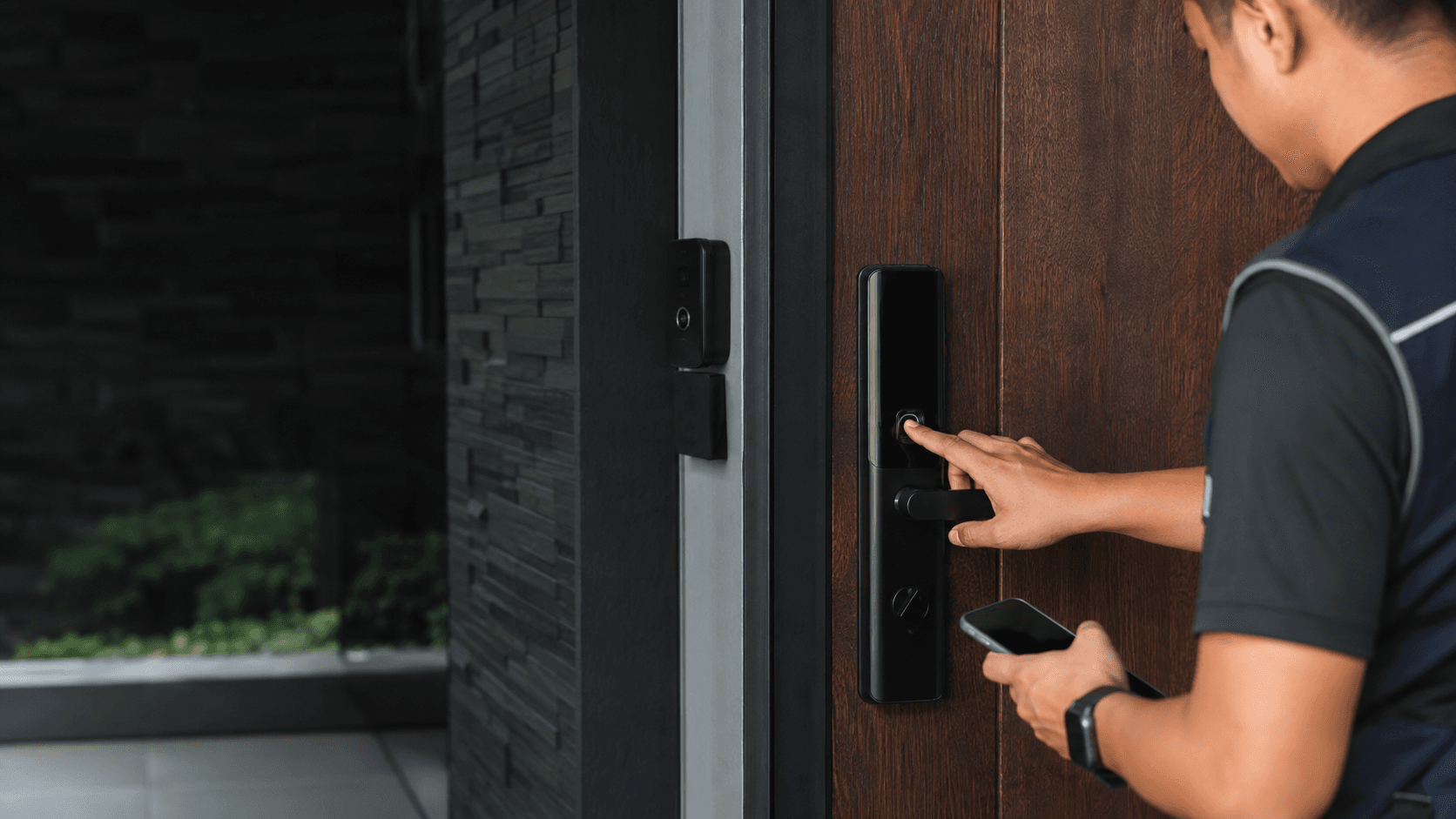
The retailer groups these locks under smart home security and door hardware, and the listings mix mechanical push-button levers with app-connected deadbolts. That range matters for buyers in Malaysia because the label describes a shelf category, not one specification. A lock bought under that label still has to match the door, the user roles, and the backup entry method at the property where it will be fitted.
Home Depot Keyless Entry Locks. What the Category Actually Covers
The category is a filter, not a product line. Home Depot sorts electronic door locks by hardware included, connectivity, features, and security grade, so the same page can hold a battery-free combination lever and a Wi-Fi deadbolt with fingerprint access.
Two patterns stand out in the listings. First, most items are deadbolts or deadbolt-and-handleset combinations rather than standalone levers. Second, connectivity splits the range into Bluetooth-only models, Wi-Fi models, and models that need a separate hub or bridge.
Because the category mixes mechanical and electronic locks, the practical question is not which lock is best but which lock type matches the door and the people using it.
Keypad, Deadbolt, and Smart Lock Formats
Three formats appear repeatedly under this label.
A keypad deadbolt replaces the existing deadbolt and opens with a code instead of a key. It is the closest match to a conventional door because the mounting points usually line up with what is already there.
A mechanical keyless lever uses push buttons and no batteries. It suits doors where power or battery maintenance is a concern, but it offers no app, no remote access, and no audit trail.
A smart lock adds wireless connectivity, so codes can be issued remotely, entry can be logged, and the lock can be tied to a broader access-control setup. That added capability also adds dependencies: a hub or bridge, a stable network, and a plan for what happens when the battery runs flat.
Brands and Models Seen in the Home Depot Range
Schlage appears most often in the observed listings, including Encode, Encode Plus, Sense Pro, and Arrive models. Yale appears through the Assure Lock 2 line in Bluetooth and Wi-Fi versions. Defiant, Lockly, and eufy also appear, with Lockly represented by fingerprint and facial-recognition models.
Brand presence in a foreign retail listing does not confirm local availability, local warranty support, or compatibility with Malaysian door hardware. A model sold in one market may ship with a different backset, cylinder, or mounting kit than the same name sold elsewhere.
For a Malaysian property, the safer sequence is to identify the door and frame first, then check whether a specific model supports that configuration, rather than choosing a model from a listing and adapting the door afterwards.
What to Compare Before Choosing a Keyless Entry Lock
Comparison should follow the door, not the feature list. The points below cover the checks that decide whether a lock will work in daily use.
- Measure the door thickness and the existing backset, and confirm the lock supports both.
- Check whether the door is wood, metal, or glass, and whether the frame can take the strike and latch.
- Decide whether the door needs a deadbolt, a lever, or a full handleset.
- Confirm the entry methods required: code, key, card, fingerprint, or app.
- Confirm the backup method if the battery fails or the network drops.
- Check how many user codes or credentials the lock supports and how they are removed.
- Check the security grade stated for the lock and whether it suits the door's exposure.
- Confirm the power source, expected battery type, and how low-battery warnings appear.
- Confirm whether a hub, bridge, or specific app is required for remote features.
- Confirm who will install it and who handles faults after handover.
Each item is a constraint rather than a preference. A lock that fails the backset check cannot be installed without door modification, and a lock with no offline backup becomes a problem the first time the battery dies outside working hours.
Door Condition, User Roles, and Backup Entry
Door condition decides most installation outcomes. Warped frames, misaligned strikes, and thin doors cause more keyless lock failures than electronics do, because the motor or latch has to overcome friction every time the door closes.
User roles decide the feature set. A home with two or three regular users needs far less than a shop with staff turnover, where codes must be added and revoked as people join and leave. For business use, the choice between a standalone smart lock and a full access-control panel depends on how many doors and how much record-keeping the site needs.
Backup entry is the check most often skipped. Every electronic lock needs a defined fallback: a mechanical key, a second entry point, or a documented override. Without one, a flat battery or a failed module locks out everyone with legitimate access.
Eyonic's own review guidance makes the same point: smart locks work best when door condition, user roles, and backup method are reviewed before installation, and for business premises the choice between a standalone smart lock and an access-control panel is worth settling early.
Installation and Local Support in Malaysia
A lock listed through a foreign retailer does not come with local installation, local warranty handling, or local spare parts. Cross-border shipping, returns, and service are separate questions that the listing itself does not answer.
Local supply and installation follow a different path. Eyonic's installation work runs through site survey, system proposal, installation, and handover, which is the same sequence that suits a keyless lock fitted to an existing door. The survey confirms the door, frame, and wiring or battery position before any hardware is ordered.
Eyonic has completed access and monitoring work for the Kuching Immigration Office, covering arrival flow, staff areas, visitor movement, and dependable daily operation, and for KTA Sarawak Sdn Bhd, covering staff movement, visitor handling, and tidy cabling. Both projects show the pattern that matters here: the door and the people using it are assessed before the hardware is chosen.
For a Malaysian property, the practical route is to have the door assessed locally, confirm which lock format fits it, and confirm who supports the lock after installation. A lock that cannot be serviced locally is a liability regardless of how it is listed abroad.
Share your location, property type and required system with Eyonic on WhatsApp at +60 11-5111 7959 for the next practical step.