
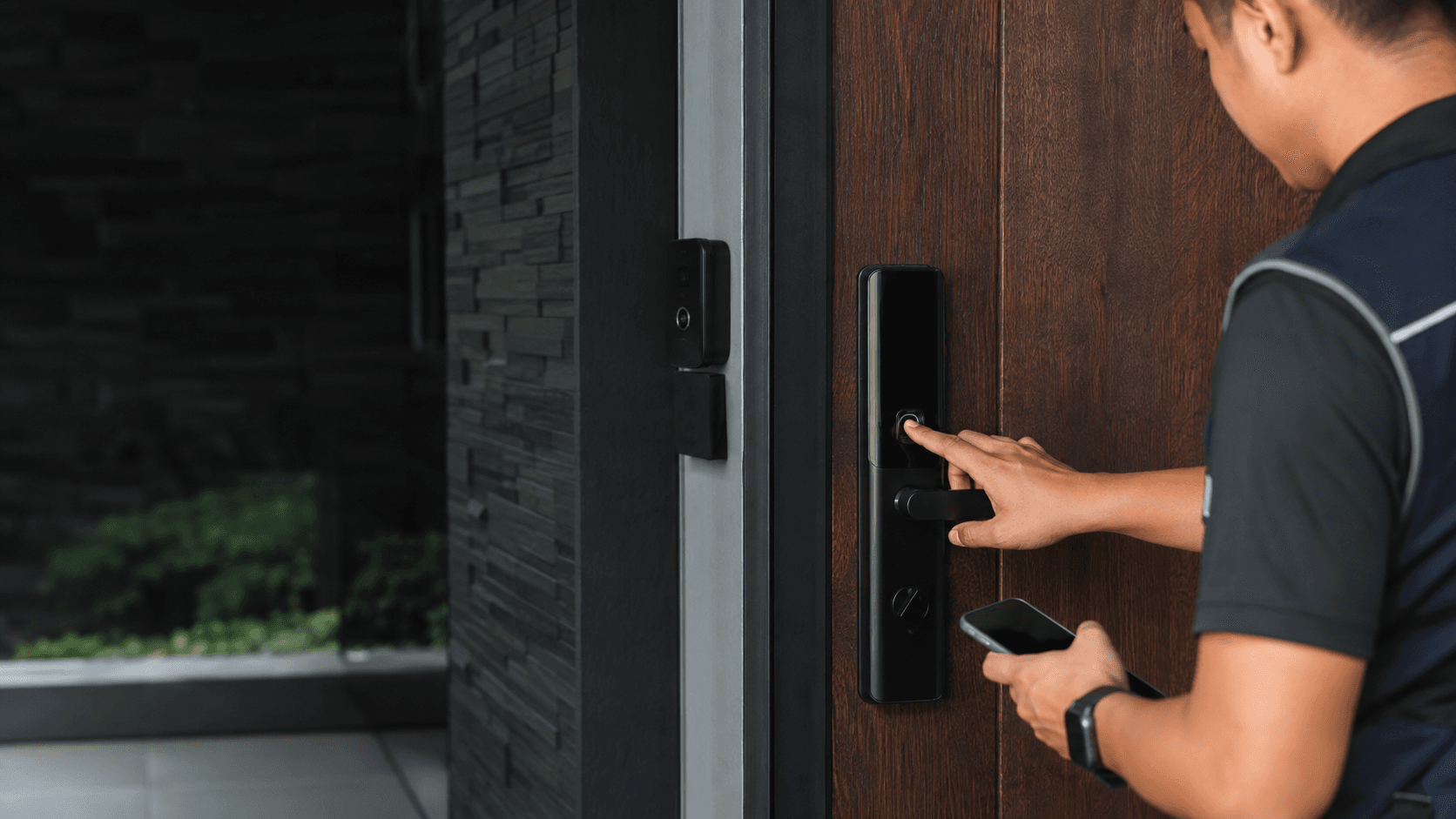
The phrase describes a family of door hardware rather than one product. Kwikset builds handlesets, where a grip and a separate deadbolt share one trim plate, and entry handles where the latch and lock sit inside a single unit. Both are sold as door handles with locks, and the difference matters before any purchase.
Kwikset Door Handle With Lock. What the Term Covers
Search results for this phrase mix two hardware types under one label. A handleset pairs an exterior grip with a deadbolt above it, so the door carries two locking points. A single-unit entry handle combines the latch and the lock in one assembly, so the door carries one.
Kwikset's own product pages group door hardware by category, listing handlesets, deadbolts, knobs, levers and electronic entry hardware as separate families. That grouping is the clearest signal that a handle with a lock is not one fixed object. The buyer picks the family first, then the style.
SmartKey re-key technology appears across Kwikset's hardware lines. Re-keying lets a lock cylinder accept a new key without replacing the cylinder, which matters when a property changes hands or a key is lost. The mechanism is a feature of the lock cylinder, not of the handle shape, so it can appear on more than one hardware family.
Handle and Lock Together on One Door
On a handleset, the exterior grip and the deadbolt are joined by a shared backplate or trim. Turning the grip retracts the latch; the deadbolt throws separately. On a single-unit entry handle, one motion path serves both the latch and the lock, and the interior side usually carries a thumb turn or button.
The practical difference shows up in daily use. A handleset gives two independent locking points, which suits a main entry door that sees heavy traffic. A single-unit handle gives one locking point and a simpler installation, which suits a secondary door, a back door or a room that needs controlled access.
Door preparation decides which type fits. A door already drilled for a separate deadbolt and a separate latch can accept a handleset without new holes. A door drilled for one bore only is a natural fit for a single-unit entry handle. Measuring the existing bores before ordering avoids a door that needs patching.
Kwikset Door Handle With Lock Compared With a Separate Deadbolt
A separate deadbolt is a standalone lock installed above an existing knob or lever. It adds a second locking point without changing the handle. A Kwikset Door Handle With Lock replaces the handle itself and, in the handleset form, brings its own deadbolt with it.
The trade-off is scope. Adding a separate deadbolt leaves the existing handle in place and touches one bore. Replacing the handle with a locking unit changes the door's appearance and its hardware in one step, which suits a renovation or a door whose handle is already worn.
Security planning sits above both choices. Eyonic's smart lock door access review notes that smart locks work best when door condition, user roles and backup method are reviewed before installation, and that business use often raises the question of whether a standalone smart lock or an access-control panel is more appropriate. The same three checks apply to mechanical hardware: what the door is, who needs entry, and what happens when the primary method fails.
Door Conditions That Decide the Choice
Door thickness, bore spacing and the door's material set the limits. A solid timber door holds screws and a deadbolt well. A hollow or lightweight door may need different fixing. A metal door frame changes how the strike plate is mounted.
Weather exposure matters on an exterior door. Hardware on a door that faces rain and direct sun ages differently from hardware on a sheltered interior door, and the finish is the part that shows it first.
Alignment is the quiet failure point. A door that has dropped on its hinges, or a frame that has moved, can leave a latch that no longer meets the strike cleanly. That condition affects any handle with a lock, regardless of brand, and it is worth checking before ordering hardware rather than after.
Eyonic applies a comparable logic to camera placement, recommending that actual lighting conditions be checked before confirming placement rather than assuming from a plan. The same principle applies to door hardware: confirm the door as it is, not as it was drawn.
Kwikset Door Handle With Lock for Homes, Shops and Offices
In a home, the main entry door usually carries the heaviest hardware, and secondary doors carry simpler units. A family entry that sees constant use benefits from a handle that can be re-keyed when keys are lost or shared too widely.
In a shop, the door that staff use for opening and closing is the one that gets replaced first. A single-unit entry handle keeps that door simple, while a handleset suits a front entrance that customers see.
In an office, the question shifts from hardware to access. Eyonic's smart lock door access review frames the business decision as a choice between a standalone smart lock and an access-control panel, decided by user roles and backup entry. A mechanical handle with a lock still has a place on store rooms, utility doors and secondary entrances where a full access system is more than the door needs.
Eyonic's completed work for the Kuching Immigration Office focused on arrival flow, staff areas, visitor movement and dependable daily operation. That pattern — separating public movement from staff movement — is the same thinking that decides which doors get simple hardware and which get controlled access.
What to Confirm Before Ordering or Installing
Ordering the wrong hardware usually traces back to a measurement that was never taken. The checks below cover the points that decide fit.
- Measure the door thickness at the edge, since hardware is built for a range rather than a single figure.
- Measure the existing bore holes and the distance between them, and note whether the door has one bore or two.
- Confirm the door material and whether the frame can take the strike plate and screws.
- Decide whether the door needs one locking point or two, based on how it is used and who uses it.
- Plan the backup entry method before installation, so a failed lock or a lost key does not close the door permanently.
- Check the door's swing and alignment, since a dropped door will not meet a new strike cleanly.
Two further points belong on the list for any door that carries controlled access. The first is who holds keys or credentials, because that list changes. The second is what happens at handover, when a property or a role changes hands and the lock needs to accept a new key without new hardware.
Eyonic's installation work follows a sequence of site survey, system proposal, installation and handover. Door hardware on a monitored site fits into that same sequence: the survey establishes the door conditions, the proposal fixes the hardware, and the handover confirms that the people who need entry can actually get it.
Where a door sits inside a wider security plan, hardware and monitoring are decided together rather than separately. A door handle with a lock controls one opening; cameras and alarms observe the space around it. Eyonic supplies and installs CCTV, alarm and autogate systems across Sarawak, and the same site survey that places cameras also records the doors that need hardware attention.
Share your location, property type and required system with Eyonic on WhatsApp at +60 11-5111 7959 for the next practical step.