
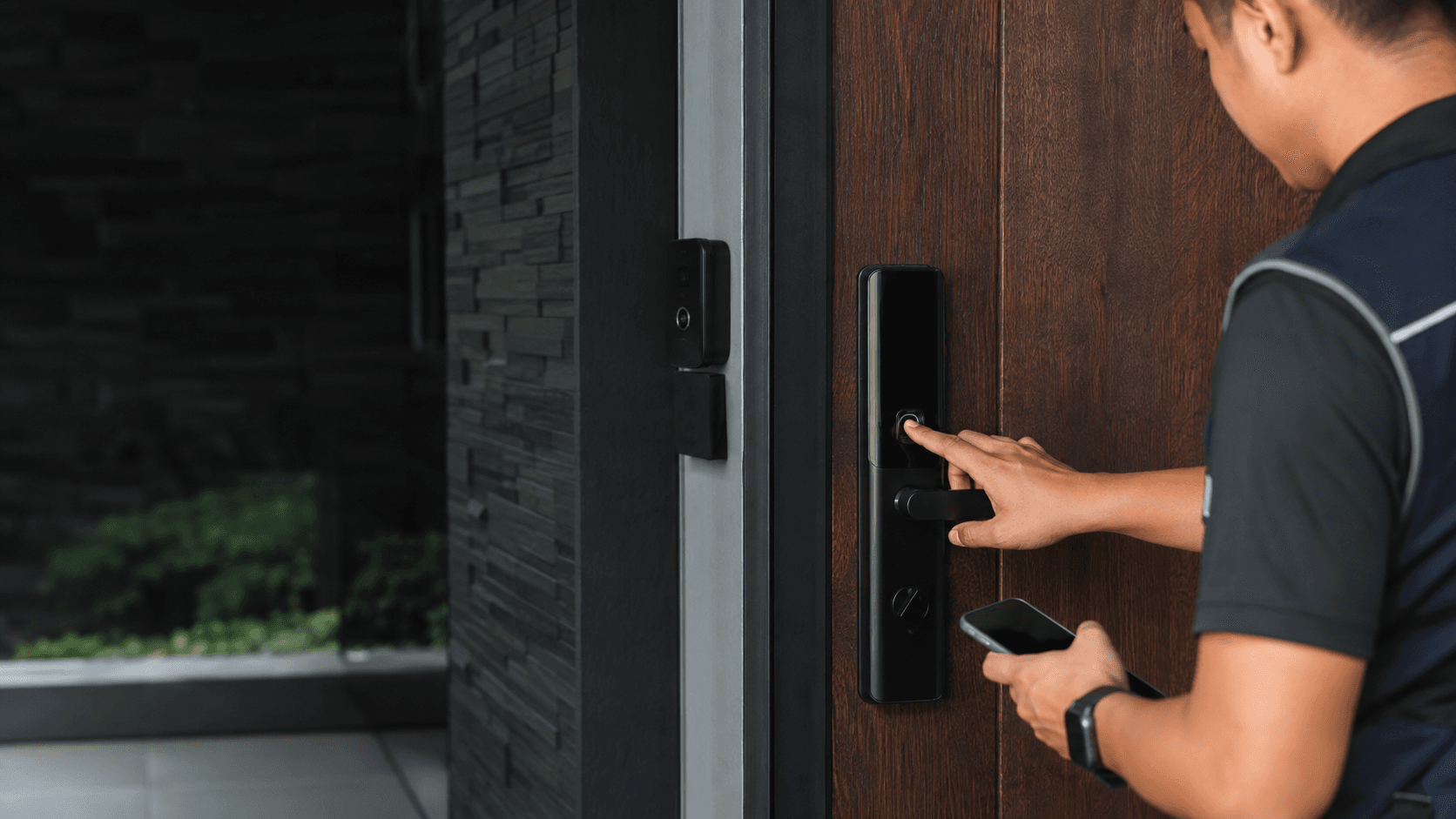
The exact-match query "wifi smart lock with keypad" describes a lock that opens by typed code and can be reached over a network. Buyers in Malaysia compare these locks mainly on keypad entry, Wi-Fi remote access, user codes, backup entry and door condition. Eyonic Sdn Bhd, a security system supplier in Sarawak, treats smart lock door access as suitable for controlled convenience when user permissions and backup entry are planned properly.
Wifi Smart Lock With Keypad. What Buyers in Malaysia Compare
Most product pages in this category are thin. Across nine analysed pages, the median word count was 4 and the median heading count was 0, and none used the complete query in its H1. That leaves the comparison ground largely open, so the useful work is explaining what actually decides whether a keypad lock suits a door.
Five checks carry most of the weight before any purchase decision:
- Door condition — whether the existing door and frame accept the lock body, latch and keypad without structural changes.
- User roles — who needs a code, who needs to revoke one, and whether staff, family or visitors need different permissions.
- Backup entry method — what opens the door when batteries are flat, Wi-Fi is down, or a code is forgotten.
- Wi-Fi coverage at the door — whether the signal reaching the door position is stable enough for remote access to be dependable.
- Standalone lock or access-control panel — whether one door is being covered or a wider site with multiple entry points and shared permissions.
These five checks are the same ones Eyonic applies when reviewing smart lock door access: door condition, user roles and backup method are reviewed before installation, and for business use the question of a standalone smart lock versus an access-control panel is settled first.
How Keypad Entry and Wi-Fi Access Work Together
Keypad entry and Wi-Fi remote access solve different problems, and a lock that does one well may do the other poorly.
The keypad is the local layer. A code typed at the door opens the lock without a phone, a key or an app session. That matters when the person entering is a child, a one-time visitor, a cleaner or a contractor who will not be issued a phone credential. The code is the credential.
Wi-Fi is the remote layer. It carries lock and unlock commands, code changes and activity records between the lock and a phone or management interface when the person is somewhere else. Without a network path, the lock still works at the door but remote access does not.
The practical consequence is that Wi-Fi coverage at the door position decides how much of the remote layer is usable. A lock installed at a door where the signal is weak or intermittent will still accept codes locally, but remote commands and status checks become unreliable. This is the same discipline Eyonic applies to camera placement, where actual conditions at the position are checked before placement is confirmed rather than assumed from a floor plan.
Battery power is the other dependency. A keypad lock that depends on batteries for both the keypad and the radio has two failure modes at once: no code entry and no remote access. That is why backup entry is treated as a design decision rather than an afterthought.
What happens when Wi-Fi or batteries fail
When the network drops, local keypad entry normally continues and remote access stops. When batteries run down, the keypad itself may stop responding, which is why a mechanical or externally powered backup path matters. The specific behaviour depends on the lock model, and no supplied evidence states battery life, wireless protocol or code capacity for any model, so those figures should come from the manufacturer's specification sheet for the exact lock under consideration.
Door, Gate and Property Conditions That Decide the Fit
Door condition is the first filter because a keypad lock is a piece of door hardware before it is a connected device. The lock body, latch and keypad have to suit the door and frame they are fitted to, and the door has to close and latch reliably for any electronic locking to mean anything.
Three property situations change the recommendation:
A single entrance door on a home or small office is the straightforward case. One lock, a small set of user codes, and a backup entry method cover the requirement.
A property with a gate, a separate office entrance and a staff area is a different case. Multiple entry points with different user groups usually point toward an access-control panel rather than several independent locks, because permissions and records need to sit in one place.
A site where the door is the only controlled point but the user list changes often — a shop with rotating staff, an office with frequent contractors — sits between the two. The deciding question is how often codes must be issued and revoked, and whether that has to happen remotely.
Eyonic's project work in Sarawak has covered both patterns. The Kuching Immigration Office project focused on arrival flow, staff areas, visitor movement and dependable daily operation. The KTA Sarawak Sdn Bhd project covered staff movement, visitor handling, tidy cabling and clearer daily site control. Both are cases where the entry and movement pattern, not the hardware alone, shaped the setup.
Malaysian door and gate considerations
No supplied evidence confirms compatibility with specific Malaysian door types, gate types or existing access-control panels. That makes a physical check at the door the only reliable answer, and it is why a site survey precedes any proposal in Eyonic's documented installation process. The survey, proposal, installation and handover sequence used for CCTV work is the same sequence that applies when a lock has to integrate with an existing door or panel.
User Codes, Permissions and Backup Entry Planning
User codes are where a keypad lock earns or loses its value. A lock with one shared code for everyone is convenient and almost impossible to audit. A lock with individual codes per person gives a record of who entered and lets a single code be revoked without reissuing credentials to everyone else.
Planning the code structure before installation avoids rework. The questions that matter are how many distinct people need entry, whether any of them need time-limited access, who is allowed to add or remove a code, and whether that administration has to work remotely.
Backup entry deserves the same treatment. A mechanical key cylinder, a physical key override, or a second powered path each solve a different failure. The choice depends on who is on site when a failure happens and how quickly someone can reach the door. For a home, a key held by a neighbour may be enough. For a business, the backup method has to work for whoever is on shift, not just for the person who administers the system.
Eyonic's stated position on smart lock door access is that the locks work best when door condition, user roles and backup method are reviewed before installation. That ordering matters. permissions and backup are decided first, then the hardware is chosen to match.
Costs and Package Context in Malaysia
No supplied evidence gives a price for a wifi smart lock with keypad in Malaysia. The documented Eyonic package pricing covers other systems: the Hikvision CCTV package, the Hikvision alarm system and the autogate package are each listed at RM 1,599, covering supply, setup and handover for those systems.
Those figures are useful as context rather than as a lock price. They show the shape of a supply-and-install package — equipment, configuration, testing and handover — which is the same shape a lock installation would follow. They do not establish what a lock costs, and no supplied evidence states installation time, warranty terms or after-sales support scope for smart locks.
Larger site work sits in a different bracket. Eyonic's Kuching Immigration Office project carried an approximate budget of RM 12,000 to RM 28,000, and the KTA Sarawak Sdn Bhd project carried an approximate budget of RM 8,000 to RM 18,000. Those ranges describe multi-point site work, not a single door lock, and they are the clearest available signal that scope — one door versus a controlled site — drives cost far more than the lock itself.
Choosing Between a Standalone Lock and an Access Control Panel
The choice comes down to how many entry points need to share one set of permissions.
A standalone lock suits a single door with a small, stable user list. It is simpler to install, has fewer parts to fail, and does not depend on a central controller. Its limit is that each additional door becomes its own separate system with its own codes and its own records.
An access-control panel suits a site where multiple doors, gates or areas need consistent permissions and a single record of movement. It costs more and depends on more infrastructure, but it avoids the situation where a person who has left still holds a valid code on one of several independent locks.
Eyonic checks this distinction specifically for business use, because the wrong choice shows up later as either unnecessary complexity on a single door or an unmanageable set of separate locks across a site.
For readers still comparing options, the practical next step is to describe the door, the property type and the required system to Eyonic on WhatsApp at +60 11-5111 7959.