
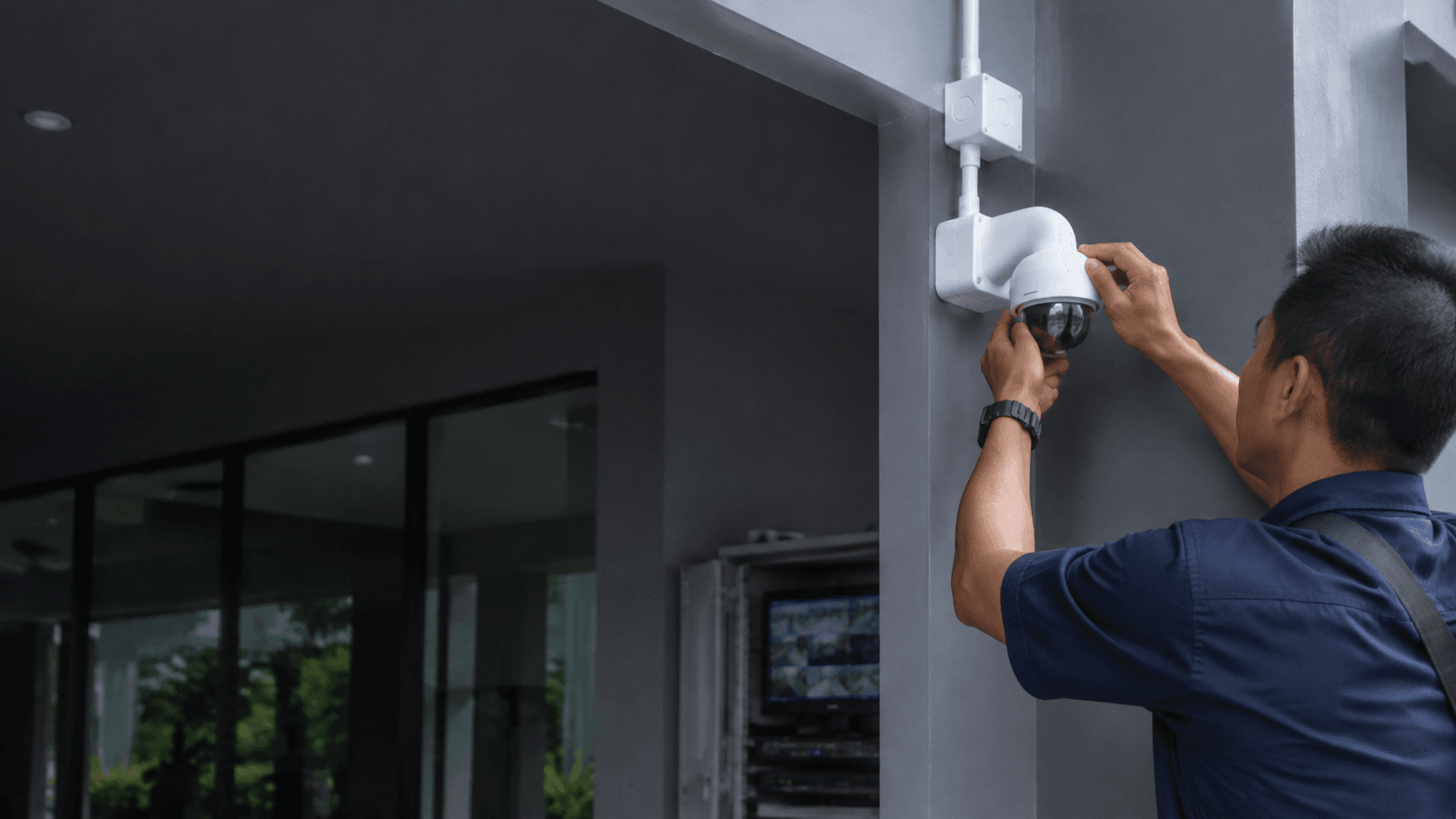
The exact-match term is used loosely online. Most pages that rank for airtel cctv are either Airtel's own broadband and Xsafe material or third-party write-ups that repeat Airtel's app features without adding independent testing. That matters for a reader in Malaysia, because the availability question comes before the feature question.
What Airtel Cctv refers to in practice
Airtel Cctv is not a standalone camera brand in the way Hikvision or Dahua is. The term maps onto Airtel Xsafe, which Airtel presents as a home security service built around Wi-Fi cameras and a companion app, sold in connection with its broadband and DTH business. The Airtel Xsafe app listing describes live streaming, motion and person detection alerts, perimeter zones, two-way audio and video sharing, and it is published for an Indian audience.
Two of the Airtel Xsafe pages in the analysed set returned no readable body content at all, and one competitor page is a video with a twelve-word description. The visible competition is therefore thin. Only one page in the set carries the exact-match phrase in its H1, and it is also the only page with substantial repetition of the term.
That thinness is the useful signal. A reader searching this term is usually trying to confirm whether a branded camera service exists in their market, not to compare resolution figures, because almost nobody publishing on the term supplies verifiable specifications.
What the competitor pages actually emphasise
Across the analysed pages, the recurring framing is broadband bundling, app features and subscription access. Airtel's own blog page ties home security cameras to a fibre broadband connection and lists indoor and outdoor Wi-Fi camera types. A news analysis piece frames the wider question as whether camera subscriptions bundled with DTH and broadband make sense. A review page describes a 360-degree camera, cloud storage and an annual subscription.
None of that establishes Malaysian availability, pricing or support. It describes how the product is positioned in India.
How Airtel Cctv connects to broadband and subscriptions
The mechanism is straightforward. A Wi-Fi camera needs a working internet connection to send alerts and allow remote viewing, so Airtel positions its broadband as the connection layer and Xsafe as the camera layer, with an app as the interface. Subscription framing appears because cloud storage and continued service access are typically recurring rather than one-off.
That model has a practical consequence. If the broadband service and the camera service come from the same provider, the camera's usefulness depends on that connection remaining active and on the provider continuing to support the hardware. A locally installed system separates those two things: the recorder and cameras keep working on the local network even when the internet link is down, and remote viewing is the part that needs connectivity.
Why the distinction matters for a Malaysian reader
No primary evidence in this set confirms that Airtel-branded camera hardware is sold, installed or supported in Malaysia. Without that confirmation, the honest position is that the term describes an India-focused service, and a reader in Malaysia is really choosing between waiting for availability and installing a comparable system locally.
A locally installed and supported setup covers the same functional ground through different means: a site survey, camera placement decisions, a recorder for local storage, remote viewing configuration, and a handover that confirms the system works before the installer leaves. Eyonic's stated installation process follows exactly that sequence.
Camera placement and lighting checks before confirming a setup
Placement decides whether a camera is useful. A camera aimed at a bright doorway from a dark corridor will either blow out the doorway or lose the corridor, depending on how it is set. The fix is to check the actual lighting at the actual time of day before confirming where a camera goes, rather than choosing positions from a floor plan alone.
Eyonic recommends checking real lighting conditions before confirming placement for ColorVu-style cameras, which are designed to hold colour images in low light. The same discipline applies to any camera choice: the lighting at the location, not the specification sheet, determines the result.
- Walk the site at the times of day that matter, including after dark, and note where light falls and where it does not.
- Identify the entry points, circulation routes and areas that need coverage, and separate them from areas that do not.
- Check whether each proposed position has a realistic cable route and a power source.
- Confirm the placement against the lighting observed, and adjust before any drilling begins.
Recording, storage and remote viewing
A recorder keeps footage locally, which means playback does not depend on an internet connection or a cloud subscription. Remote viewing is the part that needs connectivity, and it is configured during installation so the user can confirm it works on their own phone before handover.
Cloud-dependent designs trade local storage for convenience and recurring cost. Local recording trades remote simplicity for independence from a subscription. Neither is universally better; the choice depends on whether the site has reliable internet and whether ongoing fees are acceptable.
Installation handover and daily operation
Installation quality shows up months later, in cable routing, connector weatherproofing and whether anyone can find the right footage when they need it. A tidy installation is also easier to extend when a site adds a camera or a door.
Eyonic's CCTV installation process runs through site survey, system proposal, installation and handover. The handover step is where the user learns to view live footage, play back a recording and manage basic settings, and it is the step most worth insisting on.
- Site survey. walk the property, note entry points, lighting, cable routes and power availability.
- System proposal. set out camera positions, recorder location, storage approach and remote viewing method.
- Installation. mount cameras, run and terminate cabling, configure the recorder and network.
- Handover. confirm live view and playback on the user's own device and explain routine operation.
For sites where movement patterns matter, the Kuching Immigration Office project shows the scope a public building can involve: arrival flow, staff areas, visitor movement and dependable daily operation. A Kuching office project for KTA Sarawak Sdn Bhd covered staff movement, visitor handling, tidy cabling and clearer daily site control. Both illustrate that the survey stage is where coverage decisions are actually made.
What to check before committing
Confirm who installs the system, who supports it afterwards, and what happens if a camera fails. Confirm whether footage is stored locally or in the cloud, and what the recurring cost is if it is the latter. Confirm that remote viewing has been demonstrated on the user's own phone, not just on the installer's.
For a branded service, the equivalent checks are availability in the reader's market, the terms attached to the subscription, and whether local support exists. Where those cannot be confirmed, a locally installed system removes the uncertainty.
Costs packages and what a quote should cover
No pricing, specification or subscription figure for Airtel-branded cameras appears in this article, because no primary evidence in this set supports one. Any figure quoted for Airtel Xsafe in Malaysia would be invented.
For a locally installed system, Eyonic publishes package pricing at RM 1,599 for a Hikvision CCTV package covering camera supply and setup, basic recording configuration and mobile viewing handover. The same figure applies to the Hikvision alarm system package and the autogate package. Larger project work sits in a different range: the Kuching Immigration Office project carried an approximate budget of RM 12,000 to RM 28,000, and the KTA Sarawak Sdn Bhd project an approximate budget of RM 8,000 to RM 18,000.
| What the Airtel-focused pages emphasise | What a locally installed setup covers |
|---|---|
| Broadband bundling as the connection layer | Site survey to establish coverage and cable routes |
| App features such as live view, alerts and sharing | Camera placement decisions based on observed lighting |
| Subscription framing for cloud storage and service access | Local recording on a recorder, independent of subscription |
| Remote monitoring through a companion app | Remote viewing configured and demonstrated at handover |
| Product positioning for the Indian market | Installation and support in Sarawak, Malaysia |
The table is a framing comparison, not a feature comparison. It contrasts how the two approaches are described, not how they perform, because no verified performance data exists for the Airtel side in this market.
Questions worth asking before signing anything
Ask what the recurring cost is, if any, and what stops working when it is not paid. Ask whether footage can be retrieved without an internet connection. Ask who attends the site if a camera fails, and how quickly. Ask whether the quoted scope includes cabling, connectors, configuration and handover, or only hardware.
Ask, for any branded service, whether the provider operates in the reader's location at all. That single question resolves most of the uncertainty around airtel cctv for a Malaysian reader, because the rest of the decision depends on the answer.
Where a branded service is not available locally, the practical alternative is a system planned around the property itself: survey first, placement second, recording and remote viewing configured to match how the site is actually used, and a handover that leaves the user able to operate it. Share your location, property type and required system with Eyonic on WhatsApp at +60 11-5111 7959 for the next practical step.