
The phrase best light bulb security camera consumer reports mixes two different things: a product category and a testing organisation. Consumer Reports has published bulb-camera reviews, including a LaView 4MP Bulb Security Camera review and a Sengled Snap LED security camera test, but those results are not reproduced on this page. What follows is a plain account of what such testing covers, where the evidence stops, and which checks a buyer in Malaysia can run without any lab at all.
What best light bulb security camera consumer reports searches usually mean
Most people typing this query want a shortlist they can trust without reading ten affiliate pages. The wording suggests they expect a testing body to have ranked the models already. That expectation is reasonable, but it is not the same as having the results in hand.
Two distinct intents sit inside the same phrase. One is comparison. which bulb camera performs best on motion detection, night vision, and app reliability. The other is validation. does an independent lab agree with the marketing claims. A page can serve the first intent honestly by explaining the test criteria. It cannot serve the second without the actual scores.
Competitor analysis of nine pages on this topic shows the gap clearly. None used the complete query in the H1, and only one carried the main entity in a heading. Median word count was 1,804 words with a median of 31 headings. Eight of nine pages used lists and seven used FAQs. Several borrowed the Consumer Reports name in the title without being Consumer Reports. That pattern is worth recognising, because a title is not a test result.
Light Bulb Security Camera Consumer Reports evidence limits in Malaysia
No verified Consumer Reports test results, scores, or rankings for any light bulb security camera are available in the supplied evidence for this page. That is a real limit, not a formatting choice. It means no model can be named here as a winner, and no score can be quoted.
The same applies to model-level specifications. Resolution, field of view, weather rating, and storage limits for the cameras named across competitor pages are not verified here, so they are not repeated. Malaysian pricing, availability, and warranty terms for bulb cameras are also unverified. Data security and privacy assessments for any bulb camera model are unverified too.
Malaysia adds a practical wrinkle that testing labs abroad rarely address. Bulb cameras depend on a live light socket, and a socket that is switched off at the wall cuts power to the camera. A fitting that is controlled by a dimmer or a timer creates the same problem. Independent testing conducted in a laboratory may not capture how a Malaysian car porch, shop lot, or apartment corridor actually switches its lights. That is a site condition, not a product defect, and it belongs in the buyer's own checklist.
What independent testing typically measures on a bulb camera
Testing organisations generally assess a consistent set of behaviours rather than marketing features. Knowing the categories helps a buyer read any review critically, whether or not the scores are available.
Motion detection is usually judged on how often real events trigger a recording and how often nothing does. Night vision is judged on image clarity once ambient light drops. Two-way audio is judged on whether speech is intelligible in both directions. Wi-Fi connectivity is judged on whether the camera holds a stable connection at realistic distances and through walls. Video storage is judged on where footage goes, how long it lasts, and what happens when the card fills or the subscription lapses.
App reliability sits underneath all of these. A camera that detects motion correctly but delivers notifications late, or fails to load a live view when it matters, has an app problem rather than a sensor problem. Testing bodies tend to weight this heavily because it affects daily use more than any specification on a box.
One caution applies to every category. A test result describes performance under the tester's conditions, on the tester's network, with the tester's firmware version. Firmware changes. A result from an earlier review cycle may not describe the unit shipping now.
Comparing bulb cameras against fixed CCTV for a Malaysian property
A bulb camera solves a specific problem: it needs no new cabling because it borrows an existing light fitting. That is its main advantage, and it is a genuine one for renters, for shop lots where drilling is restricted, and for positions where running cable is impractical.
The trade-offs are equally specific. A bulb camera occupies a light socket, so that socket no longer lights the area unless the model includes a lamp function. Coverage is fixed to wherever the socket happens to point, which is rarely the ideal camera angle. Recording depends on Wi-Fi reaching that exact spot, and a socket on an outer wall is often the weakest signal point on the property. Storage is typically a memory card or a cloud plan rather than a central recorder.
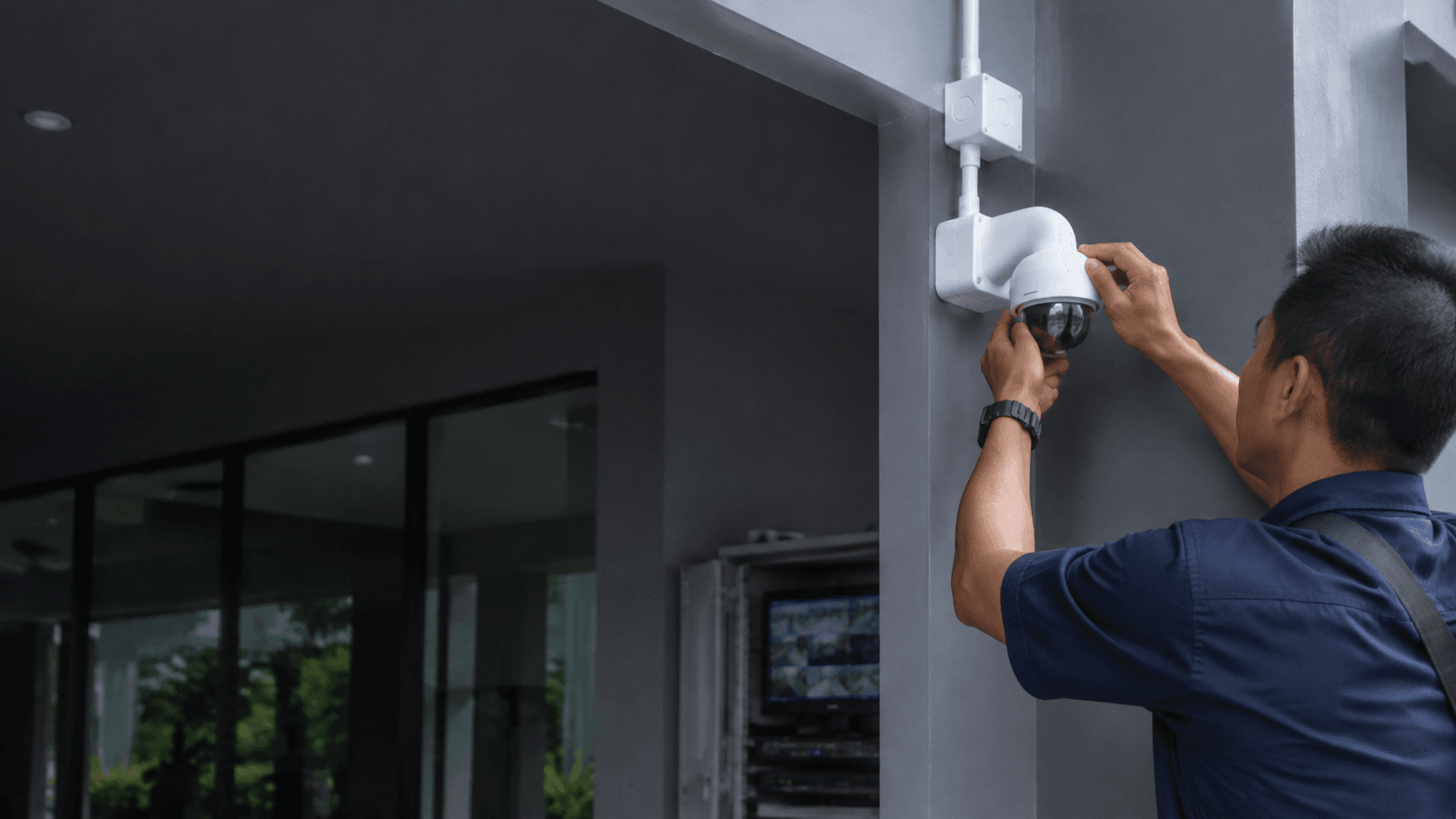
Fixed CCTV works differently. Cameras are placed for coverage rather than convenience, recording lands on a recorder, and the system does not depend on a light switch staying on. Eyonic's CCTV work follows a site survey, system proposal, installation, and handover sequence, and the company's project for the Kuching Immigration Office focused on arrival flow, staff areas, visitor movement, and dependable daily operation. That kind of planning is about positioning and continuity, which is exactly what a socket-mounted camera cannot offer.
The honest comparison is not which is better. It is which constraint matters more: the cost and disruption of cabling, or the limits of a fixed socket position.
Practical checks before buying a light bulb security camera
These checks can be run before any purchase, and they address the conditions a lab test cannot see.
- Confirm the socket type and fitting. Bulb cameras are commonly built for E26 or E27 sockets, and a bayonet-style fitting will not accept them without an adapter. Check the actual socket in the intended position rather than assuming.
- Confirm the Wi-Fi band and signal strength at the mounting point. Many bulb cameras operate on 2.4GHz, and a socket on an outer wall or behind a gate is often the weakest point on the property. Test the signal there, not in the room where the router sits.
- Confirm where recordings are stored and what happens when that storage fills. Local memory card and cloud subscription behave differently, and the difference matters when footage is needed after an incident.
- Confirm the lighting conditions at the chosen position. Eyonic recommends checking actual lighting conditions before confirming placement for ColorVu-style cameras, and the same discipline applies to a bulb camera: a position that is bright at noon may be dark and backlit at night.
- Confirm the socket stays powered. A switched socket, dimmer, or timer will cut the camera off, and this is the single most common reason a bulb camera appears to fail.
Where Eyonic fits for installation and camera placement
Eyonic Sdn Bhd is a security system supplier in Sarawak working across CCTV and ELV systems, with planning, supply, and installation for homes, offices, shops, and industrial sites. The company's founder, Eric Yong, has more than ten years in the industry, with experience in technical installation of digital security solutions for commercial businesses in Sarawak.
Bulb cameras are not part of Eyonic's verified product line, and no pricing or installation experience specific to them is claimed here. What Eyonic does provide is the part that decides whether any camera works: camera placement, site survey, NVR setup, and remote viewing. A site survey answers the questions a product page cannot, including whether the intended position has power that stays on, whether Wi-Fi reaches it, and whether a fixed camera would cover the area better than a socket-mounted one.
For a property where a bulb camera is the right fit, the practical value is in confirming the socket, the signal, and the storage plan before purchase. For a property where coverage matters more than installation convenience, a planned CCTV layout with cameras positioned for the actual approach routes will usually serve better. Eyonic's published packages start at RM 1,599 for a Hikvision CCTV package, an alarm system, or an autogate package, each covering supply, setup, and handover.
Share your location, property type and required system with Eyonic on WhatsApp at +60 11-5111 7959 for the next practical step.