
Eyonic Sdn Bhd is a security system supplier in Sarawak that plans, supplies and installs monitoring systems for homes, offices, shops and industrial sites. The company's founder, Eric Yong, has worked in the industry for more than 10 years, with a focus on technical installation of digital security solutions for commercial businesses in Sarawak.
Most global coverage of the best home cctv concentrates on subscription cameras sold in the United States. Malaysian buyers face a different set of decisions: which corners of a terrace house or apartment need coverage, whether recording stays on site, how footage is viewed remotely, and who handles the cabling and handover.
Best Home CCTV. What Malaysian Homes Actually Need
A workable home system answers four questions before any camera is chosen. What must be seen, where does the recording live, how is the footage viewed when nobody is home, and who fixes it when something fails.
Eyonic's CCTV service covers exactly those four areas: camera placement, recording, remote viewing and installation. That framing matters because a house in Kuching and a shoplot in the same city rarely need the same layout, even when the budget is identical.
Two practical constraints shape most Malaysian homes. First, many properties are semi-detached or terraced, so a camera aimed at a car porch may also overlook a neighbour's gate. Second, cable routes usually follow existing conduits or roof spaces, which limits where cameras can sit without visible trunking.
Recording is the second decision. An NVR setup keeps footage on a recorder inside the property, which suits households that want the recording to stay on site. Remote viewing is separate from recording: it depends on the home internet connection and the mobile app configured during handover.
Home CCTV Placement and Lighting Checks Before Installation
Placement decides more of the final result than camera choice does. A well-positioned camera at a gate or porch usually produces more useful footage than a higher-specification unit pointed at the wrong angle.
Eyonic recommends checking actual lighting conditions before confirming placement for ColorVu-style cameras. Colour night footage depends on how much ambient light reaches the scene, so a position that looks bright during a daytime survey can behave differently after dark.
Useful checks before confirming positions include:
- Whether a porch light, street lamp or neighbouring light spills into the camera's view at night.
- Whether the camera angle captures faces at the gate rather than the tops of heads.
- Whether trees, awning brackets or parked cars block part of the frame at different times of day.
- Whether the chosen position can be reached for cleaning and minor adjustment.
Lighting is not the only variable. A camera facing directly into a strong light source will lose detail in the rest of the frame, and a position that catches reflections from a car windscreen can waste much of the recorded image.
Home CCTV Packages and Budget Ranges in Malaysia
Eyonic lists three packages at RM 1,599 each. They cover different jobs rather than different quality tiers, so the right choice depends on what the property needs.
| Package | What it covers |
|---|---|
| Hikvision CCTV Package | Camera supply and setup, basic recording configuration, mobile viewing handover |
| Hikvision Alarm System | Control panel and sensors, siren and zone setup, user testing and handover |
| Autogate Package | Motor recommendation, remote-control setup, safety testing and handover |
Larger or more complex sites sit above package level. Eyonic's completed project for the Kuching Immigration Office, a public office focused on arrival flow, staff areas, visitor movement and dependable daily operation, had an approximate budget of RM 12,000 to RM 28,000. A project for KTA Sarawak Sdn Bhd, covering a practical office setup in Kuching with staff movement, visitor handling and tidy cabling, had an approximate budget of RM 8,000 to RM 18,000.
Those two figures describe office-scale work, not a typical house. They are useful as a sense of how budget scales when a site has more entry points, more cabling and a need for tidier routing.
Home CCTV Installation Steps from Survey to Handover
Eyonic's installation process runs through four stages. Each stage produces something the next one depends on, which is why skipping the survey tends to surface problems during cabling instead of before it.
- Site survey — the property is reviewed for camera positions, lighting conditions, cable routes and recorder location.
- System proposal — the survey findings are turned into a recommended system covering placement, recording and remote viewing.
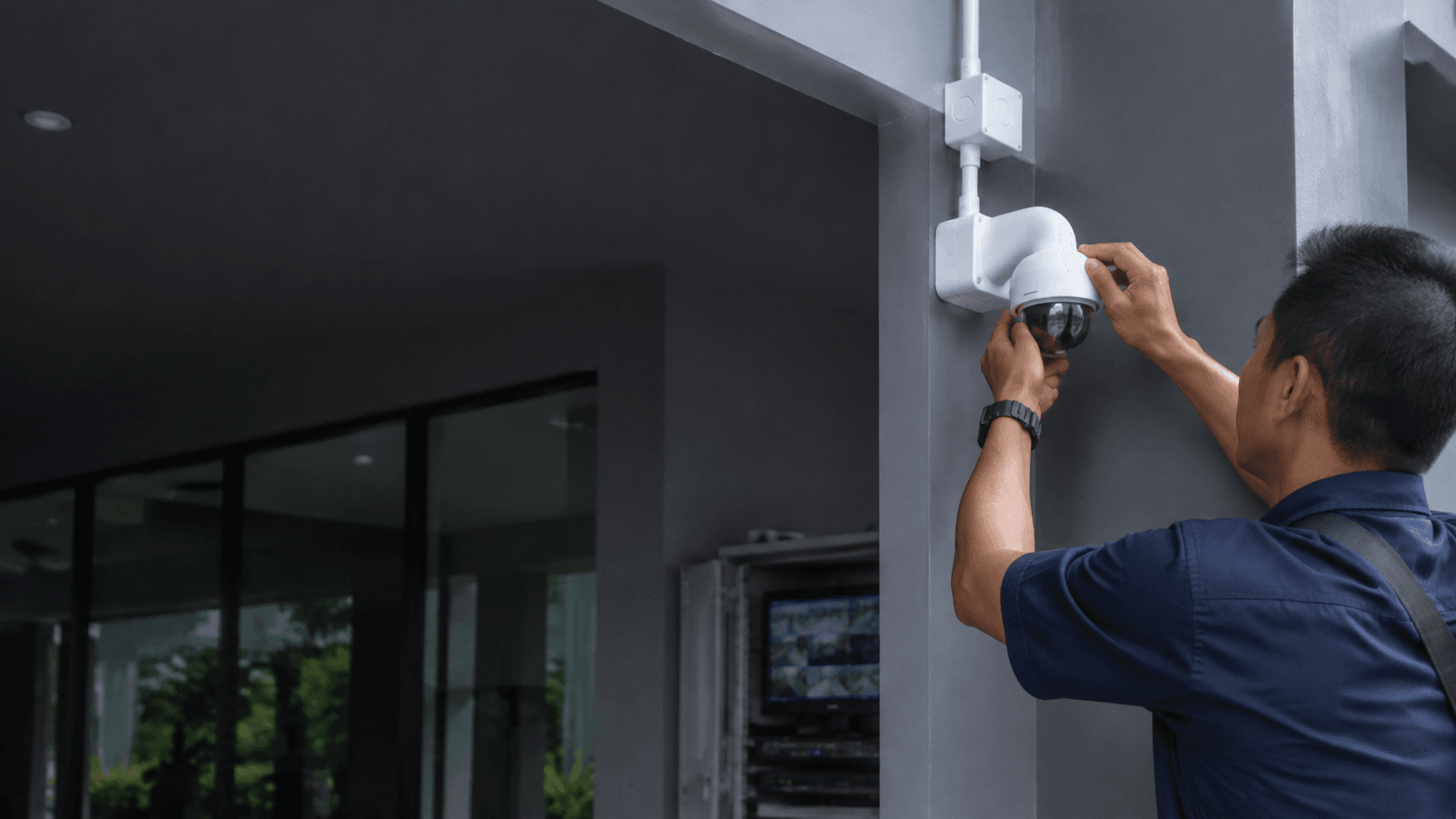
- Installation — cameras, cabling and the recorder are installed and configured on site.
- Handover — recording and mobile viewing are set up and explained so the system can be used day to day.
The survey stage is where most of the risk sits. Cable routes that cross a finished ceiling, or a recorder position without power and network access, are far cheaper to resolve before installation begins.
Handover is the stage that decides whether the system gets used. A recorder that runs but has never been checked on a phone is effectively an unmonitored system, so mobile viewing setup belongs in the handover rather than in a manual left on a table.
Home CCTV for Shops, Offices and Public-Facing Sites
The same four stages apply to commercial premises, but the priorities shift. A shop or office usually needs coverage of entrances, counters and staff areas rather than a single wide view of a compound.
The Kuching Immigration Office project shows how that plays out at scale. The work centred on arrival flow, staff areas and visitor movement, with dependable daily operation as the underlying requirement. A public-facing site cannot rely on someone remembering to restart a recorder, so reliability matters more than extra features.
The KTA Sarawak Sdn Bhd project followed a similar pattern at office scale: staff movement, visitor handling, tidy cabling and clearer daily site control. Tidy cabling is not cosmetic in these settings. It affects how quickly a fault can be traced and how easily a system can be extended later.
For a home-based business, the practical middle ground is to plan the house system so that a future camera can be added at the entrance or stock area without replacing the recorder or re-running the main cable route.
Home CCTV Questions Before Confirming a System
Several questions come up repeatedly once a survey has been done and a proposal is on the table.
Does recording need an internet connection? Recording to an NVR happens on site. Remote viewing is the part that depends on the home internet connection, so a broadband outage affects viewing rather than recording.
How many cameras does a typical house need? That depends on entry points. A car porch, front door and back door are the usual starting set, with additional cameras for side gates or outbuildings. The survey is what turns that into a number.
Can cameras be added later? Yes, provided the recorder has spare channels and the cable route allows it. This is worth confirming during the proposal stage rather than after installation.
What happens at handover? Recording configuration and mobile viewing are set up and explained. The Hikvision CCTV Package lists camera supply and setup, basic recording configuration and mobile viewing handover as its scope.
What is not covered by the package price? The listed package covers supply, setup and handover. Sites with more entry points, longer cable runs or additional systems sit outside that scope and are quoted from the survey.
For a next step, share the location, property type and required system with Eyonic on WhatsApp at +60 11-5111 7959. Supplied evidence centres on Sarawak and Kuching, so buyers outside that area should confirm coverage before planning around it.