
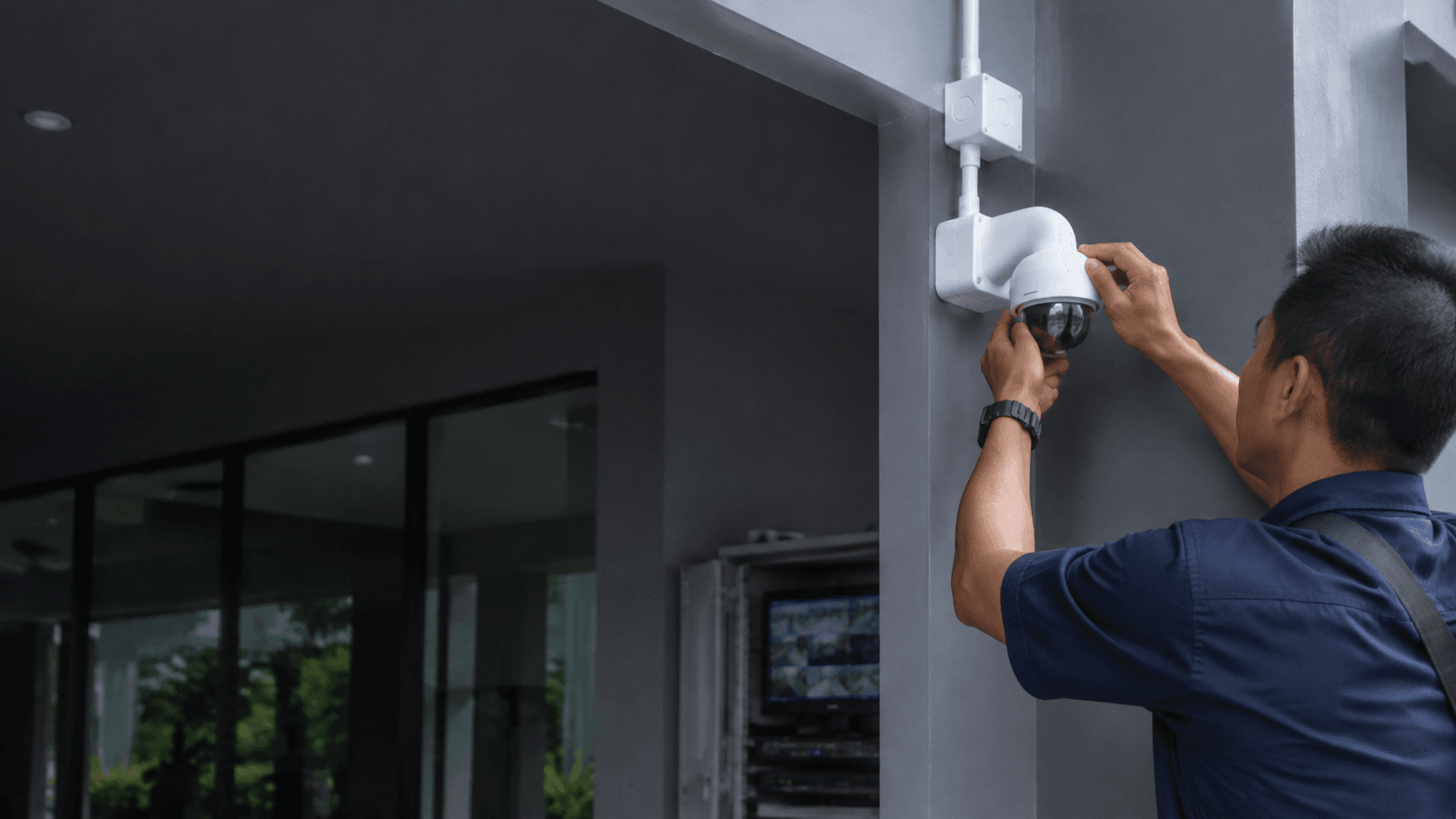
The term nvr ip compresses two ideas into one search: the recorder that stores footage, and the internet-protocol cameras that feed it. Understanding how those two halves connect explains most of the practical decisions that follow — channel count, cabling, storage, and how footage reaches a phone.
Nvr Ip. What Matters Before You Choose
A Network Video Recorder is the box that receives video streams from IP cameras over a network and writes them to a hard drive. The cameras do the encoding; the recorder organises, stores and serves the footage. That division of labour is why an nvr ip system behaves differently from older analogue setups, where a single DVR handled both capture and recording.
Before choosing anything, work through the sequence below. It reflects the order Eyonic follows on site: survey first, proposal second, installation third, handover last.
- Count the camera positions needed now, then add one or two spare channels for later.
- Confirm whether cameras will be wired with Power over Ethernet or connected over existing network cabling.
- Estimate how many days of footage must be retained, since that drives hard-drive size.
- Check the actual lighting at each position before confirming camera placement.
- Decide who needs remote viewing access and on which devices.
- Confirm the recorder, cameras and storage are compatible before purchase.
Eyonic's own installation process runs site survey, system proposal, installation and handover, so the first three items on that list are usually settled during the survey rather than guessed at afterwards.
Choosing the Right Nvr Ip Setup
Channel count is the first real constraint. A recorder with eight channels accepts eight cameras; sixteen accepts sixteen. Buying exactly the number of channels needed leaves no room for a later camera at the gate or the back entrance, which is why spare capacity is worth planning for at the start.
Power over Ethernet simplifies wiring considerably. A PoE recorder or switch sends both data and power down a single Ethernet cable, so a camera needs one cable rather than a cable plus a separate power point. Where existing network cabling already reaches a position, a non-PoE arrangement can still work, but each camera then needs its own power source.
Compatibility matters more than brand loyalty. Cameras and recorders generally need to agree on streaming standards, and mixing equipment from different manufacturers can work but should be verified before purchase rather than assumed.
What is nvr ip?
An nvr ip system is a recorder that stores video from cameras which transmit footage as data over a network rather than as an analogue signal over coaxial cable. The recorder sits on the network, receives each camera's stream, and writes it to internal storage. Authorised users then view live or recorded footage through a monitor, a computer, or a mobile app.
Because the video arrives as data, the same network can carry camera feeds, remote viewing traffic and alerts. That is the practical difference from analogue: one cable type, one recorder, and footage that can be reviewed from elsewhere.
NVR - Network Video Recorder
The recorder itself is the storage and management hub. Its job is to keep writing when the network hiccups, keep footage retrievable when someone needs to check an incident, and keep access limited to the people who should have it.
Storage is the variable most often underestimated. More cameras, higher resolution and longer retention all consume drive space, and the three multiply together. A small shop with four cameras and a fortnight of retention needs far less capacity than a site with sixteen cameras recording continuously for a month.
Remote viewing is the feature most users notice day to day. Once configured, footage can be checked from a phone without returning to the premises — useful for confirming a delivery arrived, a gate was left open, or a staff area was clear at closing time.
Practical Considerations for Nvr Ip
Placement decisions made on paper often need adjusting once lighting is checked on site. Eyonic recommends verifying actual lighting conditions before confirming placement for ColorVu-style cameras, because a position that looks adequate in daylight can behave very differently after dark.
Retention is a policy question as much as a technical one. Decide how long footage should remain available, then size storage to match. Keeping everything indefinitely is rarely necessary and adds cost without adding much practical value.
Access control deserves the same attention as the cameras. A recorder that anyone can log into offers limited protection, so user permissions and password discipline are part of the system, not an afterthought.
For sites with more than one concern — cameras plus alarms, or cameras plus door access — planning the systems together usually produces tidier cabling and simpler day-to-day operation than adding each piece separately.
Where an Nvr Ip System Fits
Homes, offices, shops and industrial sites all use the same underlying technology, but the priorities differ. A home may care most about remote viewing and a clear front entrance. An office may care about staff and visitor movement. An industrial site may care about coverage across a larger area and footage that survives a long retention window.
Eyonic's work for the Kuching Immigration Office focused on arrival flow, staff areas, visitor movement and dependable daily operation — a reminder that camera placement follows the movement patterns of the site, not a generic template. A separate project for KTA Sarawak Sdn Bhd covered staff movement, visitor handling and tidy cabling in an office setting.
Budget expectations vary with scope. Eyonic's published package pricing starts at RM 1,599 for a Hikvision CCTV package covering camera supply and setup, basic recording configuration and mobile viewing handover. Larger project work sits well above that: the Kuching Immigration Office project carried an approximate budget of RM 12,000 to RM 28,000, and the KTA Sarawak Sdn Bhd project an approximate budget of RM 8,000 to RM 18,000.
Making an Informed Choice About
The decision usually comes down to three things: how many cameras the site genuinely needs, how long footage must be kept, and who needs to see it. Answer those and the recorder specification largely follows.
Two edge cases are worth flagging. First, a site with no reliable network path to a camera position may need additional cabling work before any recorder is chosen. Second, a site planning to expand later should buy channel capacity now, because replacing a recorder is more disruptive than adding a camera.
For readers in Sarawak, the practical next step is a site survey. Eyonic's founder, Eric Yong, has worked in the industry for more than ten years, with experience in technical installation of digital security solutions for commercial businesses in Sarawak. A survey confirms camera positions, cabling routes and lighting before any equipment is ordered.
Share your location, property type and required system with Eyonic on WhatsApp at +60 11-5111 7959 for the next practical step.