
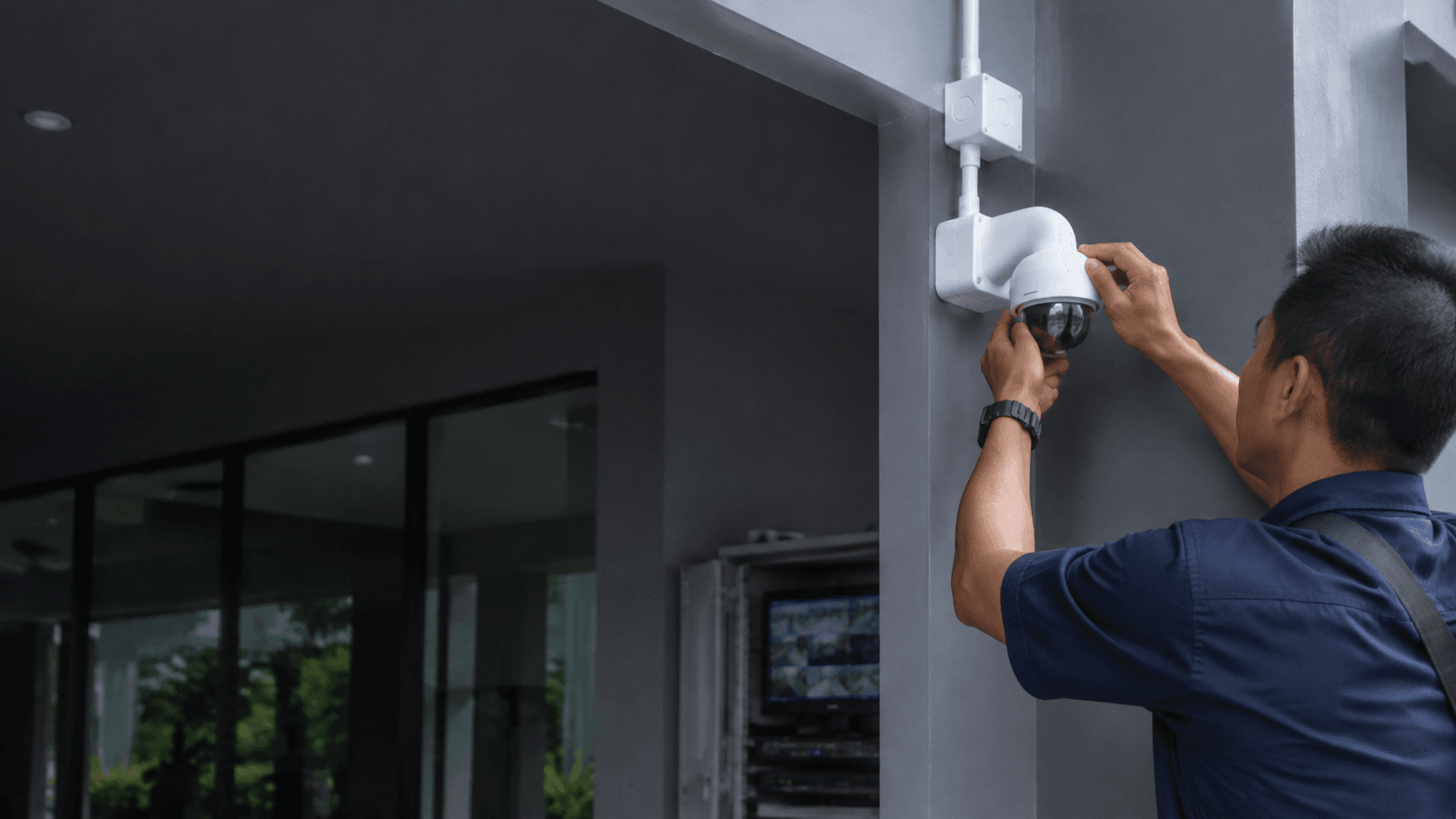
Eyonic Sdn Bhd plans, supplies and installs monitoring systems with camera placement, recording and remote viewing for homes, offices, shops and industrial sites. The company is based in Sarawak, Malaysia, and its founder Eric Yong has worked in the industry for more than 10 years.
Most buyers in Malaysia arrive at this topic through a product listing, then discover that the hard part is not the camera. It is deciding what to watch, where to mount it, how long to keep footage, and who fixes it when something stops working. That is the gap this page fills.
Home Monitoring Cameras. What They Cover
A home monitoring camera setup is a small system, not a single box. It usually has three working parts: cameras that capture video, a recorder or storage location that keeps the footage, and a viewing method that lets someone see live or recorded video from elsewhere.
Eyonic describes its CCTV work as planning, supplying and installing monitoring systems with camera placement, recording and remote viewing. Those three words map onto the three parts above, which is why a useful conversation about home monitoring cameras starts with coverage rather than with a model number.
Coverage means the areas a household actually wants to observe. Common choices are the front gate or car porch, the main entrance, a back door or service yard, and any side passage that is not visible from inside the house. A camera pointed at a wall covers nothing. A camera pointed at a walkway records everyone who uses it.
Two limits are worth stating plainly. First, no camera prevents entry; it records what happens and supports a response afterwards. Second, footage is only useful if it can be found later, which makes storage duration and playback method as important as the camera itself.
Indoor and outdoor placement
Indoor and outdoor positions solve different problems. Indoor cameras watch interior movement and are usually placed to cover a room entry or a corridor rather than a whole open-plan floor. Outdoor cameras watch approaches, gates and perimeters, and they face weather, insects, dust and changing light through the day.
Placement decisions that matter more than camera count:
- Height and angle, so faces are captured rather than the tops of heads.
- Distance to the recorder or network point, which affects cabling and cost.
- Whether the position is reachable by someone who wants to disable the camera.
- Whether the view includes a neighbour's property or a public walkway.
Eyonic's own project work shows the same logic at a larger scale. For the Kuching Immigration Office, the focus was arrival flow, staff areas, visitor movement and dependable daily operation. A home version of that thinking asks which routes people use, which areas need continuous coverage, and which areas only need a camera at certain times.
Recording and remote viewing
Recording answers the question of what happens after an incident. Remote viewing answers the question of what can be checked while away from the property. Both depend on a recorder or storage device, a network connection, and a viewing app that has been set up and tested.
Eyonic lists NVR setup and remote viewing as part of its CCTV service scope, alongside camera placement. In practice, remote viewing is the part most likely to disappoint if it is not tested before handover, because it depends on the home's internet connection and on the app being configured correctly on the devices that will actually be used.
A practical check at handover. open the app on the phone that will be used daily, confirm live view works, confirm a recorded clip can be found and played, and confirm what happens when the internet drops. If nobody has tested those three things, the system is not finished.
Lighting and night conditions
Night performance is where expectations and results diverge most often. A camera that looks clear in daylight can produce a soft or grainy image after dark, and the cause is usually the amount of light at the position rather than the camera alone.
Eyonic's guidance on ColorVu-style cameras is to check actual lighting conditions before confirming placement. That is a placement instruction, not a product claim. A position with a porch light, a street lamp nearby, or reflected light from a wall will behave differently from a dark back lane with no light source at all.
The practical sequence is to look at the position at night, not during a daytime survey. If the area is genuinely dark, the options are to add light, to accept a different image quality, or to move the camera to a position where light already exists. Deciding this before installation avoids re-cabling later.
Planning a Home Monitoring Cameras Setup
A home monitoring cameras plan starts with the property, not the product. The number of cameras, the type of each camera, and the storage arrangement all follow from what needs to be seen and how long footage must be kept.
Eyonic's CCTV installation process follows four stages:
- Site survey.
- System proposal.
- Installation.
- Handover.
The site survey is where the useful decisions get made. It establishes where cameras can be mounted, how cable will run, where the recorder will sit, and which positions have usable light at night. A proposal built without that visit is a guess about someone else's house.
Installation covers mounting, cabling, recorder configuration and the connection between the system and the home network. Handover is the point where the household learns to use what was installed, which is why mobile viewing handover appears in Eyonic's Hikvision CCTV Package description alongside camera supply and setup and basic recording configuration.
Budget is a real constraint and worth naming honestly. Eyonic's published Hikvision CCTV Package is RM 1,599, covering camera supply and setup, basic recording configuration and mobile viewing handover. Larger or more complex work costs more: Eyonic's Kuching Immigration Office project carried an approximate budget of RM 12,000 to RM 28,000, and the KTA Sarawak Sdn Bhd office project carried an approximate budget of RM 8,000 to RM 18,000. Those are commercial and office projects, not homes, but they show how far the range extends once coverage, cabling and site conditions grow.
Three constraints tend to decide the final shape of a home system:
- Wiring routes. A camera position with no practical cable path becomes a different, more expensive job.
- Storage duration. Keeping footage longer requires more storage, and the requirement should be agreed before installation rather than discovered afterwards.
- Who maintains it. A system that nobody can adjust, restart or troubleshoot will degrade quietly.
Edge cases worth raising during the survey include rented properties where mounting and cabling need landlord agreement, homes with unreliable power, and properties where the areas of concern are far from the main building. Each of these changes the plan before any equipment is chosen.
Getting the next step right
The most useful next step is a site survey, because it converts a general interest in home monitoring cameras into a specific list of positions, cable routes and storage needs. Everything after that is a consequence of the survey.
Eyonic's service scope covers homes, offices, shops and industrial sites, so the same planning process applies whether the property is a single-storey house in Kuching or a larger site. The company also supplies related systems including alarm systems, autogate packages and keyphone intercoms, which matters when a household wants monitoring to work alongside entry control rather than as a separate purchase.
Before the survey, it helps to prepare three things: the property address and type, a rough list of the areas that need coverage, and any existing wiring or equipment that should be reused. That is enough for a useful first conversation.
Share the location, property type and required system with Eyonic on WhatsApp at +60 11-5111 7959 for the next practical step.