
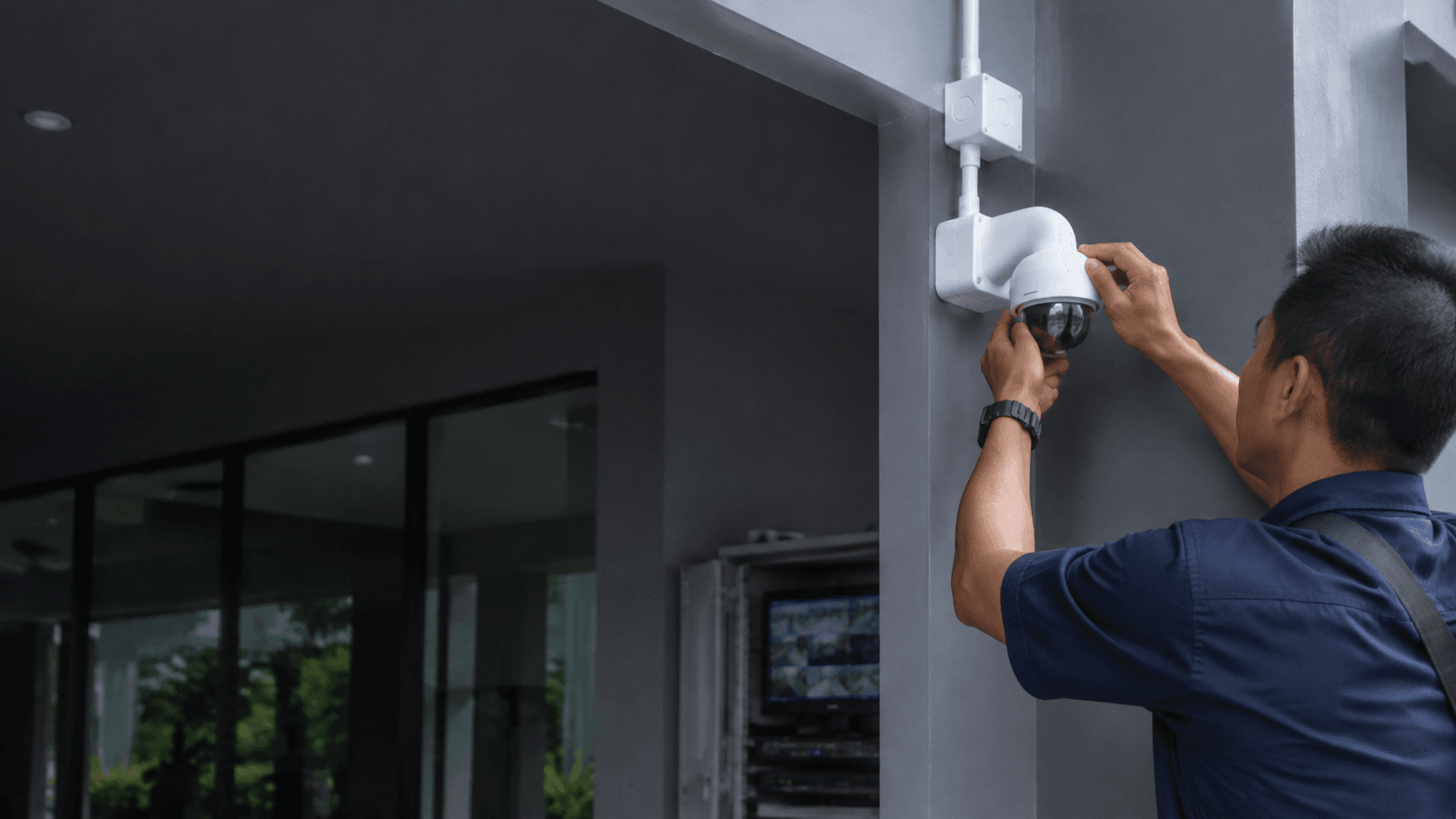
The exact-match query hikvision products describes a catalogue that spans far more than a single camera box. Buyers in Malaysia usually arrive with one of two questions: what the range actually contains, and who will put it together on site. This page answers both, using Eyonic's documented Sarawak work and its published installation sequence.
Hikvision Products. Supply and Installation in Malaysia
Hikvision Products are supplied and installed in Malaysia through security system integrators rather than through a single retail counter. Eyonic Sdn Bhd is a security system supplier based in Sarawak, and its documented scope is planning, supply and installation of CCTV and ELV systems for homes, offices, shops and industrial sites.
That distinction matters because a camera on its own does not record anything. A working system needs a recorder, storage, cabling, power, network access and a viewing method. The supply side covers the hardware; the installation side covers placement, configuration and handover.
What the local scope covers
Eyonic's published service list names five connected activities: site survey, camera placement, NVR setup, remote viewing and the broader CCTV security system scope of planning, supply and installation. Those five items describe the practical boundary of a local supply-and-install engagement.
Coverage claims beyond Sarawak are not supported by the available evidence, so this page does not make them. Buyers outside Sarawak should confirm scope directly before assuming coverage.
What Hikvision Products Cover
The range divides into categories that serve different jobs on the same site. Cameras capture; recorders store and manage; alarm systems detect intrusion; access devices control entry. A site rarely needs all four at once, and the mix depends on what the property actually has to protect.
Cameras and recording
Cameras are the visible part of the system. Placement decides whether footage is useful, because a camera aimed at the wrong angle records a wall rather than a doorway. Eyonic's documented process treats camera placement as a distinct step rather than an afterthought.
Recording is handled by an NVR, which is the network video recorder that receives camera streams and stores them. NVR setup appears as its own step in Eyonic's published process, which reflects the fact that recorder configuration determines how far back footage can be reviewed and how reliably it survives a power interruption.
Lighting is a real constraint on camera choice. Eyonic's review of ColorVu-style cameras recommends checking actual lighting conditions before confirming placement, because low-light performance depends on the site rather than the brochure.
Alarm systems and access devices
An alarm system covers a different job from a camera. Cameras record what happened; alarms attempt to interrupt it. Eyonic lists a Hikvision Alarm System package at RM 1,599 that includes a control panel and sensors, siren and zone setup, and user testing and handover.
Access devices handle entry control. Eyonic's product review notes that smart locks work best when door condition, user roles and backup entry are reviewed before installation, and that for business use the choice between a standalone smart lock and an access-control panel should be checked first.
Remote viewing
Remote viewing is the handover step that makes a system usable away from the site. It appears in Eyonic's published service list and in the Hikvision CCTV Package description, which includes mobile viewing handover.
How Eyonic Plans for a Site
Planning follows a fixed sequence rather than a product-first conversation. The order below reflects Eyonic's published CCTV installation process.
- Site survey. The property is assessed before any hardware is proposed, so that camera positions, cable routes and recorder location are based on the actual building.
- System proposal. A proposed system is put together from the survey findings, covering the cameras, recorder and supporting devices the site needs.
- Installation. Cameras are mounted, cabling is run, the recorder is configured and the system is brought online.
- Handover. The system is explained and remote viewing is set up so the owner can check footage without calling for help.
The sequence exists because the alternative — buying cameras first and working out placement later — usually produces coverage gaps that are expensive to correct once cabling is in.
Why the survey comes first
A survey answers questions that a product list cannot. Where does the building actually need coverage? Which entrances carry the most traffic? Where can a recorder sit without being obvious or vulnerable? Which cable routes avoid damaging finished surfaces?
Eyonic's founder, Eric Yong, has worked in technical installation of digital security solutions for commercial businesses in Sarawak for more than 10 years, which is the experience base behind that survey-first approach.
Matching the system to the property type
A home, a shop, an office and an industrial site need different things from the same product range. A home usually prioritises entrance coverage and simple mobile viewing. A shop often needs till and counter coverage alongside the entrance. An office tends to need staff and visitor movement covered without intruding on work areas. An industrial site usually needs wider coverage across larger distances and more attention to cable protection.
Those differences are why the survey step exists rather than a standard package applied everywhere.
in a Working Installation
The clearest local example is the Kuching Immigration Office project. Eyonic's documented work there focused on arrival flow, staff areas, visitor movement and dependable daily operation — four requirements that map directly onto camera placement decisions rather than product selection.
A second documented project, for KTA Sarawak Sdn Bhd, covered a practical office setup in Kuching supporting staff movement, visitor handling, tidy cabling and clearer daily site control. Tidy cabling is worth noting because it is an installation outcome, not a product feature.
What these projects show about product choice
Both projects were public-facing or professional environments where the system had to work every day without supervision. That pushes the design toward reliable recording and clear coverage of movement paths, rather than toward the highest specification available.
The Kuching Immigration Office project carried an approximate budget of RM 12,000 to RM 28,000. The KTA Sarawak Sdn Bhd project carried an approximate budget of RM 8,000 to RM 18,000. Those figures describe the scale of comparable work rather than a fixed price for any site.
Cost and Scope for
Eyonic publishes three packages at RM 1,599 each. The Hikvision CCTV Package covers camera supply and setup, basic recording configuration and mobile viewing handover. The Hikvision Alarm System covers control panel and sensors, siren and zone setup, and user testing and handover. The Autogate Package covers motor recommendation, remote-control setup, and safety testing and handover.
Those packages describe a defined scope rather than a full site system. A larger property with multiple buildings, long cable runs or access control requirements will sit above package level, which is where the project budget ranges become the more useful reference.
What moves the cost
Three things change the figure most: the number of cameras and their positions, the length and difficulty of cable routes, and whether access control or alarm integration is included. A single-storey shop with four cameras is a different job from a multi-level office with coverage across entrances, corridors and a car park.
Pricing beyond the published packages is not verified here, so no other figures are stated.
. Evidence Gaps and Next Step
Several things a buyer might reasonably want are not verified in the available evidence. No technical specifications, resolutions, lens figures, storage capacities or model numbers are confirmed here. No warranty terms are confirmed. No stock availability, lead times or delivery terms are confirmed. No Malaysia-wide coverage claim is supported, because the documented evidence is Sarawak-based.
Those gaps are stated rather than filled with estimates, because a wrong specification is worse than an absent one when a system is being designed for a real building.
What to prepare before making contact
Three pieces of information make the first conversation productive: the location of the property, the type of property, and the system required. With those, a survey can be scoped and a proposal built against the actual site rather than a generic package.
Share your location, property type and required system with Eyonic on WhatsApp at +60 11-5111 7959 for the next practical step.