
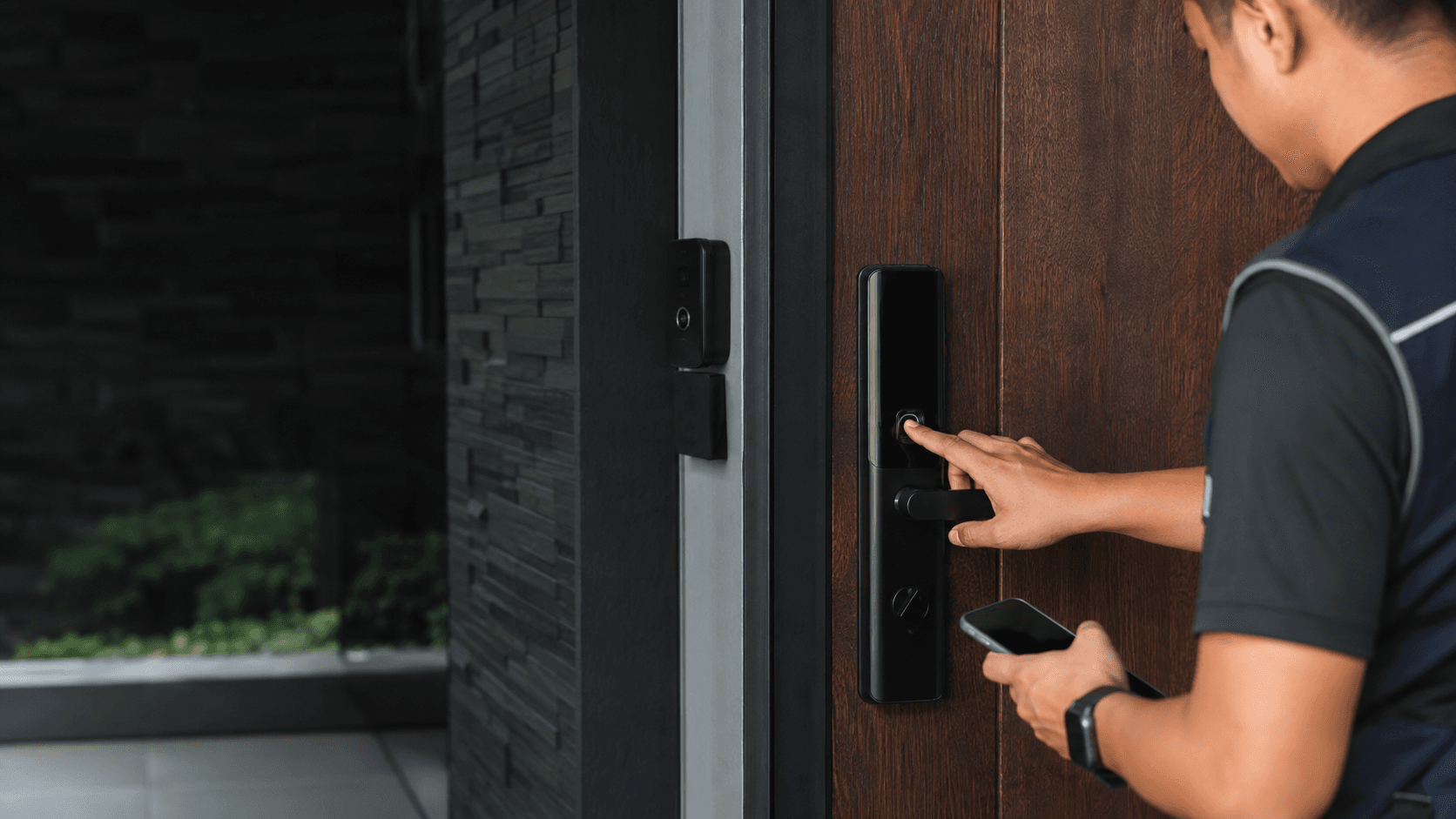
Most buyers start with the lock itself. The more reliable starting point is the door, the people who will use it, and what happens when the battery runs flat or the network drops. Eyonic, a security system supplier in Sarawak, reviews door condition, user roles, and backup method before recommending a unit, and the same order of checks applies whether the door belongs to a house, an office, or a shop lot.
Digital Entry Door Lock. What Malaysian Buyers Check First
Three questions decide most projects: will the lock physically fit the door, who needs to get in and when, and how does the door open if the electronics fail. A lock that passes all three is usually the right one. A lock that fails any of them becomes a daily problem regardless of how many features it carries.
Malaysian doors vary widely. Solid timber, hollow-core flush doors, metal grille doors, and glass shopfront doors each present different mounting and cutout conditions. A unit designed for a standard deadbolt bore may not suit a door that has never been drilled, and a door that already carries a mortise lock may need a different body shape entirely. This is why a physical check matters more than a catalogue comparison.
Feature lists also mislead. Fingerprint readers, app control, and temporary codes are useful, but they sit on top of the same fundamentals: fit, users, and backup. Buyers who settle the fundamentals first tend to keep the lock longer and complain less.
Door Condition and Lock Type Before Any Purchase
Door condition determines which lock types are even possible. The check covers door thickness, the existing cutout or bore, the door frame and strike plate, the closing action, and whether the door is exposed to rain or direct sun.
A door that closes loosely will defeat a well-made lock. Alignment matters because the bolt has to enter the strike cleanly every time, and a door that has swollen or dropped will resist that entry. Fixing the door first is usually cheaper than replacing a lock that keeps jamming.
For business premises, the choice between a standalone smart lock and an access control panel is a real fork. A standalone lock suits a single door with a small, stable group of users. An access control panel suits multiple doors, shift-based access, or a site where entry records and central administration matter. Eyonic states that for business use it usually checks whether a standalone smart lock or an access-control panel is more appropriate, which reflects how differently the two behave once staff turnover and visitor traffic enter the picture.
Outdoor and semi-outdoor doors add a further constraint. A gate-adjacent door, a back entrance facing the weather, or a shop shutter area may need a unit rated for exposure, and the available evidence does not supply verified ingress ratings for specific models. That gap is a reason to confirm the rating on the actual unit before purchase rather than assume it.
Access Methods, Users, and Backup Entry
Access methods should follow the user list, not the other way round. A household with two adults and a helper needs far less than a shop with rotating staff and daily deliveries.
Common access methods include keypad codes, fingerprint recognition, mobile app control, physical key override, and card or tag entry. Each carries a different failure mode. Codes get shared beyond the intended group. Fingerprints fail on wet or worn hands. App control depends on a working network and a charged phone. A physical key override depends on someone actually carrying the key.
User roles are the part most buyers under-plan. A household needs a simple owner and guest split. An office needs to distinguish permanent staff, contract staff, cleaners, and visitors, and it needs a way to remove access the day someone leaves. A shop needs to decide whether counter staff can open the door during trading hours and whether the back entrance follows the same rules.
Backup entry deserves a decision before installation, not after. The practical options are a mechanical key override, a second independent entry point, or a documented procedure for a dead battery. Whichever is chosen, at least two people on site should know it and be able to use it under pressure.
Power, Connectivity, and Daily Reliability
Power and connectivity decide how the lock behaves on an ordinary Tuesday, which is the only test that matters over years of use.
Battery-powered locks avoid cabling but introduce a maintenance routine. Someone has to notice a low-battery warning and act on it. Wired locks avoid that routine but require a power path to the door, which is straightforward on a new build and disruptive on a finished wall.
Connectivity is optional for many users. A lock that works by code or fingerprint alone keeps functioning when the internet is down. A lock that depends on an app or a remote server for daily entry introduces a dependency that a household may not want and a business may not be able to accept.
Reliability also depends on the door continuing to close the way it does on installation day. Humidity, settling, and heavy use all change how a door sits. A lock that was perfectly aligned in the first month can start to bind in the second year, and the fix is usually door adjustment rather than lock replacement.
Installation, Handover, and Support in Sarawak
Installation quality decides whether a good lock performs well. The work covers the cutout, the mounting, the strike alignment, the power or battery setup, and the configuration of every user credential.
Eyonic's installation process runs through site survey, system proposal, installation, and handover, and the same sequence applies to door access work. The survey is where door condition, user roles, and backup method get settled. The proposal turns those findings into a specific recommendation. Handover is where the people who will actually use the door learn how to add a user, remove a user, and respond to a low-battery warning.
Sarawak adds practical considerations. Travel to site, the availability of replacement parts, and the response path when something fails all affect how a lock should be chosen. A unit that is easy to service locally is worth more than a marginally better unit that is not.
Eyonic has completed work for the Kuching Immigration Office, focused on arrival flow, staff areas, visitor movement, and dependable daily operation, and for KTA Sarawak Sdn Bhd, an engineering consultancy office in Kuching that needed support for staff movement, visitor handling, tidy cabling, and clearer daily site control. Both projects sit in the same territory as door access work: controlled movement through a building, with the door as one point in a wider flow.
Before committing to a unit or an installer, work through these checks in order:
- Confirm door condition and the existing cutout, including thickness, bore or mortise shape, frame alignment, and exposure to weather.
- Decide between a standalone lock and an access control panel based on door count, user turnover, and whether entry records are needed.
- Define user roles and permissions, including who can add or remove a user and how quickly access is revoked.
- Plan the backup entry method and make sure at least two people on site can use it.
- Confirm power and connectivity, including whether the lock must keep working without internet or mains power.
- Schedule the site survey and installation, and confirm what handover covers.
Costs, Evidence Gaps, and What to Confirm on Site
Pricing for a digital entry door lock supply-and-install job in Malaysia is not published in the available evidence, so no figure is quoted here. What is evidenced is Eyonic's package pricing for adjacent systems: a Hikvision CCTV package at RM 1,599, a Hikvision alarm system at RM 1,599, and an autogate package at RM 1,599, each covering supply, setup, and handover. Two completed project budgets are also evidenced, at RM 12,000 to RM 28,000 for the Kuching Immigration Office work and RM 8,000 to RM 18,000 for the KTA Sarawak Sdn Bhd work. Those figures describe wider security and ELV scopes, not a single lock installation, and should not be read as a lock price.
Several details cannot be confirmed from the available evidence and should be settled on site or in writing before purchase. These include the door thickness range and backset the chosen unit supports, its ingress rating for exposed doors, its battery life under real traffic, its wireless protocol and whether that protocol fits the existing setup, any warranty terms, and the response path if the lock fails.
One further point is worth stating plainly. A lock is a single point in a wider access flow. On a site with a gate, a lobby, and an internal door, the lock only solves part of the problem, and the rest is handled by intercom, camera, or alarm coverage. Eyonic supplies and installs CCTV, alarm, autogate, keyphone intercom, and Starlink systems alongside door access, so a site with more than one entry point can be planned as one system rather than several disconnected purchases.
Share your location, property type and required system with Eyonic on WhatsApp at +60 11-5111 7959 for the next practical step.