
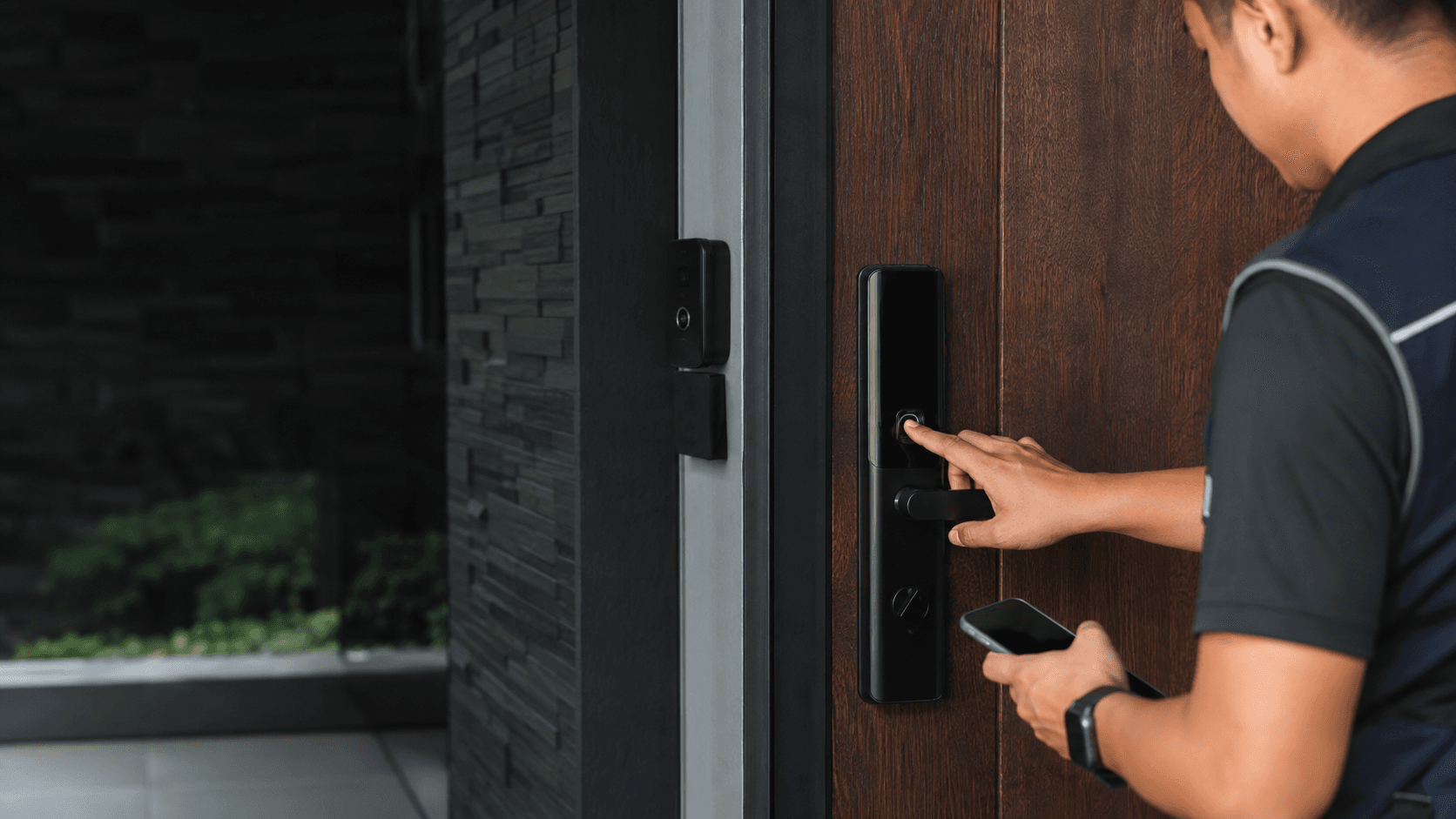
The home connect door lock category covers electronic deadbolts that speak a wireless protocol rather than standing alone. Kwikset builds these locks around Z-Wave and Zigbee radios, which means the lock joins a hub, panel, or app that already manages other devices in the building.
That distinction matters in Malaysia, where many homes and offices already run an alarm panel, CCTV recorder, or autogate motor. A lock that joins those systems avoids a second app and a second set of user codes.
Home Connect Door Lock. What Matters Before Choosing
Three things decide whether this category fits a property: the wireless protocol the existing hub supports, the physical door and frame condition, and the backup entry method if power or network fails.
Kwikset's own product pages describe Home Connect locks as communicating wirelessly with other devices, controllable from a phone, tablet, or another internet-connected device. The support pages for HomeConnect list Amazon Echo and SmartThings Hub among the integration points, alongside the Premis lock line.
Protocol choice is the first filter. A Z-Wave lock pairs with a Z-Wave controller. A Zigbee lock pairs with a Zigbee controller. A hub that speaks only one protocol will not manage a lock built for the other, regardless of brand.
- Confirm which wireless protocol the existing hub, alarm panel, or automation controller supports.
- Check the door thickness, backset, and whether the existing deadbolt bore hole matches a standard replacement.
- Decide the entry methods. keypad code, touchscreen code, physical key, or app control.
- Plan the backup path for a flat battery, lost phone, or dropped network connection.
- Set user roles and code permissions before handover, especially on a shared or commercial door.
Choosing the Right Home Connect Door Lock
Kwikset's electronic lock range splits into keypad models, touchscreen models, and deadbolt form factors. The Home Connect 918 appears in both contemporary and traditional touchscreen versions with Z-Wave 700, while the Home Connect 620 is a traditional keypad deadbolt with Z-Wave Plus and a physical key slot.
The key slot is a practical dividing line. A model with a keyway still allows mechanical entry when the electronics fail or the battery drains. A fully keyless model depends entirely on code entry and battery health.
For a rented property or a door that must keep a master key system, the keyed version keeps the existing keyway logic intact. For a door where key control is the problem being solved, the keyless version removes that variable.
Protocol and Hub Compatibility
Z-Wave and Zigbee both let a lock report status and accept commands through a controller. The lock does not need its own internet connection; the hub provides that. This is why the same lock can appear in a home app, an alarm panel interface, or an automation scene.
Compatibility lists published by retailers show these locks working with panels and hubs from multiple vendors, including Alarm.com-based systems and common Z-Wave controllers. The lock is one node in that network, not a separate ecosystem.
Door Condition and Fit
Smart locks work best when the door condition, user roles, and backup method are reviewed before installation. A warped door, a misaligned strike plate, or a frame that has shifted will cause a motorised deadbolt to bind, and binding shortens battery life and creates false lock errors.
Eyonic's own review guidance on smart lock door access notes that for business use, the choice between a standalone smart lock and a full access-control panel should be checked first. A single office door and a multi-door staff entrance are different problems.
What Is Home Connect Door Lock Technology?
Home Connect is Kwikset's name for the wireless capability built into a set of its electronic locks. The lock contains a radio that communicates with a hub or controller, which in turn connects to a phone app, an alarm system, or an automation platform.
The practical result is remote locking and unlocking, code management from an app, and status reporting. A door can be checked or released without walking to it, provided the hub and network are running.
This is not the same as a standalone keypad lock. A standalone lock stores codes locally and offers no remote visibility. A home connect door lock adds the network layer, and with it the dependency on that network.
Z-Wave and Zigbee in Plain Terms
Z-Wave uses existing smart home devices for lock and unlock capabilities, and the same logic applies to Zigbee. Both are low-power mesh protocols designed for sensors, switches, and locks rather than video or bulk data.
Mesh means each mains-powered device can pass signals onward, which helps in larger buildings. Battery-powered locks do not repeat the signal, so a lock at the far end of a property depends on other devices in between.
Control Through an Existing Security System
When the lock joins an alarm panel or automation controller, control sits inside the system already managing the property. That can mean one interface for cameras, alarms, gates, and door locks, and one place to review who entered and when.
Eyonic's project work in Sarawak follows this pattern of consolidating systems rather than adding isolated devices. At the Kuching Immigration Office, the scope centred on arrival flow, staff areas, visitor movement, and dependable daily operation. At KTA Sarawak Sdn Bhd, the focus was staff movement, visitor handling, tidy cabling, and clearer daily site control.
Support for HomeConnect and Practical Limits
Kwikset maintains a dedicated HomeConnect support section covering compatibility and integration questions. That is the correct place to confirm whether a specific lock model works with a specific hub before purchase.
The limits are worth stating plainly. A lock that depends on a hub stops responding remotely if the hub loses power or the network drops. A lock with a flat battery stops responding entirely unless a keyway or external power option exists.
User permissions need planning on shared doors. A code that is never revoked after a staff change is a standing risk, and a lock with no audit trail cannot answer who entered and when.
Where a Standalone Lock Is the Better Fit
A single residential door with no existing hub gains little from network integration and takes on the cost and complexity of one. A standalone keypad lock covers that case with fewer failure points.
A commercial entrance with multiple users, shift patterns, and a need for records points the other way. There, integration with an access-control or alarm system carries more value than the lock hardware alone.
Practical Considerations for Installation
Installation is a deadbolt replacement in most cases, but the surrounding work decides whether the result holds up. Door alignment, strike plate position, and hub placement all affect daily reliability.
Eyonic's installation process runs through site survey, system proposal, installation, and handover. The same sequence applies to a lock that must join an existing system: the survey confirms the door, the hub, and the network path before anything is ordered.
Eyonic's published packages sit at RM 1,599 for a Hikvision CCTV package, RM 1,599 for a Hikvision alarm system, and RM 1,599 for an autogate package. Larger project work has run in the RM 8,000 to RM 18,000 range for an office setup and RM 12,000 to RM 28,000 for a public office installation, which shows how much scope changes the figure.
Battery life is the recurring maintenance item. Motorised deadbolts draw more current than a simple latch, and a binding door or a cold, damp environment will shorten the interval between changes.
Network and Power Dependencies
A home connect door lock needs the hub running for remote functions. If the hub sits on a plug that is easily switched off, remote control disappears with it. Placing the hub on a stable circuit and confirming mesh coverage at the door prevents most complaints.
Backup entry deserves a decision before installation, not after. That can be a physical key, a second code held offline, or a documented procedure for a building manager.
Working With an Installer in Sarawak
Eyonic Sdn Bhd plans, supplies, and installs security and ELV systems for homes, offices, shops, and industrial sites in Sarawak. The company's founder, Eric Yong, has worked in technical installation of digital security solutions for commercial businesses in the state for more than ten years.
For a lock that must integrate with an existing alarm or automation system, the useful starting information is the property location, the property type, and the system already in place. That determines whether a home connect door lock, a standalone smart lock, or a panel-based access-control setup is the right answer.
Eyonic can be reached on WhatsApp at +60 11-5111 7959 with those details.
Making an Informed Choice About Hardware
The decision comes down to what already exists on site. A property with a Z-Wave or Zigbee hub, an alarm panel, and a need for remote visibility gets real value from a home connect door lock. A property with none of those gets a simpler and more reliable result from a standalone keypad lock.
Confirm the protocol, confirm the door, and confirm the backup entry method before ordering. Those three checks prevent the most common failures, and they cost nothing to run.