
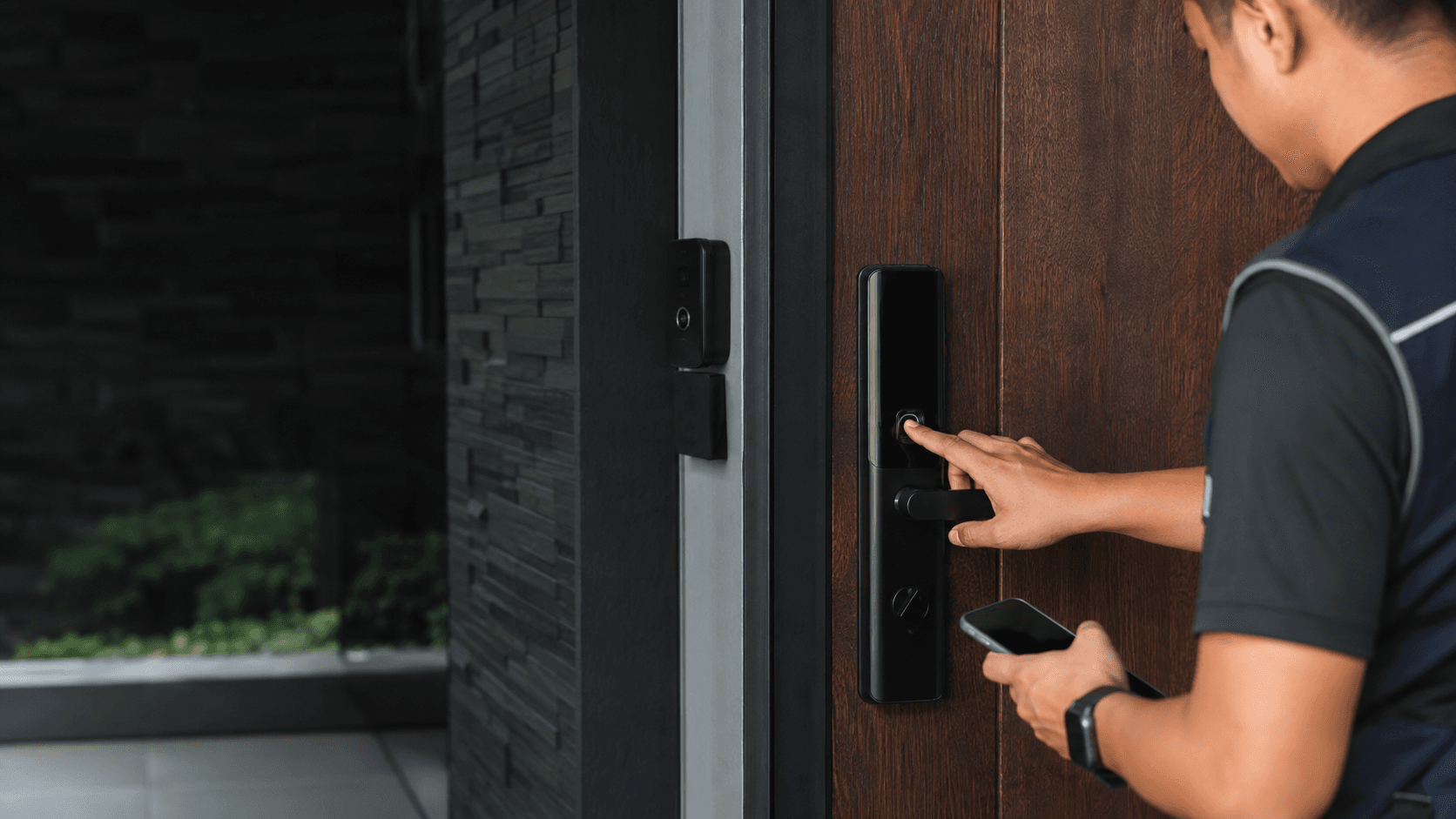
The term covers a small family of door hardware rather than one product. A fingerprint door lock reads a stored print and releases the bolt. A keypad lock asks for a code instead. Many units sold today do both, and some add app control or a physical key as a fallback. The category sits inside the wider smart lock door access market, which also includes card readers and panel-based systems used in offices.
Malaysian homes rarely need the same specification as a commercial entrance. A single-family terrace house in Kuching has different traffic from a shop lot with staff arriving in shifts. That difference drives the choice between a standalone lock and a managed access-control panel.
Biometric Locks For Home. What The Term Covers
Biometric locks for home are door locks that verify a physical trait, usually a fingerprint, before releasing the latch. The reader sits on the exterior face. A stored template is compared against the presented print, and a match drives the motor or solenoid that retracts the bolt.
Three sub-types appear in the market. Fingerprint-only models carry a reader and little else. Combination models pair the reader with a numeric keypad. Connected models add Bluetooth or Wi-Fi so an app can issue temporary codes or log entries. The connected layer is optional and often the first thing to fail when the network drops, so it should not be the only way in.
Eyonic's own product review notes that smart locks work best when door condition, user roles and backup method are reviewed before installation. For business use, the same review checks whether a standalone smart lock or an access-control panel is more appropriate. That logic applies to a home with regular visitors, a helper, or a rented room.
Fingerprint And Keypad Entry Compared
Fingerprint entry suits people who carry nothing and want the door open in one motion. It fails when a finger is wet, dirty, or injured. Keypad entry suits shared households where a code can be changed after a tenant leaves. It fails when the code is shared too widely or written down near the door.
Most buyers end up with both. A fingerprint door lock with a keypad gives each household member a personal print and a shared code for guests. The trade-off is a larger exterior unit and more components that can wear.
Neither method removes the need for a mechanical fallback. A keyed override or a 9V jump terminal is standard on many models, and it is the difference between a locked-out evening and a locksmith call. The specific backup method varies by model, so it should be confirmed against the actual unit before purchase rather than assumed from the category.
Door Condition And User Roles Before Purchase
Door condition decides whether a biometric lock can be fitted at all. The checks below are the ones that most often change the recommendation, and they are worth completing before any model is chosen.
- Measure the door thickness and the backset, which is the distance from the door edge to the centre of the existing bore hole. A lock sized for the wrong backset will not align with the strike.
- Check the door material and frame. Solid timber and metal frames hold a mortise or deadbolt well; hollow or warped doors may need repair first.
- Confirm the existing cutout. A lock that replaces a standard deadbolt is simpler to fit than one requiring a new bore.
- List every person who needs routine access, and decide which of them should have a personal credential rather than a shared code.
- Decide the backup entry method and where the physical key or jump terminal will be kept.
- Confirm the power source and how the unit signals a low battery.
User roles matter more in shared properties. A landlord managing a rented unit needs to add and remove access without changing the hardware. A household with a live-in helper needs a credential that can be revoked on the last working day. A standalone lock with per-user slots handles this; a lock with one shared code does not.
Eyonic's smart lock door access review treats user permissions and backup entry as planning items rather than afterthoughts, which is the same sequence used on its commercial access work.
Backup Entry And Battery Planning
Every electronic lock eventually loses power. The planning question is what happens at that moment, and who is standing outside.
Three fallbacks exist in the market. A mechanical key cylinder is the most reliable because it does not depend on the lock's electronics. An external power terminal, often a 9V contact, lets a dead unit be woken for one entry. A second entrance with a conventional lock covers the case where the primary door fails entirely.
Battery type and replacement interval vary by model and are not published in a form that can be quoted here. The practical approach is to record the install date, note the low-battery warning behaviour during handover, and keep the specified cells on hand. A lock that warns early is easier to live with than one that warns late.
There is also a security trade-off. A mechanical override is a physical key that can be copied or lost. A jump terminal is a contact that anyone with a battery can use. Neither is wrong, but the choice should match the property. A home in a gated neighbourhood carries a different risk profile from a shop house on an open frontage.
Installation And Handover In Sarawak
Eyonic's installation process runs through site survey, system proposal, installation and handover. The same sequence applies to door access work, and the survey stage is where door condition and user roles are confirmed on site rather than from a photograph.
Eyonic is based in Sarawak and has completed work for the Kuching Immigration Office, covering arrival flow, staff areas, visitor movement and dependable daily operation. A separate project for KTA Sarawak Sdn Bhd involved a practical office setup in Kuching to support staff movement, visitor handling, tidy cabling and clearer daily site control. Both are access and movement projects rather than residential lock jobs, but they show the survey-first approach applied to real buildings.
Handover is the stage that decides whether the lock is usable a month later. It should cover enrolling each person's fingerprint, setting and testing codes, confirming the auto-lock delay, testing the backup entry, and showing how a credential is deleted. A lock handed over without a deletion walkthrough tends to keep an ex-resident's access long after they leave.
For properties outside Sarawak, coverage is not confirmed in the available material and should be checked directly before any site visit is planned.
Costs, Packages And Next Practical Step
No verified price for a biometric lock supply-and-install package is available here, so no figure is quoted. The published Eyonic packages at RM 1,599 cover Hikvision CCTV, the Hikvision alarm system and autogate, which are separate product categories and should not be read as lock pricing.
For comparison, the Kuching Immigration Office project carried an approximate budget of RM 12,000 to RM 28,000, and the KTA Sarawak Sdn Bhd project an approximate budget of RM 8,000 to RM 18,000. Both were multi-point access and movement projects rather than single-door residential work, so they set a scale reference rather than a lock price.
A single residential door lock sits well below those figures in scope. The variables that move the number are the number of doors, whether the existing cutout can be reused, whether a managed panel is needed for multiple users, and whether cabling is required for a connected model.
Share the location, property type and required system with Eyonic on WhatsApp at +60 11-5111 7959 for the next practical step.