
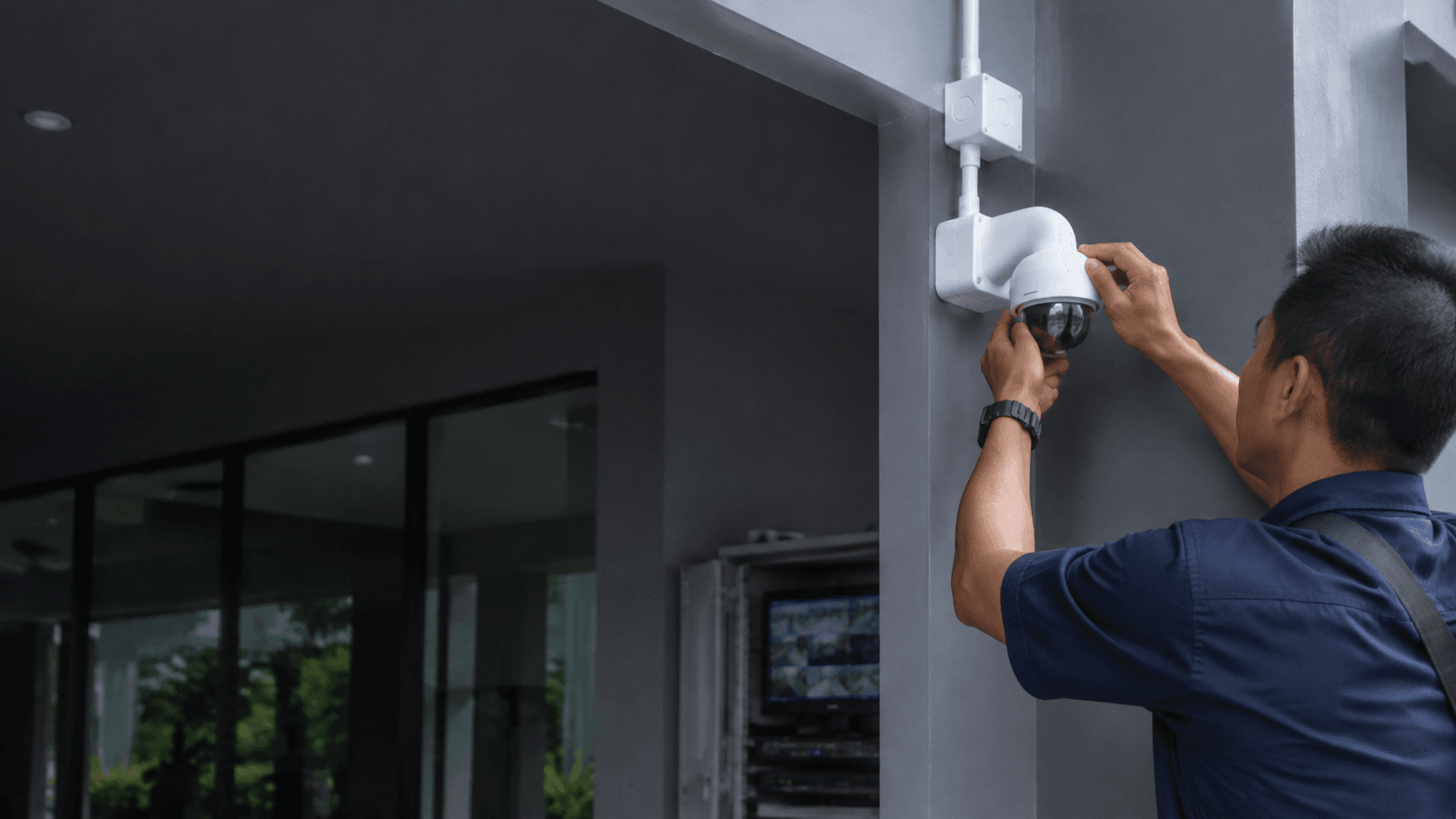
The range is broad enough that model names alone rarely settle a buying decision. What matters more is where a camera points, how it gets power, where footage lands, and who handles the physical work when a property in Malaysia needs more than one unit.
Tapo Cctv. What the Name Covers
Tapo is TP-Link's smart-home line, and its camera side sits alongside plugs, bulbs, and switches under one app. The cameras are Wi-Fi devices rather than traditional coax-and-DVR kits, which changes both the cabling and the way footage is reviewed.
TP-Link's own support documentation groups Tapo camera questions into installation, motion detection, live view, ONVIF and RTSP, audio and video, storage and recording, and account security. That structure is a useful map of what buyers actually run into after purchase: pairing, sensitivity tuning, remote playback, and how recordings are kept.
Two practical consequences follow from the Wi-Fi design. First, camera count and placement depend on wireless coverage rather than on how far coax can run. Second, storage decisions happen at the camera or account level, not at a central recorder, unless the setup is deliberately bridged to one.
Where Tapo Fits and Where It Does Not
A single camera watching a front gate, a shop counter, or a small office entrance is the natural fit. The model line is built around quick app-based setup, and TP-Link publishes step-by-step pairing guides for iOS and Android.
The fit weakens when a site needs many cameras across a large floor plate, long cable runs to a locked equipment room, or recording that must survive a camera being removed. Those are recorder-and-cabling problems, and they are usually solved with a different class of system.
Indoor and Outdoor Models in the Tapo Range
Tapo's product pages separate indoor cameras, indoor/outdoor cameras, and outdoor cameras, with variants that differ by mounting, pan and tilt movement, floodlight function, and power source. Some models are wired, some battery-powered, and some pair with a solar panel.
That spread matters because the outdoor category is not one thing. A wired outdoor camera needs a power point near the mounting position. A battery or solar model trades continuous recording for placement freedom. A floodlight model adds illumination, which changes both visibility and how conspicuous the camera is.
Because the supplied evidence does not include verified resolutions, weather ratings, or prices for specific Tapo models, those details should be confirmed against the current TP-Link or Tapo product page for the exact model under consideration rather than assumed from the brand name.
Choosing Between Indoor and Outdoor
Indoor models suit rooms where the camera sits on a shelf or bracket and points at a doorway, till, or corridor. Outdoor models suit entrances, car porches, and perimeter walls, where the housing and mounting have to tolerate weather and where the camera is often the first thing a visitor sees.
A common mistake is buying an indoor unit for a covered outdoor position. A roof overhang reduces rain exposure but does not make a camera an outdoor camera, and the difference usually shows up months later rather than on installation day.
Tapo Cctv Setup and Storage Options
Setup runs through the Tapo app. TP-Link's published guide walks through adding the camera, confirming pairing mode, connecting to the camera's own signal, then joining it to the home Wi-Fi network and naming the device. Ethernet-capable models offer a wired connection path during setup.
Storage is the decision that shapes daily use. TP-Link's support material covers local microSD recording, cloud storage, and the interaction between Tapo Care, SD card recording, and NVR, NAS, or ONVIF recording. Those options are not always usable at the same time, which is why the recording plan should be settled before cameras are mounted.
Motion detection settings also deserve early attention. Sensitivity, activity zones, and notification behaviour determine whether the system is useful or merely noisy, and TP-Link documents how to adjust sensitivity and how detection distance behaves.
Remote Viewing and Network Reality
Remote viewing depends on the camera reaching the internet and on the account being signed in on the viewing device. TP-Link's FAQ set covers bandwidth requirements, multiple simultaneous viewers, and what happens when Wi-Fi credentials change — the last of which is a frequent cause of a camera appearing offline.
For a Malaysian home or shop, the practical constraint is usually upload speed and Wi-Fi coverage at the camera position, not the camera itself. A camera at the far end of a shophouse may pair successfully indoors and still stream poorly once it is mounted at the back.
Placement and Lighting Checks
Placement decides more outcomes than model choice. A camera aimed at a bright doorway from inside a dark room will silhouette faces. A camera aimed at a reflective surface will record glare. A camera mounted too high will capture heads and not faces.
Eyonic's own guidance on ColorVu-style cameras is to check actual lighting conditions before confirming placement, because low-light performance claims and real site conditions do not always match. The same discipline applies to any camera chosen for night duty, including Tapo models.
Night vision behaviour is worth testing on site rather than trusting a specification line. Infrared reflection from walls, eaves, and signage can wash out part of the frame, and the fix is usually a small change in angle or distance rather than a different camera.
Coverage Angles and Privacy
Two cameras at sensible angles generally beat one camera with a wide view, because wide views trade detail for coverage. Entrances, cash handling points, and vehicle approaches are the positions that repay a dedicated camera.
Privacy zones and activity zones exist for a reason. A camera that overlooks a neighbour's window or a public walkway creates a problem that is easier to avoid at the placement stage than to correct afterwards.
Supply and Installation in Sarawak
Eyonic Sdn Bhd is a security system supplier in Sarawak that plans, supplies, and installs monitoring systems with camera placement, recording, and remote viewing for homes, offices, shops, and industrial sites. The company's published installation process runs through four stages.
- A site survey to review the property, existing cabling, power points, and network coverage.
- A system proposal covering camera positions, recording approach, and the equipment list.
- Installation of cameras, cabling, and recording equipment.
- Handover covering live view, playback, and mobile viewing.
That sequence is the same one Eyonic applies to larger work. For the Kuching Immigration Office, the project focused on arrival flow, staff areas, visitor movement, and dependable daily operation, with an approximate budget range of RM 12,000 to RM 28,000 for that type of work. A KTA Sarawak Sdn Bhd office project in Kuching addressed staff movement, visitor handling, tidy cabling, and clearer daily site control, with an approximate budget range of RM 8,000 to RM 18,000.
Those figures describe commercial office projects, not a Tapo camera installation, and they should not be read as a price for a single-camera job. They do show the scale at which a surveyed and cabled installation is normally quoted.
Eyonic's published packages start at RM 1,599 for a Hikvision CCTV package covering camera supply and setup, basic recording configuration, and mobile viewing handover. The same figure applies to the alarm system and autogate packages. These are Hikvision-based packages, and the supplied evidence does not confirm that Eyonic supplies or installs Tapo products, so that question is best settled directly before assuming a brand match.
What a Site Survey Actually Resolves
A survey answers questions that a product page cannot: where power is available, whether the Wi-Fi reaches the mounting point, how cable can be routed without damaging finishes, and which positions give usable images at night. It also surfaces the awkward cases — a shop with a roller shutter, a house with a long driveway, an office with a shared corridor.
For a single Tapo camera in a small home, self-installation is often reasonable. For a shop or office needing several cameras, consistent recording, and tidy cabling, the survey and handover stages are where most of the value sits.
Questions Before Confirming a System
Most hesitation around Tapo Cctv comes down to a handful of unresolved points rather than the cameras themselves.
Does the camera need a subscription? TP-Link's support material distinguishes local microSD recording from cloud storage, and notes that Tapo Care, SD card, and NVR or NAS recording cannot always run together. Local recording avoids a recurring cost; cloud recording adds off-site retention. The trade-off is between monthly spend and the risk of a camera being taken along with its card.
Can it work without Wi-Fi? TP-Link documents this directly, and the answer depends on the model and whether a local recording path exists. A camera with no network still records locally in some configurations, but remote viewing stops.
Will it integrate with an existing recorder? ONVIF and RTSP support varies by model, and TP-Link's FAQ set addresses NAS, NVR, and DVR compatibility. This is worth confirming by exact model number before purchase if the plan is to fold Tapo cameras into an existing system.
Who installs it? That is the question the product pages do not answer. A property in Sarawak with several cameras, long cable runs, or a requirement for tidy workmanship is usually better served by a supplier who surveys first and hands over a working system, rather than by a series of separate purchases.
Share your location, property type and required system with Eyonic on WhatsApp at +60 11-5111 7959 for the next practical step.