
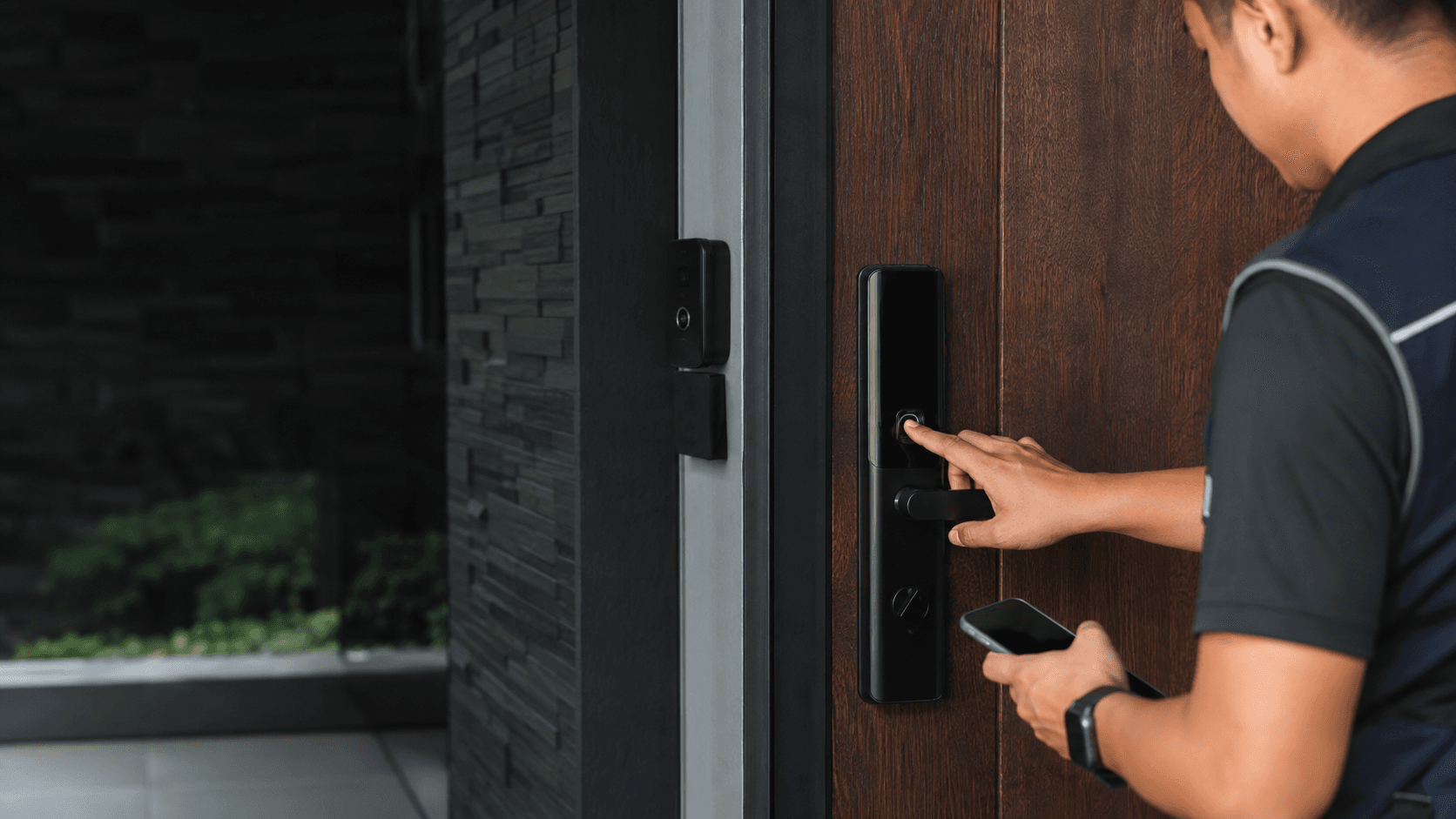
The phrase best z wave door lock points to a comparison question, but the deciding evidence sits on the door itself. Lock bodies differ in how they mount, hubs differ in which devices they accept, and buildings differ in who needs a key, a code, or a card. Eyonic, a security system supplier in Sarawak, reviews door condition, user roles and backup method before recommending smart lock work, and checks whether a standalone lock or an access control panel suits a business site.
Best Z Wave Door Lock. What Actually Decides The Choice
A lock that ranks well in a review roundup can still fail on a specific door. The useful comparison starts with four physical and operational facts, then moves to the electronics.
- Check the door condition. thickness, backset, bore hole size, door material, and whether the frame closes squarely enough for a motorised bolt.
- List the user roles. who needs permanent entry, who needs temporary entry, and who only needs to pass through during working hours.
- Agree the backup entry method before installation, so a flat battery or a failed hub does not lock people out.
- Confirm hub compatibility, because a Z-Wave lock joins a network through a controller rather than connecting directly to a phone.
- Plan the handover. codes issued, app access granted, test entries completed, and a named person responsible for future changes.
Those five checks come before brand shortlisting. A lock that passes them is a candidate; a lock that fails any of them is a return, a re-drill, or a support call.
What A Z Wave Door Lock Connects To
A Z-Wave lock is a node on a wireless mesh network. It talks to a hub or controller, and the controller passes commands to an app, a keypad, or a wider system. The lock does not need household Wi-Fi to open, but remote control usually depends on the hub being online.
This matters in Malaysia because hub choice often follows what a household or business already owns. A lock that works with one controller may not appear in another controller's device list, and pairing behaviour can differ between hub generations. Compatibility should be confirmed against the specific hub in use, not against the Z-Wave name alone.
For a business, the same question becomes an architecture question. Eyonic reviews whether a standalone smart lock or an access-control panel is more appropriate, because a panel handles multiple doors, shared rules and audit needs that a single lock cannot. A shop with one staff entrance and a home with one front door sit at opposite ends of that decision.
Deadbolt Replacement Or Retrofit
Two installation paths exist, and they suit different buildings.
A deadbolt replacement removes the existing deadbolt and fits a new motorised lock in its place. It usually gives a cleaner result and a full keypad or keyed exterior, but it depends on the door accepting the new body and on the existing bore and backset matching the lock's requirements.
A retrofit lock keeps the existing deadbolt and attaches a motorised unit to the interior side, turning the thumbturn. It suits rented apartments and doors that should not be drilled, and it preserves the original key cylinder. The trade-off is that the exterior still looks like the old lock, and the retrofit body must fit the door's interior face and trim.
Neither path is automatically better. A solid timber door with a standard bore favours replacement. A rented unit with a landlord's original hardware favours retrofit. A metal or glass door may rule out both without additional fabrication.
Door Condition, User Roles And Backup Entry
Door condition is the most common reason a lock project stalls. Thickness, backset, bore diameter, door alignment and frame condition all affect whether a motorised bolt can throw and retract reliably. A door that swells in wet weather can bind a bolt that worked during the dry season, which is a real consideration in Sarawak's climate.
User roles decide the feature set. A home needs a handful of codes and a simple way to add or remove a helper. An office needs grouped permissions, time-limited access for contractors, and a record of who entered. A lock with a small user limit will not serve a site with rotating staff, and a lock with complex administration will frustrate a household.
Backup entry deserves a decision before installation, not after. Options include a mechanical key, a keypad code, an external power point for a flat battery, or a second entrance. The right choice depends on who is on site, what happens outside working hours, and how quickly a locksmith or technician can attend. A backup method that nobody can reach is not a backup method.
Battery, Keypad And Alarm Details Worth Comparing
Battery life is a maintenance interval, not a specification to admire. A lock that reports low battery through the hub gives warning before failure; a lock that only beeps at the door gives warning to whoever happens to be standing there. For a business, the reporting behaviour matters more than the claimed duration.
Keypad design affects daily use. Backlit keys help at night, physical buttons suit gloved hands, and touchscreens need a clean surface to register presses. Codes should be changeable without dismantling the lock, and temporary codes should expire on their own where the lock supports it.
Built-in alarms and tamper alerts are useful only if someone receives them. A lock that sounds a siren inside an empty shop adds little; the same alert routed to a phone or an alarm panel adds real value. This is where a lock decision meets the wider alarm and monitoring setup, and where a site with existing security infrastructure should check integration before buying.
Installation And Handover In Sarawak
Installation quality decides whether a good lock performs well. Door preparation, bolt alignment, hub pairing and code setup are separate tasks, and skipping any of them produces a lock that works on the bench and fails at the door.
Eyonic's installation process runs through site survey, system proposal, installation and handover, and the same sequence applies to access work. The survey confirms door condition and hub compatibility on site. The proposal sets out what will be supplied and fitted. Installation pairs the lock, tests the bolt, and configures users. Handover covers codes, app access, backup entry and who to contact for changes.
Eyonic has completed access and security work for the Kuching Immigration Office, covering arrival flow, staff areas, visitor movement and dependable daily operation, and for KTA Sarawak Sdn Bhd, covering staff movement, visitor handling and tidy cabling. Both projects show the same pattern: the operational flow is planned first, and the hardware follows.
For readers comparing options in Malaysia, the practical next step is to record the door's measurements, the hub in use, the number of people needing entry, and the preferred backup method. Those four items turn a general search into a specific, installable specification. Eyonic can be reached on WhatsApp at +60 11-5111 7959 with the location, property type and required system.