
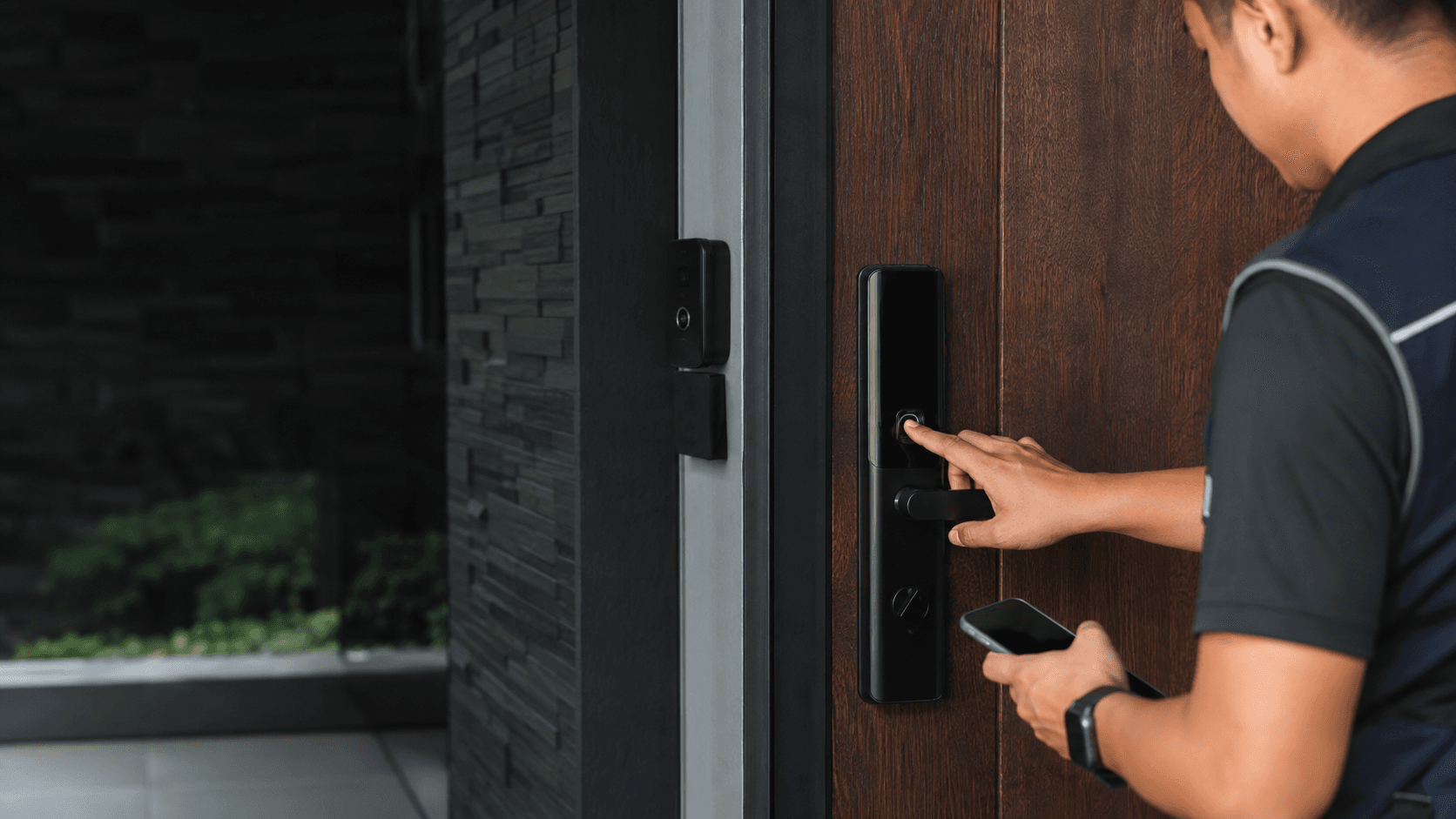
The exact-match phrase "keyless mortise lock" describes a category of door hardware rather than one product. The lock case is mortised, meaning it is recessed into the door, and the credential replaces the key cylinder. That combination changes what has to be checked before purchase, because the door itself becomes part of the specification.
Eyonic Sdn Bhd, a security system supplier in Sarawak, reviews smart lock door access with the same starting questions: door condition, user roles and backup method. Those three checks decide whether a keyless mortise lock is the right fit or whether a different access-control approach suits the opening better.
Keyless Mortise Lock. What It Is and Where It Fits
A mortise lock is a self-contained lock body that slides into a rectangular cavity cut into the edge of a door. The latch, the deadbolt and the locking mechanism all live in that one case. Because the case sits inside the door, the visible hardware is limited to the handle set, the escutcheon plates and the credential reader.
A keyless version replaces the mechanical key cylinder with an electronic reader and a controller. Entry happens through a PIN code, an RFID card, a fingerprint scan, a mobile app over Bluetooth or Wi-Fi, or a combination of those methods. The mechanical override, where one exists, is usually a concealed keyway or an external power point rather than a visible keyhole.
This design suits doors where the frame and leaf are thick enough to hold a mortise case. Solid timber doors, metal doors and many commercial door assemblies fall into that group. Hollow-core doors and thin residential leaves generally do not, because there is not enough material to cut a stable pocket.
The trade-off is straightforward. A mortise lock gives a cleaner face, a stronger lock body and a wider choice of credential methods than a surface-mounted deadbolt. It also demands more door preparation, and preparation is the part that cannot be undone cheaply if it goes wrong.
Door Condition and Cavity Checks Before Any Purchase
The door decides whether a keyless mortise lock is viable. A cavity has to be cut or matched, and the surrounding material has to hold the case without splitting, warping or losing alignment.
Five conditions matter most. The first is door thickness, because the case and the through-bolts are sized to a range. The second is the existing preparation, since a door already cut for a mortise lock may accept a new case and a door with only a bored cylindrical hole usually will not. The third is the backset, the distance from the door edge to the centre of the spindle or cylinder. The fourth is the stile width, the solid vertical section at the door edge, which has to be wide enough for the pocket. The fifth is the frame and strike, because a new lock body has to align with the strike plate already in the frame or the frame has to be modified.
Door material and condition carry equal weight. A swollen timber door, a rusted metal frame or a leaf that already drags on the threshold will not improve with heavier hardware. Alignment problems that exist before installation tend to reappear after it.
For commercial openings, the check extends to fire-rated assemblies and egress requirements. A door on an escape route has specific hardware expectations, and changing the lock body can affect how the door behaves under those conditions. That is a question for the door supplier or the relevant authority rather than for the lock retailer.
- Measure the door thickness and confirm it falls within the lock body's stated range.
- Identify the existing preparation: mortise cavity, cylindrical bore, or no preparation at all.
- Record the backset and the stile width at the door edge.
- Check the frame, strike plate and door alignment for existing drag or misalignment.
- List every person or group that needs entry, and what each should be allowed to open.
- Decide the backup entry method if the credential fails, the battery drains or the network drops.
- Confirm the power source, expected battery change interval and any wiring the door can accept.
- Test the installed lock across all credentials, the backup method and the closing action before handover.
User Roles, Permissions and Backup Entry
Access design comes before hardware selection. A household needs one set of rules; an office with staff, cleaners, contractors and visitors needs another. The lock has to express those rules, not the other way around.
Most keyless mortise lock systems support multiple user slots with different permission levels. A common pattern gives permanent codes to residents or long-term staff, time-limited codes to contractors and service providers, and one-off codes to guests. Some systems log every entry with a timestamp and a user identity, which is useful when a door needs to be accounted for rather than simply opened.
Eyonic's own guidance on smart lock door access notes that smart locks work best when door condition, user roles and backup method are reviewed before installation, and that for business use the choice between a standalone smart lock and an access-control panel should be checked first. That distinction matters. A standalone lock manages one door. An access-control panel manages many doors, shared credentials and central records, and it usually costs more to install because it involves wiring and a controller.
Backup entry is the part most often left until after installation. Options include a mechanical key override, a concealed keyway, an external power terminal for a temporary battery, or a second credential type that does not depend on the same failure point. A lock that only opens through a mobile app is exposed to a flat phone battery, a lost phone or a dropped network connection. A lock with a key override is exposed to key duplication and key loss. Neither is wrong; the choice depends on who needs guaranteed entry and how often.
For a public-facing site, the Kuching Immigration Office project shows the pattern Eyonic works to: arrival flow, staff areas, visitor movement and dependable daily operation. A door that hundreds of people pass through in a day has different reliability expectations from a store room door opened twice a week.
Keyless Mortise Lock Options Seen in the Malaysian Market
Malaysian buyers generally meet this category through three routes: international lock brands sold through local dealers, regional smart-lock brands with local distribution, and imported units bought directly online. Each route carries a different balance of support, spares and warranty handling.
Credential methods vary by model. PIN pads and RFID cards are common in commercial settings because they are cheap to issue and easy to revoke. Fingerprint readers suit smaller user groups where enrolment is manageable. Mobile app access over Bluetooth or Wi-Fi adds remote management and entry logs, but it also adds a dependency on the phone, the app and the network.
Power source is the other dividing line. Battery-powered locks avoid wiring but require a maintenance routine and a plan for the moment the battery runs down. Wired locks avoid battery changes but need a power path to the door, which is often the more expensive part of the job in an existing building.
Retrofit options exist for doors that already have a mortise preparation, and they are usually the simplest path because the cavity is already there. Doors with a cylindrical bore and no mortise pocket generally need either a new preparation or a different lock type. That is a physical constraint, not a preference.
Availability, stock levels and lead times for specific models in Malaysia are not something this article can state, because that information changes and has not been verified here. A dealer or installer can confirm what is currently obtainable.
Installation and Handover. What a Site Survey Covers
Eyonic's installation process runs through site survey, system proposal, installation and handover. Applied to door access, that sequence means the door is assessed before anything is ordered, the proposed hardware and access rules are set out in writing, the work is carried out, and the finished system is tested with the people who will use it.
A site survey for a keyless mortise lock typically covers the door and frame condition, the existing preparation and measurements, the material and thickness of the leaf, the routing for any power or network connection, and the list of users and their permissions. It also covers the practical questions: how a visitor announces themselves, how a delivery is handled, and what happens at the end of the day when the last person leaves.
Installation itself involves cutting or adjusting the mortise cavity, fitting the lock case, aligning the strike, mounting the reader and handle set, and connecting power or network where required. On an existing door, the cavity work is the step most likely to reveal a problem, because the internal structure of the door is not visible until it is opened up.
Handover is where the system either works or does not. It should include enrolling each user, testing every credential type, testing the backup entry method, confirming the lock engages and releases cleanly with the door closed, and showing the responsible person how to add or remove a user. A lock that has never been tested with the door shut has not been tested.
Cost, Budget Ranges and Evidence Gaps
Cost for a keyless mortise lock depends on the lock body, the credential reader, the number of doors, the door preparation required and whether power or network has to be run to the opening. Those variables move the figure far more than the brand name does.
Eyonic's published package pricing covers RM 1,599 for a Hikvision CCTV package, RM 1,599 for a Hikvision alarm system and RM 1,599 for an autogate package. Those figures relate to CCTV, alarm and autogate work, not to locks, and they should not be read as lock pricing. For larger access and security projects, Eyonic's completed work has carried approximate budgets in the range of RM 8,000 to RM 18,000 for an office setup and RM 12,000 to RM 28,000 for a public office project. Those ranges describe whole projects, not a single door lock.
Verified pricing for keyless mortise lock products or installation in Malaysia is not available in the evidence behind this article, and no figure is offered here in its place. The same applies to technical specifications such as backset, door thickness range, battery life and connectivity protocols, and to brand, model, warranty and security-rating claims. Those details belong on a manufacturer datasheet or a dealer quotation for the specific model under consideration.
The practical conclusion is that the door survey comes before the budget conversation. Once the door condition, the cavity measurements, the user list and the backup method are known, the hardware options narrow to a small set and the cost becomes a real number rather than a range.
For readers in Sarawak working through those checks on a specific property, Eyonic can be reached on WhatsApp at +60 11-5111 7959 with the location, property type and required system.