
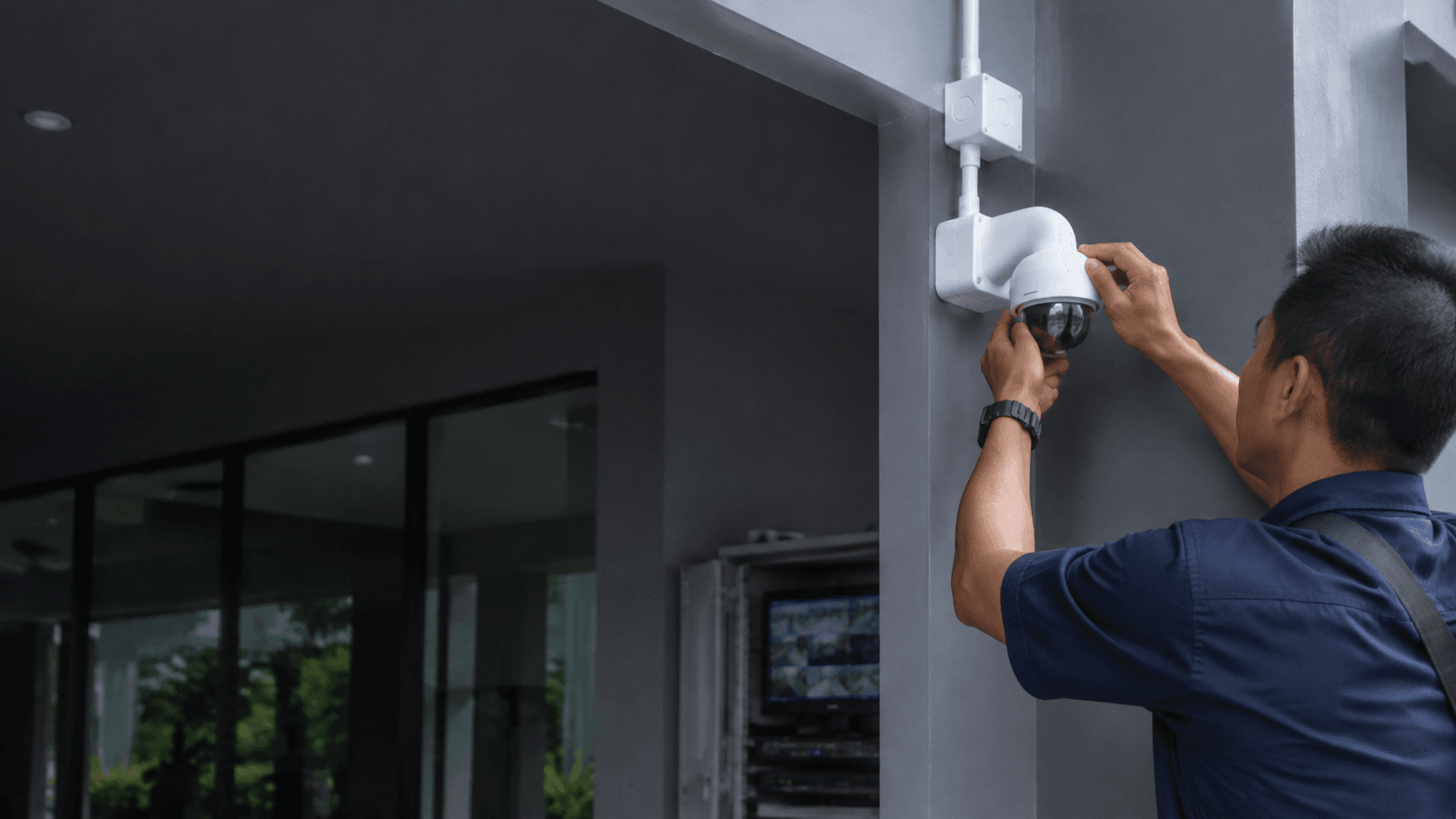
Most buyers picture a camera that simply never stops. The hardware can do that, but the recording only continues when power, storage and light all hold up at the same time. Remove any one of the three and the footage develops holes — a dead hour during a blackout, an overwritten clip from three days ago, or a grey blur where a face should be.
Eyonic Sdn Bhd plans, supplies and installs monitoring systems with camera placement, recording and remote viewing for homes, offices, shops and industrial sites in Sarawak. The sections below cover what always-on recording actually requires, how the recording modes differ, and how a local installation is planned and handed over.
24 Hour Security Camera: What Always-On Recording Requires
Always-on recording is a chain, not a single feature. The camera captures, the recorder writes, the drive stores, and the network carries the result to a phone or monitor. Each link has to survive the full 24 hours, including the hours when nobody is watching.
Three conditions decide whether the chain holds:
- Power that does not stop. A camera on mains power or Power over Ethernet keeps running through the night. A battery camera that records continuously drains far faster than one that wakes on motion, so battery models suit event recording better than round-the-clock capture.
- Storage sized for the whole period. Continuous recording writes every second, so the drive fills faster than motion-triggered recording ever would. Retention depends on how many cameras run, the resolution and compression in use, and the size of the drive.
- Lighting that still resolves detail. A camera can record in near darkness and still produce footage too soft to identify anyone. Eyonic recommends checking actual lighting conditions before confirming placement for ColorVu-style cameras, because the real scene at night decides whether colour detail survives.
Two smaller factors matter at the edges. Network bandwidth affects remote viewing more than recording, since the recorder writes locally whether or not anyone is streaming. Heat and dust affect drives and camera housings over long runs, which is why placement and enclosure choice belong in the survey rather than the shopping list.
Power, Storage and Lighting Decide Whether Recording Continues
These three constraints interact. A site with excellent lighting can run a lower-resolution stream and stretch storage further. A site with poor lighting may need cameras positioned closer to the subject, which changes cabling and power runs. Storage and power are therefore planned together, not chosen separately.
Power options and what each one suits
Wired power and PoE suit fixed cameras that must record continuously, because the supply never needs recharging. Plug-in wireless cameras work where a socket sits near the mounting point. Battery and solar cameras trade continuous recording for placement freedom, and they typically wake on motion instead of writing every frame.
Storage and retention
Continuous recording is usually written to a network video recorder with an internal hard drive, which keeps footage on site without a monthly fee. Retention is a planning decision: a site that needs a month of history needs a larger drive than one that needs a week. The honest answer is that retention cannot be quoted without knowing camera count, resolution and compression, so it belongs in the survey conversation rather than a product page.
Lighting conditions
Night performance separates a system that identifies people from one that only shows movement. Colour night-vision cameras need some ambient light to hold colour, while infrared cameras fall back to monochrome. A survey that checks the actual scene at night — street lighting, entrance lamps, reflective surfaces — prevents the common mistake of mounting a camera where the daytime view looks perfect and the night view does not.
How Eyonic Plans a 24 Hour Security Camera Installation
Eyonic's CCTV installation process runs through four documented stages, from first visit to handover.
- Site survey. The property is reviewed on location, including camera placement options, lighting conditions, cabling routes and where the recorder will sit.
- System proposal. The survey findings become a proposed system covering cameras, recording and remote viewing, matched to the property type and the areas that need coverage.
- Installation. Cameras, cabling and the recorder are installed and configured, including NVR setup and recording configuration.
- Handover. Recording and mobile viewing are demonstrated so the owner can check footage and view the site remotely.
The order matters. Placement decided before the survey tends to miss the angles that actually matter, and storage decided before camera count is known tends to be undersized. A survey-led sequence avoids both.
What the survey is looking for
The survey answers questions a product listing cannot: which entrances need identification rather than detection, where a camera can see a face rather than a back, whether existing cabling can be reused, and where the recorder can sit with ventilation and access. For commercial sites, staff and visitor movement patterns shape placement as much as perimeter coverage does.
Kuching Immigration Office. Arrival Flow Staff Areas and Visitor Movement
Eyonic completed a project for the Kuching Immigration Office, a public office in Kuching, focused on arrival flow, staff areas, visitor movement and dependable daily operation. The approximate budget for that type of work is RM 12,000 to RM 28,000.
The scope shows how a public-facing site differs from a home. Arrival flow means the entrance and queue areas need coverage that holds up during busy periods. Staff areas need separate consideration from public zones. Visitor movement means the path through the building matters as much as the door itself. Dependable daily operation is the requirement that ties back to continuous recording: a public office cannot afford gaps in the record during operating hours.
A second Eyonic project, for KTA Sarawak Sdn Bhd, covered a practical office setup in Kuching to support staff movement, visitor handling, tidy cabling and clearer daily site control, with an approximate budget of RM 8,000 to RM 18,000. Both projects point to the same planning habit: coverage follows how people actually move through a site.
Recording Options Compared. Continuous Motion and Scheduled
Continuous recording is one of three common modes, and it is not always the right one. The table below contrasts what triggers each mode, how storage demand differs, and where each fits.
| Recording mode | What triggers recording | Storage demand | Suits |
|---|---|---|---|
| Continuous | Nothing — the camera writes constantly | Highest, because every second is stored | Sites where gaps are unacceptable, such as public counters, cash handling and entrances |
| Motion-triggered | Movement detected in the scene | Lower, since idle periods are not written | Low-traffic areas, battery and solar cameras, and sites watching for events rather than activity |
| Scheduled | Set hours, such as after closing | Moderate, limited to the chosen window | Offices and shops where only out-of-hours coverage is needed |
Many systems combine modes. continuous recording on the main entrance, motion recording on a back lane, and a schedule on an internal corridor. Mixing modes is often the practical answer, because it spends storage where the footage is most likely to be needed.
Where continuous recording is the wrong choice
A battery camera asked to record continuously will not last long between charges, and a site with no fixed power at the mounting point is better served by motion recording. A low-risk area with heavy foot traffic can also generate so much continuous footage that reviewing it becomes harder, not easier. Continuous recording earns its storage cost where the record itself is the point.
Practical Next Step for a in Malaysia
A working always-on system comes down to a survey that checks power, storage and lighting before anything is mounted. Eyonic's Hikvision CCTV Package is listed at RM 1,599 and covers camera supply and setup, basic recording configuration, and mobile viewing handover. Larger or multi-zone sites are quoted from the survey, as the Kuching Immigration Office and KTA Sarawak projects show.
Share your location, property type and required system with Eyonic on WhatsApp at +60 11-5111 7959 for the next practical step.