
That gap between RM 1,599 and RM 28,000 is the whole story of outdoor CCTV camera price in Malaysia. A package price covers a defined set of work. A project budget covers a site. The distance between the two is made of camera count, cable runs, recorder capacity, storage depth and how much of the work is done for the buyer rather than handed over as boxes.
Eyonic Sdn Bhd plans, supplies and installs monitoring systems with camera placement, recording and remote viewing for homes, offices, shops and industrial sites. The company's founder, Eric Yong, has worked in the industry for more than ten years, with a focus on technical installation of digital security solutions for commercial businesses in Sarawak.
Outdoor CCTV Camera Price in Malaysia: What the Figure Covers
A published package price and a surveyed project price answer two different questions. The package answers what a standard configuration costs. The survey answers what this building costs.
Eyonic lists a Hikvision CCTV Package at RM 1,599. The stated scope is camera supply and setup, basic recording configuration, and mobile viewing handover. Those three items are the spine of any quotation, and they are also the three places where scope quietly expands.
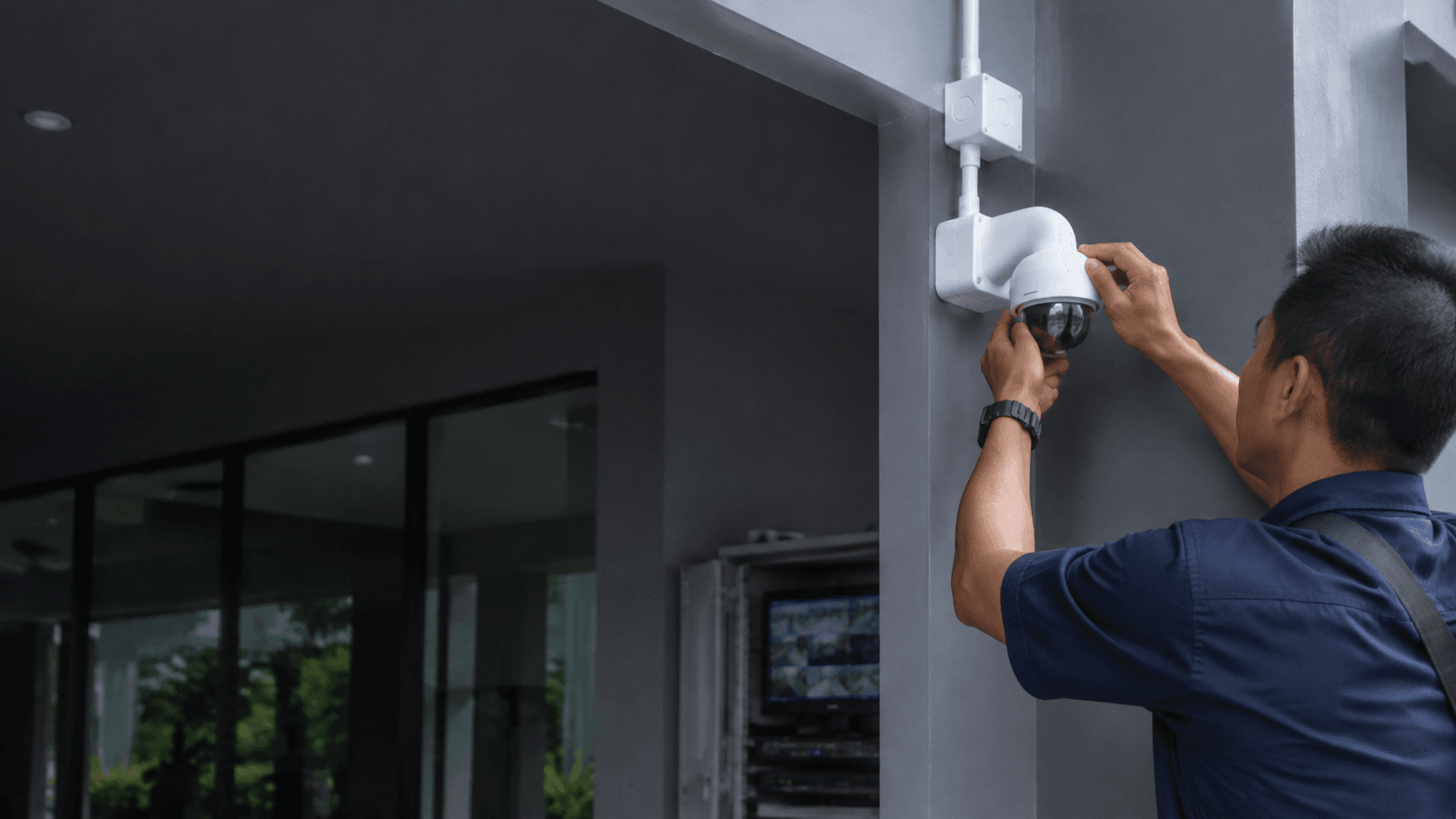
Camera supply and setup means the units, the mounting, and the initial configuration that makes each camera produce a usable image. Basic recording configuration means the recorder is set to capture and retain footage according to an agreed plan. Mobile viewing handover means the people who need to check the system can actually do so from a phone before the installer leaves.
What the package figure does not state is camera count, cable length, recorder model, storage capacity or retention period. Those are the variables that move a price. A quotation that names a figure without naming those four things is not yet a quotation; it is a starting point.
Why package pricing and project pricing diverge
Two completed Eyonic projects show the upper end of the range. The Kuching Immigration Office project carried an approximate budget of RM 12,000 to RM 28,000, covering arrival flow, staff areas, visitor movement and dependable daily operation. The KTA Sarawak Sdn Bhd project, an engineering consultancy office in Kuching, carried an approximate budget of RM 8,000 to RM 18,000 for staff movement, visitor handling, tidy cabling and clearer daily site control.
Both are commercial sites with multiple zones and a requirement for tidy cabling. Neither is a single-camera domestic job. The budgets reflect scope, not markup.
What an outdoor CCTV camera price includes beyond the camera unit
The camera unit is one line in a quotation. The rest of the figure is the work that makes the camera useful.
Cabling is usually the largest hidden variable. A camera mounted close to an existing cable path costs far less to connect than one mounted across a compound, through a wall, or at the far end of a perimeter. Cable route length, conduit, trunking and whether the route is accessible all change the labour content of the job.
Mounting hardware and weather exposure matter outdoors in ways they do not indoors. Brackets, junction boxes and sealing are part of the installation, and they are part of the price.
Power delivery is a separate decision. A camera that draws power over the network cable needs different infrastructure from one that needs a local power point at the mounting position. Where no power point exists, the cost of creating one belongs in the quotation.
Recording hardware sits behind every camera. An NVR setup is a distinct line item from the cameras themselves, and its capacity has to match the number of cameras and the retention period agreed with the buyer.
Configuration and handover are labour, not hardware, and they are frequently the first thing trimmed when a price is squeezed. A system that records correctly but cannot be checked from a phone has not been finished.
Supply-only versus supply and installation
Supply-only quotations price the equipment and leave the buyer to arrange mounting, cabling, configuration and handover. Supply and installation quotations price the finished working system.
The two are not comparable on headline figure alone. A supply-only price that looks lower often becomes more expensive once an electrician, a cabler and a configuration visit are added separately. The practical test is whether the quotation states who mounts, who cables, who configures recording, and who confirms mobile viewing works.
Camera placement and lighting checks before the price is fixed
Placement is decided before the price is fixed, because placement determines cable length, mounting method and how many cameras are needed to cover the same area.
Eyonic recommends checking actual lighting conditions before confirming placement for ColorVu-style cameras. That recommendation exists because a camera chosen for low-light performance only delivers that performance if the position genuinely matches the lighting on site. A position that looks adequate on a plan can behave differently once the sun sets, street lighting is accounted for, and reflections from nearby surfaces are considered.
Coverage overlap is the other placement decision. Two cameras angled to cover an entrance from different directions cost more than one camera pointed at the same door, and they also remove the single point of failure that a lone camera creates. Whether that redundancy is worth the cost depends on what the entrance protects.
Height and angle affect identification, not just detection. A camera mounted high enough to be out of reach may capture the top of a head rather than a face. Placement that balances tamper resistance against usable image detail is a survey decision, and it is one of the reasons a site visit changes a quotation.
Recording, storage and remote viewing in the quoted scope
Recording configuration determines how far back the footage goes. Retention is a function of camera count, resolution, recording schedule and storage capacity. More cameras or longer retention requires more storage, and storage is a cost line.
Continuous recording and motion-triggered recording produce very different storage demands. A site that needs continuous coverage of a public counter has different requirements from a site that only needs to capture movement after hours. The recording configuration should match the operational need rather than defaulting to the most storage-hungry option.
Remote viewing is the feature most often assumed and least often verified. Mobile viewing handover means the responsible people have the app installed, the cameras labelled, and the access confirmed while the installer is still on site. A handover that consists of a password written on a box is not a handover.
Where a site has multiple users with different levels of access, the configuration work grows. Staff who need to view one area and managers who need to view all areas require separate permissions, and permissions take time to set up and test.
A numbered walkthrough from site survey to handover
Eyonic's CCTV installation process runs through four stages. Each stage produces something the buyer can check.
- Site survey. The property is reviewed for camera positions, lighting conditions, cable routes, power availability and the areas that need coverage. This stage produces the information that turns a package price into a project price.
- System proposal. The survey findings become a proposed system: camera positions, recorder and storage, recording configuration and remote viewing arrangements. This is where the scope is agreed before work begins.
- Installation. Cameras are mounted, cabling is run, the recorder is set up and recording is configured according to the proposal.
- Handover. Mobile viewing is set up and confirmed with the people who will use it, so the system is checked as working before the job closes.
The sequence matters because each stage constrains the next. A survey that misses a cable route produces a proposal that understates labour. A proposal that omits recording configuration produces an installation that records the wrong thing. A handover that skips mobile viewing produces a system nobody checks.
Where the moves once the site is surveyed
Once the survey is done, the outdoor cctv camera price moves for identifiable reasons rather than vague ones.
Camera count is the first mover. Covering a shopfront, a side lane and a rear entrance takes more cameras than covering a single gate, and each additional camera adds a unit, a mount, a cable run and a share of recorder capacity.
Cable route difficulty is the second. A short run through an accessible ceiling void is quick work. A long run across a compound, through masonry, or along a perimeter wall is not, and the difference shows up in labour rather than hardware.
Lighting conditions are the third. Positions that need low-light performance may require a different camera choice from positions that are well lit, and mixing camera types across a site adds configuration work.
Recording depth is the fourth. Extending retention from days to weeks requires more storage, and storage capacity is priced.
Site type is the fifth. A home, an office, a shop and an industrial site have different coverage priorities and different cable environments. The Kuching Immigration Office project and the KTA Sarawak Sdn Bhd project both sit in the commercial range because both needed multi-zone coverage and tidy cabling rather than a single camera on a bracket.
Questions that come up when comparing quotations
Does the price include installation? Only if the quotation says so. Eyonic's listed package scope covers camera supply and setup, basic recording configuration and mobile viewing handover, which describes a working system rather than a box of equipment. A quotation that lists equipment only is a supply-only price.
Does the price include the recorder and storage? The package scope names basic recording configuration, which implies a recorder is part of the setup. Storage capacity and retention period should be stated explicitly, because they determine how far back footage can be reviewed.
Does the price include remote viewing setup? Mobile viewing handover is named in the package scope. Confirming that the app is installed and working on the relevant phones is part of finishing the job.
Why is one quotation RM 1,599 and another RM 12,000? Because they describe different amounts of work. A standard package covers a defined configuration. A multi-zone commercial site with long cable runs, multiple camera types and extended retention covers considerably more.
Can a price be confirmed before a site visit? A package price can be quoted from a published list. A project price cannot, because cable routes, power availability and lighting conditions are only known once the site is seen.
For a site in Sarawak, the practical next step is to share the location, property type and required system with Eyonic on WhatsApp at +60 11-5111 7959. That information is what turns a published package figure into a scoped quotation.