
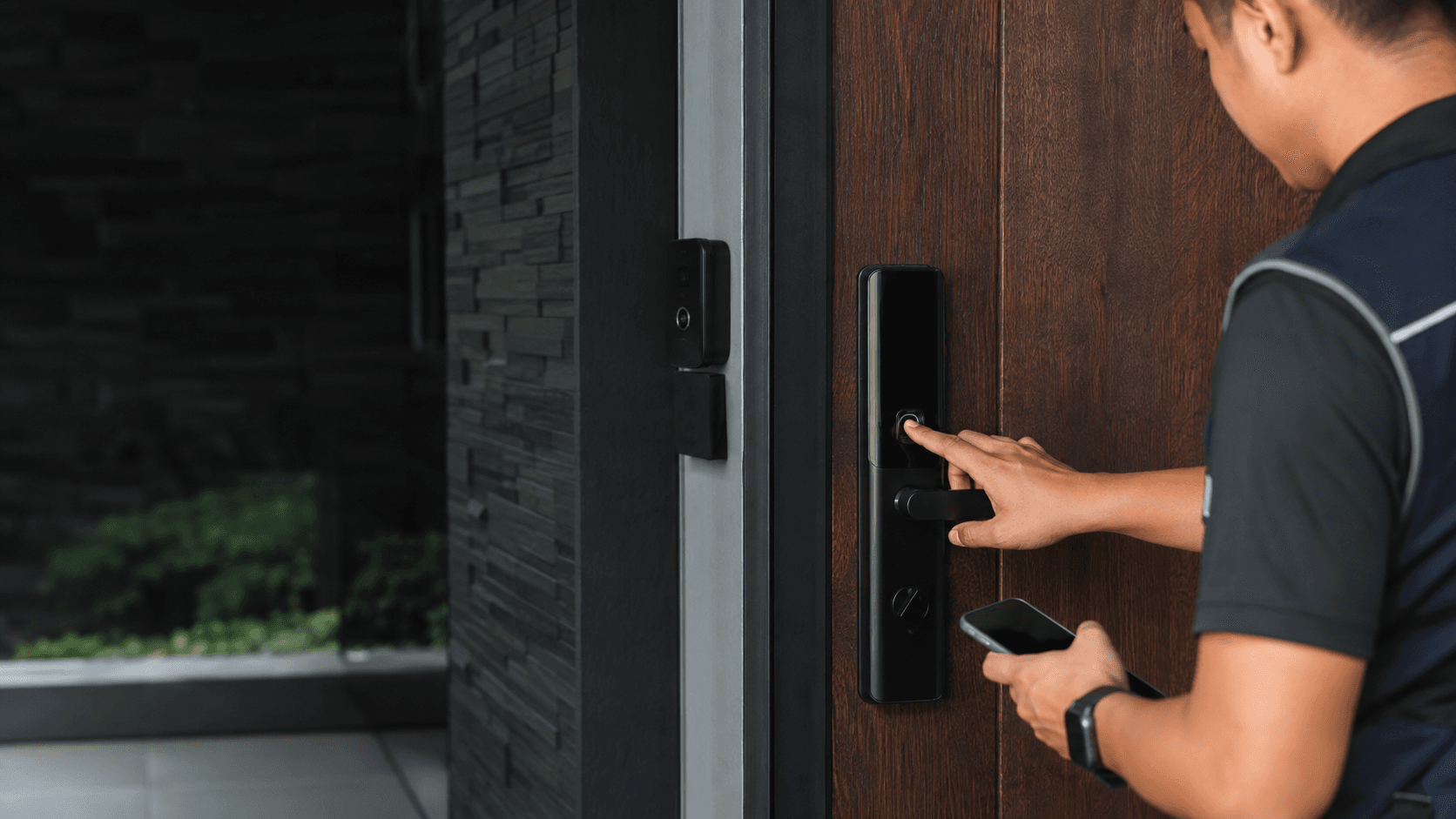
The exact-match query best z wave smart lock hides a practical question. Which lock suits the door already fitted, which hub already controls the house, and who has to get in when the battery dies? Those three answers narrow the field faster than any ranking of models.
Eyonic Sdn Bhd, a security system supplier in Sarawak, reviews smart locks on door condition, user roles and backup method before recommending installation. That order matters. A lock that fits one door and one household can fail on another door with a different frame, thickness or closing action.
Best Z Wave Smart Lock: What Matters Before You Choose
A Z Wave smart lock needs four things confirmed before money changes hands: a compatible hub, a door that accepts the lock body, a backup entry method, and a plan for who holds which credential. Skip any one of these and the lock becomes an expensive inconvenience.
Z Wave is a wireless protocol, not a brand. Locks that speak it join a mesh network run by a hub, and the hub is what connects the lock to an app, a schedule or an alarm system. Without a hub, a Z Wave lock cannot be reached remotely. That single fact eliminates many purchase mistakes.
Buyers comparing options should confirm the following before ordering:
- Site survey — check the door, frame, thickness, closing action and existing hardware.
- System proposal — match the lock to the hub already in use and to the entry roles required.
- Installation — fit the lock, pair it to the hub, and test locking, unlocking and alerts.
- Handover — confirm user codes, backup entry and battery status with the people who will use it daily.
That sequence mirrors the process Eyonic follows for its security installations, which runs from site survey through system proposal, installation and handover. The same discipline applies to a single door lock, because a lock that is paired but untested is not finished work.
Hub compatibility and Z Wave range in Malaysian homes
Hub compatibility is the first filter. A Z Wave lock only works with a controller that speaks Z Wave, and the lock must be added to that controller before any app, schedule or remote command functions. Buyers who already run a Z Wave hub should confirm the specific lock model is supported by that hub before purchase, because support is decided model by model rather than by protocol alone.
Range behaves differently from Wi-Fi. Z Wave devices form a mesh, so mains-powered devices in the network can pass signals onward and extend reach. A lock at the far end of a long house may still connect if other Z Wave devices sit between it and the hub. A lock on a detached gate or a separate block may not, and no amount of app configuration fixes a signal that never arrives.
Malaysian homes add their own variables. Reinforced concrete walls, metal doors and layered security grilles all weaken wireless signals compared with timber and plasterboard. A lock that pairs reliably in one property can behave differently two streets away. Testing at the actual door, before final fixing, is the only reliable check.
Battery life belongs in the same conversation. A lock that reports low battery through the hub gives warning before failure, but only if the hub is reachable and the alert is seen. Locks used many times a day drain faster than a lock used twice. Buyers should treat battery replacement as routine maintenance rather than an emergency.
Door condition, user roles and backup entry
Door condition decides whether a lock can be fitted at all. Deadbolt replacements need a door prepared for a deadbolt, with enough thickness and a frame that accepts the bolt. Retrofit designs sit over an existing cylinder and suit renters or doors that should not be drilled. Neither approach rescues a door that is warped, misaligned or too thin.
Eyonic's own smart lock guidance notes that smart locks work best when door condition, user roles and backup method are reviewed before installation. For business premises, the same guidance asks whether a standalone smart lock or an access-control panel is the better fit. That question is worth answering early, because a shop with shift staff and a home with one family have different requirements.
User roles and access control
User roles determine how many credentials the lock must manage and how often they change. A household may need a handful of codes for family and a temporary code for a cleaner. An office may need codes that expire, codes tied to named staff, and a record of who entered when.
Where roles change frequently, an access-control panel often suits better than a standalone lock. Panels are built for scheduled access, multiple doors and central administration. A standalone smart lock is simpler and cheaper to run, but its user management is limited to what the lock and hub support.
Keypad entry and remote access serve different purposes. A keypad works without a phone and without the hub, which makes it useful during network outages. Remote access depends on the hub and the network, so it should be treated as a convenience rather than the only way in.
Backup entry and edge cases
Backup entry is the detail that separates a working installation from a frustrating one. Every Z Wave smart lock needs a way in when the battery is flat, the hub is offline or the network is down. A mechanical key, a keypad with its own power, or a second entry point all serve that purpose. The backup method should be tested at handover, not discovered during a failure.
Edge cases worth planning for include doors that swell in wet weather, gates exposed to direct rain, and properties where the lock sits beyond reliable mesh range. Rental properties add another constraint: any change to the door may need the landlord's agreement, which pushes retrofit designs ahead of drilled replacements.
Installation and handover steps
Installation quality decides whether a Z Wave smart lock performs as intended. The physical fit comes first, then pairing, then testing under real conditions. A lock that is fitted but never tested against the actual hub and the actual door is an unfinished job.
Handover is where the installation becomes usable. Codes are set for each role, the backup method is demonstrated, battery status is confirmed, and the people who use the door daily know what to do when something fails. For commercial premises, that handover also covers who administers codes and how they are removed when someone leaves.
Eyonic's completed work for the Kuching Immigration Office focused on arrival flow, staff areas, visitor movement and dependable daily operation. The lesson transfers to a single door: the lock has to work every day, for the people who actually pass through it, without supervision.
Costs and practical next steps
Costs for a Z Wave smart lock in Malaysia vary with the lock model, the hub, the door work required and whether installation is handled professionally. No verified Malaysian pricing for specific Z Wave lock models is available here, so any figure quoted without a supplier check should be treated with caution.
For context on what professional security installation work costs in Sarawak, Eyonic's published packages for CCTV, alarm systems and autogate run at RM 1,599 each, covering supply, setup and handover. Larger project work has ranged from approximately RM 8,000 to RM 18,000 for an engineering consultancy office in Kuching and approximately RM 12,000 to RM 28,000 for the Kuching Immigration Office project. Those figures describe broader security installations rather than a single lock, but they show how door access fits into a wider system budget.
The practical next step is to gather three facts before comparing models: the door's condition and measurements, the hub already in use, and the list of people who need entry plus the backup method. With those confirmed, the shortlist of suitable locks becomes short and specific.
Eyonic Sdn Bhd plans, supplies and installs security systems across Sarawak, and its smart lock review process starts with door condition, user roles and backup method. Buyers who want the door assessed alongside the wider security setup can share the location, property type and required system with Eyonic on WhatsApp at +60 11-5111 7959.