
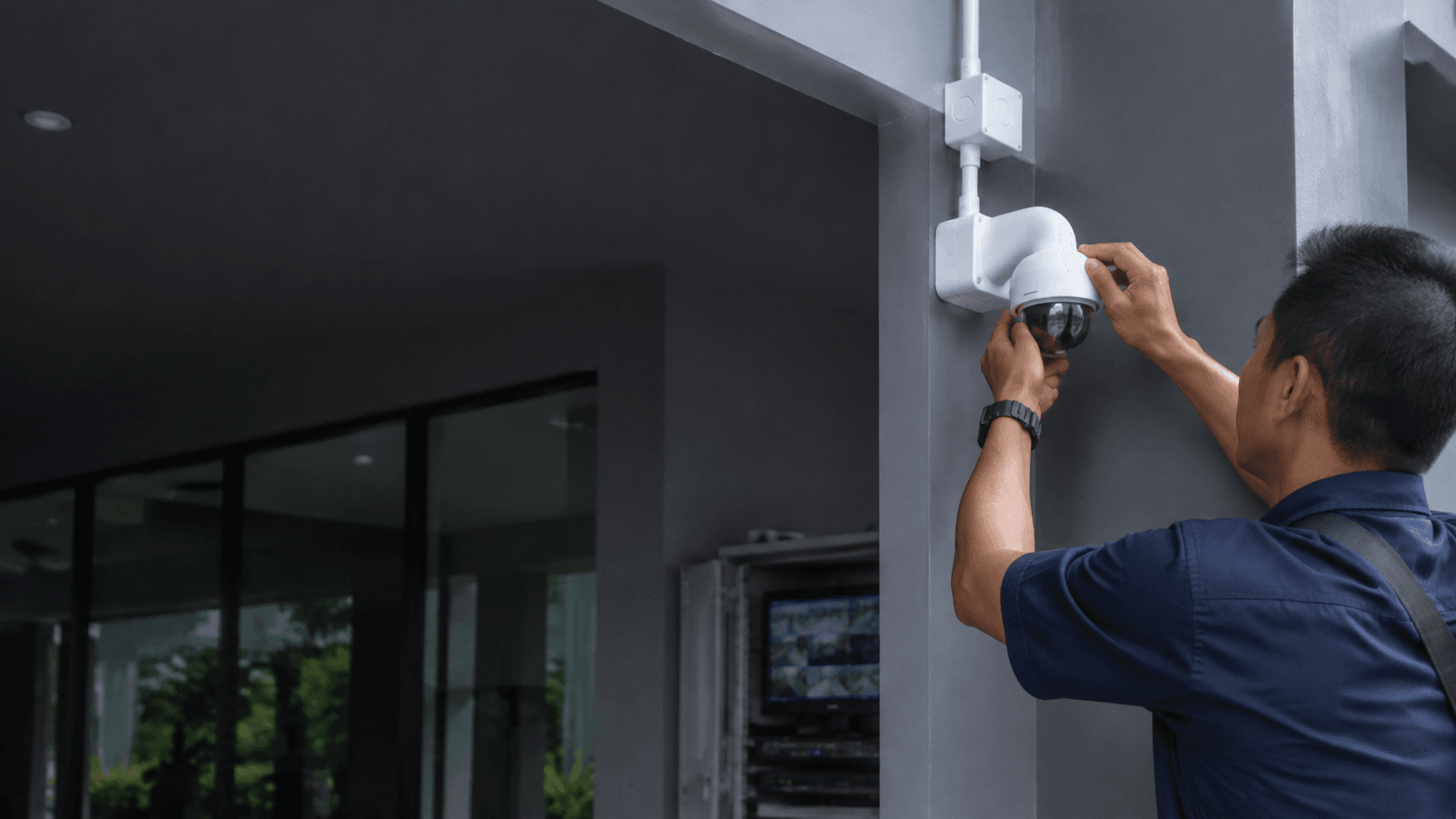
The term covers a family rather than a single product. Dahua builds dome cameras for analog HD over coax and for IP networks, and the same dome shell appears in fixed, motorised and pan-tilt-zoom versions. Buyers in Malaysia usually meet the term while comparing megapixel tiers, night-vision behaviour and whether an existing cable run can be reused.
Dahua Dome Kamera. what the term covers
A dome camera is defined by its housing. The camera body sits behind a curved cover, which makes the lens direction harder to read from ground level and keeps the unit compact against a ceiling or soffit. Dahua applies that housing across several product lines rather than one.
Two transmission families sit underneath the dome shape. HDCVI carries HD video over coaxial cable, which suits sites with existing analog cabling. IP models carry video over network cable, usually with PoE, and pair with an NVR. Dahua's own catalogue and distributor listings show both families sharing dome and eyeball housings, so the housing alone does not tell a buyer which family a model belongs to.
Model codes carry the real information. In distributor listings, prefixes such as IPC indicate network cameras and HAC indicate HDCVI models, while suffixes describe lens type, illumination and housing. Reading the code is more reliable than reading the product photo.
Dome, eyeball and PTZ housings in practice
Three shapes dominate the category, and each solves a different placement problem.
A fixed dome points in one direction set at installation. It suits corridors, lift lobbies and shop interiors where the field of view is known and unlikely to change. The curved cover also resists casual tampering and hides which way the lens faces.
An eyeball camera, sometimes called a turret, uses a ball joint inside a short bracket. It offers similar discretion with easier manual aiming and often less infrared reflection off the cover, which matters when the camera sits close to a wall or under a low ceiling.
A PTZ dome adds motors. It can pan, tilt and zoom, either under operator control or on preset tours. That flexibility costs more and introduces moving parts, so it usually earns its place at entrances, car park ramps or large open floors rather than in every position.
Lighting conditions before camera placement
Placement decisions fail more often on lighting than on resolution. A position that looks adequate in daylight can produce unusable footage after dark, and the fix is usually a different position or a different camera rather than a settings change.
Eyonic's own review guidance for ColorVu-style cameras recommends checking actual lighting conditions before confirming placement. The same discipline applies to any dome camera with colour night vision or infrared. Practical checks include whether a wall, awning or sign reflects infrared back into the lens, whether a bright doorway sits inside the frame, and whether the scene is lit evenly or in patches.
Wide dynamic range matters where a frame contains both a bright entrance and a shaded interior. Infrared range matters in unlit areas, but the useful distance is shorter than the headline figure once the scene is assessed honestly. Where colour footage after dark is essential, a camera with integrated white light behaves differently from one relying on infrared alone, and neighbours or staff may notice the difference.
Recording, storage and remote viewing setup
A dome camera produces video; something else has to record it. IP models typically connect to a network video recorder over PoE, which carries both power and data on one cable. HDCVI models connect to a compatible recorder over coax. In both cases the recorder holds the hard drive, manages retention and provides the remote viewing path.
Retention is a storage decision, not a camera decision. More cameras, higher resolution and longer retention all consume drive space, and the recorder's channel count and drive bay limit what can be added later. Planning the recorder alongside the camera count avoids a rebuild when coverage expands.
Remote viewing depends on the recorder's platform and on the network at the site. A stable connection and a correctly configured recorder matter more than the camera brand. Handover should include confirming that live and recorded footage can be reached from a phone before the installer leaves.
Installation sequence from survey to handover
Eyonic's documented CCTV installation process runs through four stages, and the sequence applies whether the cameras are Dahua or another brand.
- Site survey, covering the property layout, existing cabling, lighting conditions and the areas that need coverage.
- System proposal, setting out camera positions, recorder and storage, and the scope of work.
- Installation, including mounting, cabling, recorder configuration and camera aiming.
- Handover, confirming recording, playback and remote viewing work and that the user can operate the system.
The survey stage carries the most weight. Cable routes, power availability and mounting surfaces decide what is practical, and a position that cannot be reached cleanly with cable is not a real option regardless of how good the view looks. For sites in Sarawak, ceiling construction and roof access often shape the plan as much as the camera choice does.
Handover is where most dissatisfaction is prevented. A system that records correctly but cannot be viewed remotely, or whose playback the user has never seen, tends to be treated as unreliable even when the hardware is fine.
Where Dahua Dome Kamera fits in a wider system
Cameras are one layer. Eyonic's project work shows how coverage decisions follow building use rather than a fixed template. At the Kuching Immigration Office, the focus was arrival flow, staff areas, visitor movement and dependable daily operation. At KTA Sarawak Sdn Bhd, an engineering consultancy office in Kuching, the priorities were staff movement, visitor handling, tidy cabling and clearer daily site control.
Those two examples point to the same method. Public-facing entrances, counters and corridors need coverage that supports how people actually move through the building. Back-of-house areas need enough coverage to confirm activity without creating unnecessary footage. Cabling should be tidy because it affects maintenance access later.
Dahua dome cameras can sit inside that plan alongside other layers. Access control, alarm systems and intercoms answer different questions, and a dome camera covering a controlled door complements an access system rather than replacing it. Eyonic supplies and installs CCTV, alarm, autogate and intercom systems, with documented packages at RM 1,599 for a Hikvision CCTV package, a Hikvision alarm system and an autogate package. Comparable published pricing for Dahua dome cameras in Malaysia is not available from approved sources, so budget figures for a Dahua-based system should come from a current quotation rather than an assumed range.
Brand choice is a secondary question. The primary questions are what needs to be seen, in what light, for how long footage must be kept, and how the site will be cabled. Answering those first makes the camera selection straightforward, whether the final choice is a Dahua dome camera or another model.
Share your location, property type and required system with Eyonic on WhatsApp at +60 11-5111 7959 for the next practical step.