
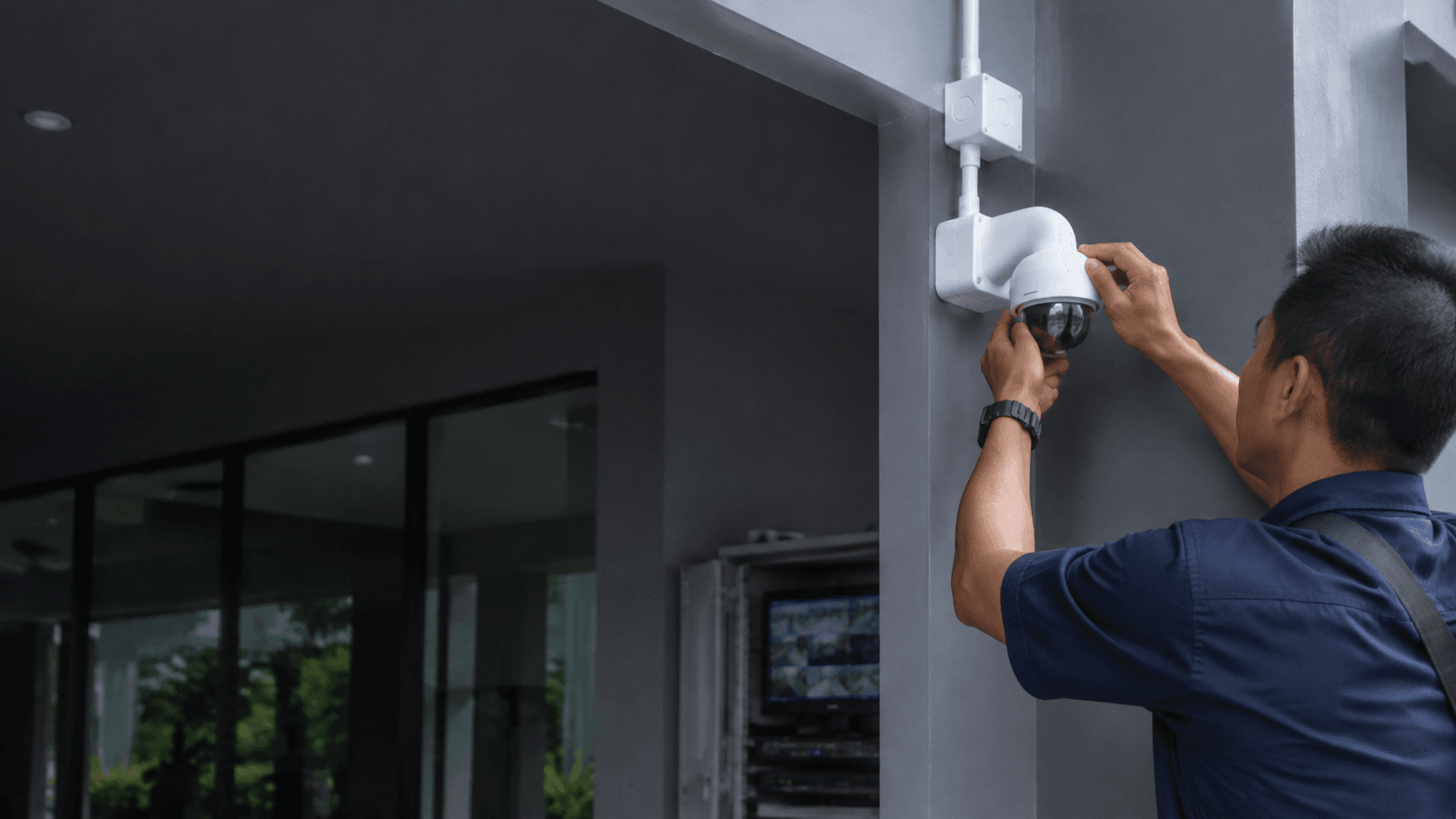
The exact field of view, sensor size, resolution and night-vision distance vary by model, and those figures are not confirmed here. What can be judged before a model is chosen is the shape of the area to be watched, the light it receives, and where a camera can physically sit.
What a Wide Angle Camera Changes on Site
A standard lens concentrates detail into a narrow cone. A wide angle lens spreads the same sensor across a much broader cone, so more of the scene lands in frame from a single mounting point. The trade is angular resolution. each object occupies fewer pixels, so a face or plate that would be legible at distance through a narrow lens becomes smaller and softer through a wide one.
That single trade-off drives most placement decisions. Wide coverage suits a reader who needs to know that something happened and roughly when, across an open area. It suits less well a reader who needs to identify a specific person at a specific doorway from far away.
Hikvision builds wide angle cameras in more than one physical form. Turret and bullet housings mount on walls and ceilings and point in one direction. Panoramic and fisheye designs sit closer to the centre of a space and capture a much broader sweep, sometimes stitched from multiple sensors. The housing choice follows the mounting surface and the shape of the area, not the other way round.
Where Wide Coverage Helps and Where It Does Not
Wide coverage earns its place where the risk is spread across an open footprint rather than concentrated at one choke point. A shop floor, a warehouse aisle junction, a lobby, a parking apron or a long corridor all present the same problem: a narrow camera sees one slice and leaves the rest unwatched.
It works less well in three situations. The first is long-range identification, where a subject stands well beyond the point at which a wide lens still resolves detail. The second is a tight, cluttered space where a wide lens pulls in shelving, pillars and reflections that add nothing. The third is a doorway or gate where the useful information sits in a narrow band and a wide lens simply wastes pixels on the wall beside it.
There is also a distortion consideration. Wide and fisheye lenses bend straight lines near the edges of frame, so a person walking past the perimeter can appear stretched. That does not stop the camera recording, but it changes how easily an operator reads the image later.
Lighting and Placement Checks Before Confirming a Model
Light is the constraint that most often decides whether a wide angle camera performs as expected. A wider cone gathers light from a larger area, and that area usually contains a mix of bright and dark zones. A doorway with daylight behind it and a dim interior in front is the classic case, and it is where wide dynamic range matters more than raw resolution.
Eyonic's own guidance on ColorVu-style cameras is to check the actual lighting conditions on site before confirming placement, rather than assuming a low-light model will behave the same way in every location. The same discipline applies to a wide angle camera: the light at the mounting point, at the hours that matter, is the deciding input.
Placement checks worth completing before a model is fixed:
- Site survey — walk the area at the hours that matter, note light sources, glare, reflective surfaces and the mounting surfaces available.
- System proposal — set out the coverage each position is expected to deliver, the recording and remote viewing arrangement, and the cabling route.
- Installation — mount, aim, configure recording and confirm the live view matches the coverage agreed in the proposal.
- Handover — walk through the live and recorded views, confirm mobile access, and agree who reviews footage and how.
Eyonic's CCTV installation process follows those four stages, from site survey through system proposal and installation to handover. The sequence matters for wide angle work because the coverage decision is made at the survey, not at the point of purchase.
Questions that decide the outcome
Does the camera need to identify a person, or only establish that someone was present? Identification pushes toward a narrower lens or a second camera at the choke point. Presence and movement across an open area push toward wide coverage.
What is behind the camera? A wide lens sees more of the room, including whatever sits behind and beside the mounting point. A window, a glossy floor or a bright sign inside the frame can wash out the parts of the image that matter.
How high can the camera sit? Higher mounting widens the ground area in frame but flattens faces and increases the distance to subjects. Lower mounting improves facial detail but narrows practical coverage.
Is one wide camera cheaper than two narrow ones? Often, but not always. A single wide unit reduces cabling, mounting hardware and recording channels. Two narrow units can deliver better identification at the same total coverage. The comparison is coverage quality against installed cost, not unit price alone.
How Eyonic Plans a Hikvision Wide Angle Camera Installation
Eyonic Sdn Bhd plans, supplies and installs CCTV systems in Sarawak, covering camera placement, recording and remote viewing for homes, offices, shops and industrial sites. Wide angle work is planned the same way as any other camera position: the survey establishes what the site needs to see, and the model follows.
The Kuching Immigration Office project is a useful reference for how that plays out in a public building. The scope centred on arrival flow, staff areas, visitor movement and dependable daily operation. Those are coverage questions before they are equipment questions, because arrival and visitor movement happen across open floor rather than at a single point.
A second reference point is the KTA Sarawak Sdn Bhd office project in Kuching, which covered staff movement, visitor handling, tidy cabling and clearer daily site control. Cabling tidiness is not cosmetic in wide angle work: a camera covering a broad sweep often sits where its cable run is visible, so the route is planned with the position.
Eric Yong founded Eyonic Security Systems and has worked in the industry for more than ten years, with a focus on technical installation of digital security solutions for commercial businesses in Sarawak. That experience sits behind the survey stage, where the coverage decision is actually made.
What the survey produces
The survey output is a set of camera positions with an agreed purpose for each one, not a list of model numbers. For a wide angle position, that means a stated area of coverage, the lighting conditions at the hours that matter, the mounting height and surface, and the cabling route. A model is then matched to those requirements.
Where a site needs both breadth and identification, the proposal usually combines a wide angle camera for the open area with a narrower camera at the entry point. That split is a planning decision, and it is cheaper to make it at the survey than to add a second camera after installation.
Practical Next Step for a Wide Angle Camera
The decision that matters is coverage, and coverage is settled on site. A reader weighing a Hikvision wide angle camera can narrow the choice considerably by answering three things before looking at models: what the camera must prove, what the light does at the relevant hours, and where a camera can physically mount.
Eyonic's published package pricing starts at RM 1,599 for a Hikvision CCTV package covering camera supply and setup, basic recording configuration and mobile viewing handover. That figure describes a package, not a wide angle camera unit or a wide angle installation, and the two should not be treated as equivalent.
Share the location, property type and required system with Eyonic on WhatsApp at +60 11-5111 7959 for the next practical step.