
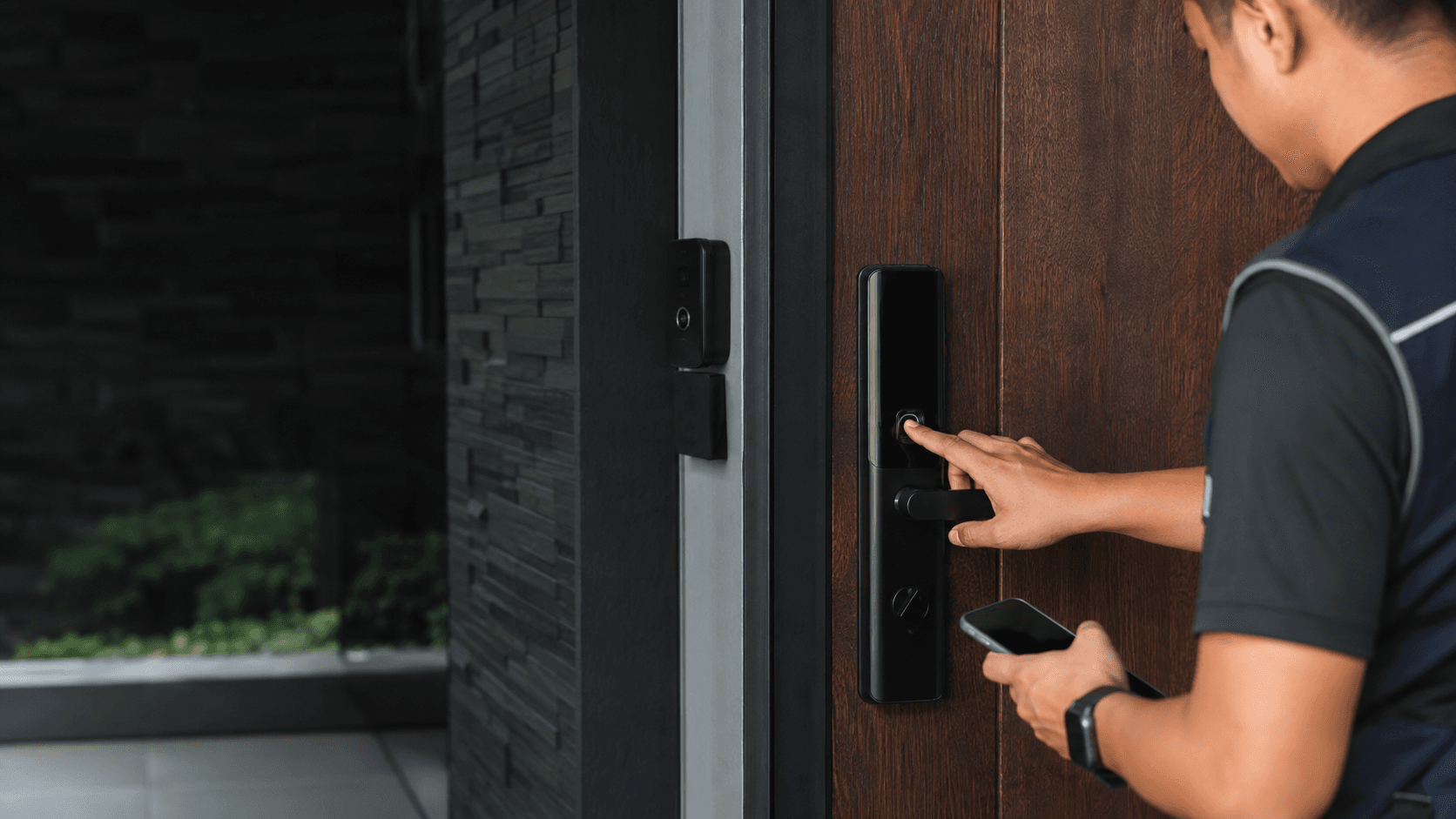
The name on the box describes three separate things working together: a deadbolt that replaces an existing lock, a keypad for code entry at the door, and a Bluetooth radio that lets a phone manage codes and access levels when the phone is nearby. Buyers in Malaysia searching for an aura bluetooth keypad smart lock are usually trying to work out whether that combination suits a specific door, and what has to be settled before anyone drills or mounts anything.
Most of the pages ranking for this term are thin product listings. The substantive one is Kwikset's own Aura page, which frames the lock around Bluetooth range, three ways to operate it, app-based access levels, activity tracking, and hardware features. That framing is useful, but it skips the part that decides whether the lock works well in practice: the door itself, who needs access, and what happens when the phone is not there.
Aura Bluetooth Keypad Smart Lock: What the Name Covers
The Aura Bluetooth Keypad Smart Lock is a single-cylinder electronic deadbolt. Kwikset's product pages describe it as Bluetooth-enabled, and the retail listings that carry the full product name describe it as a keypad smart lock deadbolt featuring SmartKey Security. Those two descriptions together are the clearest supported picture of what the product is.
Three operating methods appear consistently in the manufacturer's own material: the Kwikset App, coded entry, and a traditional keyway. That matters for planning, because it means the lock is not purely app-dependent. A code can be typed at the door, and a physical key still works.
Kwikset's Aura page also lists access levels that can be set from the app, including anytime access, access limited by date range, access limited by day or time, and one-time access. For a household or a small office, those four categories cover most of what a door actually needs: family or staff who come and go, contractors who need a window, cleaners who need a slot, and a visitor who needs one entry.
Activity tracking is part of the same app. Kwikset's page describes tracking lock activity and setting up codes from a mobile device. That is the practical difference between a keypad lock and a mechanical deadbolt — there is a record of what happened at the door.
Two hardware details appear in the manufacturer's feature list: an accessible battery compartment, a one-touch locking button, and audible and visual low battery alerts. Those are worth knowing before installation because they affect where the lock can sit and how often someone has to think about it.
What the supplied evidence does not establish is equally important. There are no verified specifications here for battery type, wireless range, code capacity, finish options, or certifications, and no verified Malaysia pricing, stock, or warranty terms. Those details should come from the manufacturer's documentation or the supplier handling the order, not from a general article.
How Bluetooth Keypad Entry Works at the Door
Bluetooth keypad entry works in two layers. The keypad is the layer that always functions at the door: a person types a code and the deadbolt retracts. The Bluetooth layer is the management layer: a phone within range talks to the lock so codes and access levels can be created, changed, or removed without touching the lock itself.
Kwikset's own wording places the app functions within Bluetooth range. That is the constraint that shapes daily use. Managing the lock from the app requires being close enough for the phone and lock to connect. It is not remote administration from another state or another country.
For a home, that constraint is usually invisible. Someone standing at the door with a phone is exactly the situation where a new code gets added for a relative or a delivery arrangement. For a small office, it changes the routine: whoever administers access has to be on site to do it, or the task has to be planned around a visit.
This is the point where a standalone smart lock and an access control panel start to diverge. Eyonic's own product review guidance notes that for business use, the usual check is whether a standalone smart lock or an access-control panel is more appropriate. A single door with a handful of users sits comfortably in the standalone category. Multiple doors, staff who join and leave regularly, and a need to manage access from a desk rather than a doorway push toward a panel-based system.
The keypad also has a practical advantage that has nothing to do with apps. Codes can be issued and revoked without collecting a key. When a tenant moves out or a staff member leaves, removing a code is faster and more certain than hoping a key comes back.
Door Condition and User Roles to Check First
Door condition decides whether a smart lock installation is straightforward or whether it turns into carpentry. Eyonic's smart lock review guidance puts door condition first among the things to review before installation, alongside user roles and the backup method.
The checks that matter are physical. The door needs enough solid material where the deadbolt sits, the existing bore and latch alignment need to suit the replacement hardware, and the door needs to close cleanly enough that the bolt extends without binding. A door that already sticks, or one where the frame has moved, will keep sticking after a new lock is fitted.
User roles are the second check, and they are usually underestimated. The useful question is not how many people need access, but how many categories of access exist. A household might need permanent access for residents, recurring access for a helper, and occasional access for a relative. A small office might need staff access during working hours, after-hours access for one or two people, and one-time access for a visitor or contractor.
Kwikset's access levels map onto those categories reasonably well, which is why the role question comes before the product question. If the roles fit the available access types, the lock is a candidate. If they do not, the mismatch will show up within the first month.
Before committing to a Bluetooth keypad lock, four things are worth confirming in order:
- Door condition — check the door's material, the existing bore and latch alignment, and whether the door closes and latches cleanly without binding.
- User roles — list the categories of access needed, such as permanent residents or staff, recurring visitors, time-limited contractors, and one-time entries.
- Backup entry method — confirm the physical keyway is usable and that a key is stored somewhere reachable but not obvious.
- Handover testing — test every code, every access level, the key override, and the low battery alert before the installer leaves.
That order matters because each step can rule out the next. A door that cannot take the hardware ends the discussion regardless of how well the access roles fit.
Backup Entry and Access Planning
Backup entry is the part of smart lock planning that gets skipped, and it is the part that causes the worst days. A Bluetooth lock depends on a phone for management and on batteries for operation. Neither is guaranteed to be available at the moment someone is standing outside.
The physical keyway is the primary backup, and Kwikset's material lists it as one of the three ways to operate the lock. That only helps if a key exists, is cut correctly, and is stored somewhere that does not require entering the building to reach. Keeping the only spare key inside the house defeats the purpose.
Low battery alerts are the second layer. Kwikset's feature list includes both audible and visual low battery alerts, which gives warning before the lock stops responding. The practical routine is to act on the alert rather than wait, because a lock that has already stopped responding is a lock that has to be opened another way.
Access planning is the third layer, and it is mostly about restraint. Codes should be issued to categories rather than individuals where possible, so that removing one person's access does not require reissuing codes to everyone else. One-time and date-limited access levels exist precisely so that temporary access does not become permanent access by accident.
For a small office, the same logic applies with more at stake. Eyonic's work for the Kuching Immigration Office centred on arrival flow, staff areas, visitor movement, and dependable daily operation — the same concerns that shape how a door is used, not just how it is locked. A door that handles arrivals badly creates a queue; a door that handles staff access badly creates workarounds.
Installation and Handover Expectations
Installation is a hardware job followed by a configuration job, and the second one is where most of the value sits. Fitting the deadbolt is the visible part. Setting up codes, access levels, and the app connection is the part that determines whether the lock is actually used as intended.
Eyonic's installation process runs through site survey, system proposal, installation, and handover. Applied to a smart lock, that sequence means the door is assessed before anything is ordered, the proposed setup is agreed before work starts, the hardware is fitted, and the handover covers testing rather than just a handover of the box.
Handover is the step worth insisting on. Every code that has been created should be tested at the door. Every access level should be tested against its intended window. The physical key should be tested. The low battery alert should be confirmed as working. A lock that has been fitted but not tested is a lock with unknown behaviour.
For a business setting, the same handover should establish who administers access and how changes get made. If the answer is "whoever has the app on their phone", that is a single point of failure worth naming before the installer leaves.
Eyonic's broader project work in Sarawak has involved office setups supporting staff movement, visitor handling, tidy cabling, and clearer daily site control, including work for KTA Sarawak Sdn Bhd. Door access is usually one part of that picture rather than the whole of it, which is why the door condition and user role questions come before the product choice.
Aura Bluetooth Keypad Smart Lock Questions Buyers Ask
Does the lock work without a phone? Yes. Coded entry and the traditional keyway are both listed as ways to operate the lock, so a phone is needed for management rather than for entry.
Can access be managed from another location? Kwikset's material places app functions within Bluetooth range, so management happens near the lock rather than remotely.
Is a standalone smart lock enough for an office? It depends on the number of doors and how often access changes. Eyonic's guidance is to check whether a standalone smart lock or an access-control panel suits the site better, which is a question about the door and the user roles rather than the lock alone.
What should be confirmed before ordering? Door condition, the categories of access needed, the backup entry method, and what handover testing will cover. Specifications, pricing, and warranty terms for this lock should come from the manufacturer's documentation or the supplier handling the order.
For a door in Sarawak that needs access planned around real users rather than a product listing, Eyonic can review the door and the access roles before anything is specified. Share the location, property type, and required system on WhatsApp at +60 11-5111 7959 for the next practical step.