
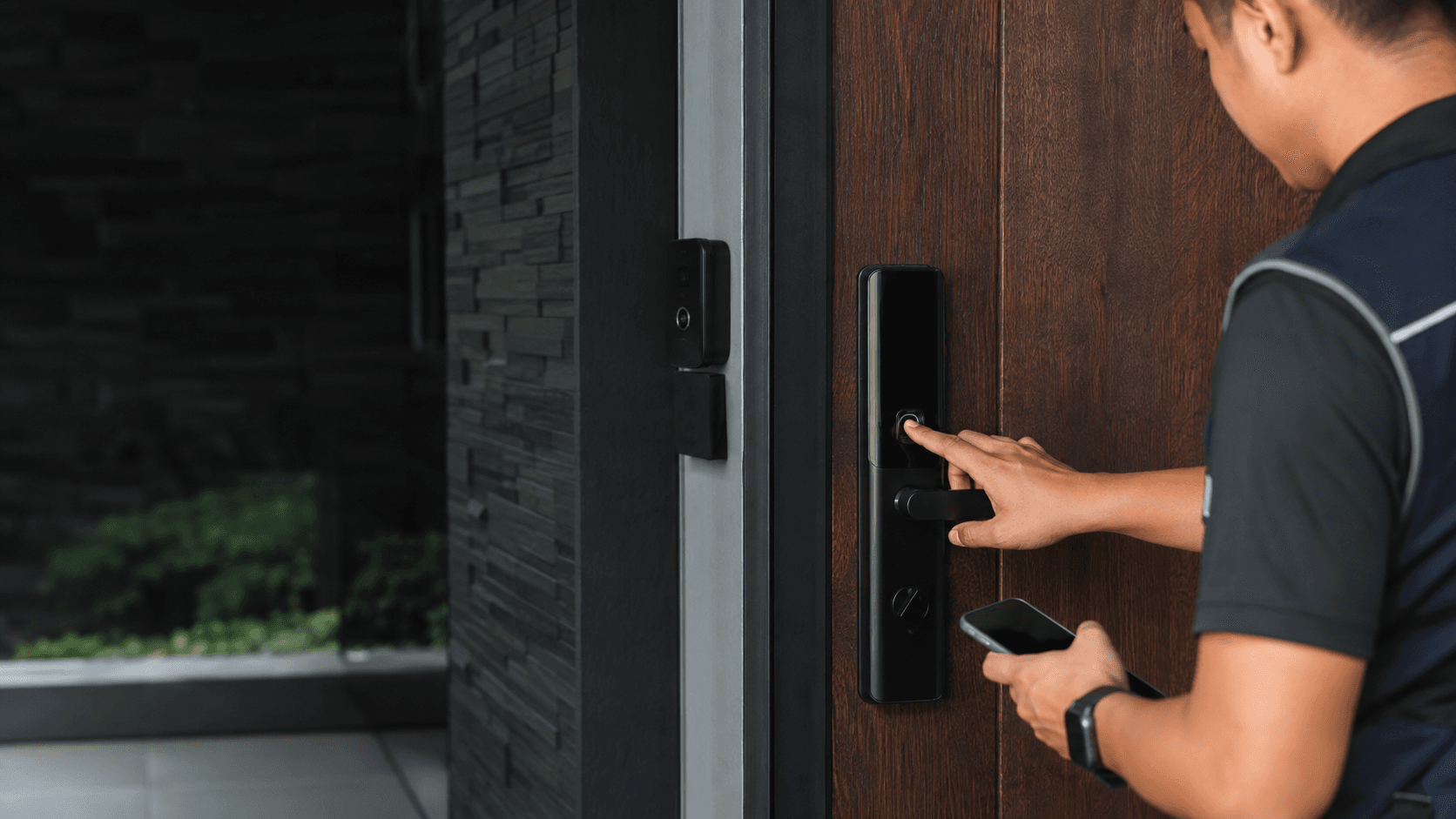
Eyonic Sdn Bhd, a security system supplier in Sarawak, reviews smart lock door access on the basis that the door condition, user roles and backup method should be settled before installation. That order matters, because a keypad changes who can enter and how entry is recorded, not just how the door is opened.
Yale Combination Door Lock. What Keypad Entry Changes at the Door
A combination lock removes the need to cut and issue physical keys. Entry moves to a shared or individual code, which can be changed without rekeying hardware. That is the practical difference between a combination lock and a conventional keyed deadbolt.
The trade-off is that the code becomes the credential. Anyone who learns it can enter, and anyone who leaves an organisation still knows it until it is changed. A keyed lock has the same weakness with a copied key, but a code can be shared verbally, by message, or by observation at the door, which is harder to trace than a missing key.
Keypad entry also changes the daily routine at the door. There is no key to carry, so entry depends on remembering a code or holding a phone or card if the model supports it. When the code is forgotten or the entry method fails, the fallback path decides whether the door can still be opened.
Door Condition and User Roles Decide the Fit
Not every door suits a combination lock. The door has to be checked before anything is ordered, because the lock body, the existing cutout and the door's own movement all affect whether a replacement will sit and latch correctly.
Door condition covers more than appearance. A door that has swollen, dropped on its hinges, or been fitted with a non-standard lock body may not accept a replacement without additional work. A door that already closes loosely will not become secure simply because the entry method changed.
User roles decide how the lock is configured. A home with two or three regular users needs a different setup from a shop with rotating staff, a clinic with visiting contractors, or an office where cleaners arrive outside working hours. Each group needs a clear answer to who holds a code, who can change it, and who removes access when someone leaves.
Eyonic's own review of smart lock door access notes that for business use, the choice between a standalone smart lock and an access-control panel is usually checked first. That distinction matters because a standalone lock manages one door, while a panel manages many doors and the records that go with them.
Home doors and business doors behave differently
A home door usually serves a small, stable group. A business door often serves staff, visitors and contractors whose access changes week to week. The same lock hardware can serve both, but the code management burden is much higher on the business side, and that burden is what usually decides whether a standalone lock is enough.
Yale Combination Door Lock Planning Steps Before Installation
The sequence below follows the same shape as Eyonic's installation process, which runs through site survey, system proposal, installation and handover. Applied to a combination lock, the order keeps the hardware decision tied to the door and the people using it.
- Survey the door and its surroundings, including how it is approached and whether the entry point is overlooked.
- Check door condition, including alignment, existing cutout and whether the door closes and latches cleanly.
- Map user roles, listing every group that needs entry and how often that group changes.
- Decide the backup entry method before installation, so a failed code or flat battery does not lock out the people who need access.
- Install the lock and confirm the door still closes, latches and locks correctly with the new hardware fitted.
- Hand over codes, explain how they are changed and removed, and confirm who is responsible for that afterwards.
Steps two and four are the ones most often skipped. A door that does not latch properly will not be fixed by a new lock, and a backup method chosen after installation is usually chosen under pressure.
Backup Entry and Code Management
Backup entry is the answer to a simple question: if the code fails, the battery is flat, or the electronics stop responding, how does the door open? The answer has to be decided before installation, not after the first lockout.
Code management is the ongoing half of the same problem. Codes need an owner, a change routine and a removal routine. In a home, that is usually one person. In a business, it is often a manager or an administrator who may not be on site every day.
Two edge cases are worth settling early. The first is a shared code used by several people, which saves administration but removes any record of who entered. The second is a code issued to a contractor or temporary staff member, which needs a defined end point so access does not quietly continue after the work is finished.
Eyonic's review of smart lock door access frames this as controlled convenience: the lock is useful when user permissions and backup entry are planned properly, and awkward when they are not.
Where a Standalone Lock Is Not the Right Answer
A standalone lock manages one door. When a site has several controlled doors, or when entry records need to be reviewed after an incident, a standalone lock leaves gaps that a panel-based system does not.
The Kuching Immigration Office project is a useful contrast. That work focused on arrival flow, staff areas, visitor movement and dependable daily operation, which is a multi-area problem rather than a single-door one. A similar pattern appears in the KTA Sarawak Sdn Bhd project, where the requirement was staff movement, visitor handling, tidy cabling and clearer daily site control.
A standalone combination lock is a reasonable answer when the door count is low, the user group is stable, and no one needs to review who entered and when. It becomes the wrong answer when access has to be audited, when many doors need to open under one policy, or when the people managing codes change frequently.
Questions to Settle With an Installer
These are the questions that change the recommendation, so they are worth raising before any hardware is selected.
What is the backup entry method, and who can use it? If the answer depends on a single person being available, that is a risk rather than a backup.
Does the existing door accept a replacement lock without modification? Door thickness, the existing cutout and the door's alignment all affect this, and the answer is only reliable after the door has been seen.
Who owns the codes after handover? If no one is named, codes tend to stay with whoever set them up.
Is a standalone lock or an access-control panel the better fit? This is the question Eyonic raises for business use, and it is usually answered by door count and whether entry needs to be recorded.
What happens on a public holiday or outside working hours, when the person who normally manages access is unavailable? That scenario often reveals whether the backup plan is real.
For readers in Sarawak who want the door and the user roles reviewed before choosing hardware, Eyonic can be reached on WhatsApp at +60 11-5111 7959 with the location, property type and required system.