
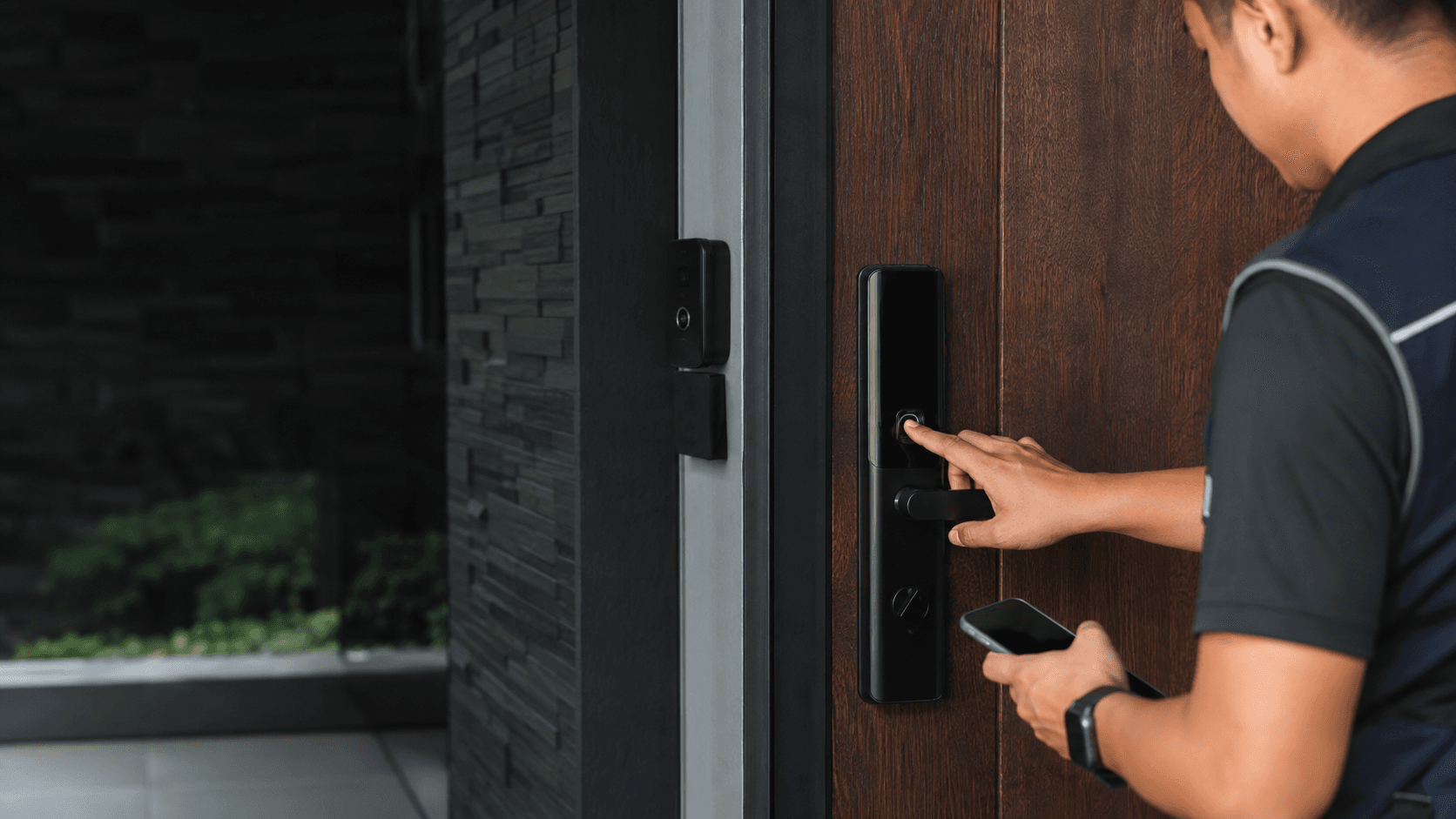
The exact-match query yale lock system describes a category of door hardware rather than a single product. Buyers in Malaysia usually meet it while comparing keyless entry for a home, office, shop or industrial doorway, and the decision rarely turns on the lock alone. It turns on the door, the people who need to pass through it, and what happens when the usual method of entry fails.
Eyonic Sdn Bhd supplies and installs security and extra-low-voltage systems in Sarawak, including smart locks, and treats smart lock door access as suitable for controlled convenience when user permissions and backup entry are planned properly. That framing is the useful starting point: a Yale lock system is an access decision before it is a hardware purchase.
What a Yale Lock System Covers in a Real Doorway
A Yale lock system covers the lock itself, the way users are identified at the door, and the rules that decide who may enter and when. In practice those three parts are chosen together, because a lock that reads a credential well but has no plan for permissions creates a different problem than a lock with tidy permissions on a door that cannot carry it.
Yale's own product range spans keypad locks, fingerprint entry, Wi-Fi and Matter-connected smart locks, smart safes and cabinet locks, and the Yale Access App appears across its catalogue pages. Those are manufacturer-side categories. They describe what exists in the market, not what suits a particular doorway in Kuching or anywhere else in Malaysia.
The practical question is narrower. A standalone smart lock suits a single door where a small, stable group of people needs entry. An access-control panel suits a site where many users, changing roles, or an audit trail matter more than the convenience of a single lock. Eyonic states that for business use it usually checks whether a standalone smart lock or an access-control panel is more appropriate, which is the same fork a buyer faces before committing to supply and installation.
Where the lock sits in the wider system
A door lock is one layer of site security. Cameras record what happened, alarms respond to intrusion, intercoms manage who is asking to enter, and autogates control vehicle movement. A lock decides whether a person may pass. Those layers can be planned separately, and the supplied evidence does not establish how a Yale lock system integrates with the CCTV, alarm, autogate or intercom services Eyonic lists, so integration should be confirmed against the specific model rather than assumed.
Door Condition and User Roles Decide the Fit
Two conditions decide whether a Yale lock system fits a doorway: whether the door can physically carry the lock, and whether the user list is simple enough for the lock's permission model.
Door condition covers the existing hardware, how the door closes, and whether the frame and leaf suit a replacement or an adapter-style fitting. A door that does not close cleanly will not become reliable because the lock is smart. This is why a site survey comes before a proposal rather than after a purchase.
User roles cover who needs entry, how often that list changes, and whether entry needs to be reviewed later. A family home, a shop with rotating staff, and an office with visitors passing through a reception area produce three different permission requirements from the same lock category.
Reader-fit scenarios
A home with a stable household suits a standalone smart lock, where convenience and a backup key or code matter most. An office with staff movement and visitor handling needs the permission list reviewed first, because a lock that cannot express those roles will be worked around rather than used. A shop or industrial doorway adds traffic volume and, often, a second entrance that should be planned at the same time. The Kuching Immigration Office project Eyonic completed focused on arrival flow, staff areas, visitor movement and dependable daily operation, which is the same set of concerns a controlled doorway has to answer at a smaller scale.
Yale Lock System Checks Before Installation Day
Eyonic's installation process runs through site survey, system proposal, installation and handover, and the pre-installation checks below follow that sequence. They are the checks that decide whether a Yale lock system can be installed as planned or needs a different approach.
- Confirm the door condition, including how the leaf closes, the existing hardware, and whether the frame suits the intended lock.
- List every user and role that needs entry, and note how often that list is expected to change.
- Agree the backup entry method before installation, so a failed credential, flat battery or unavailable phone does not lock out the people who need access.
- Decide whether a standalone smart lock or an access-control panel better matches the user list and the level of record-keeping required.
- Confirm what the lock will and will not connect to, rather than assuming it will join the existing camera, alarm, intercom or gate setup.
- Walk through handover with the people who will actually manage users, not only the person who placed the order.
Each check removes a way the installation can go wrong later. Skipping the user list produces a lock that is shared by code instead of managed by permission. Skipping the backup method produces a door that depends entirely on one phone or one credential. Skipping the integration question produces an expectation that the lock will behave like part of a single system when it may operate on its own.
What the checks cannot settle
Some answers sit outside the lock. Tenancy agreements, building management rules and fire door requirements can restrict what may be changed on a door, and the supplied evidence does not cover Malaysian door types or building rules for lock replacement. Those need to be confirmed locally for the specific premises before work is scheduled.
Backup Entry and Daily Operation
Backup entry is the part of a Yale lock system that decides how a bad day is handled. A lock that depends on one phone, one code or one fingerprint has a single point of failure, and the failure is discovered at the door, usually at the least convenient moment.
Daily operation matters just as much. Adding a user, removing a user who has left, and checking who entered are the tasks that determine whether the lock stays useful after the first month. If those tasks are awkward, permissions drift and the lock stops reflecting who should actually have access.
Power loss and connectivity loss are the two edge cases worth naming. Behaviour during a power or battery failure depends on the specific model, and the supplied evidence does not state battery life, wireless protocols or power-loss behaviour for any Yale lock system model. That information should come from the manufacturer documentation for the exact model under consideration, and the backup method should be agreed with that behaviour in mind rather than assumed.
Handover is part of the system
Handover is where a lock becomes an operating system rather than a fitted device. The people who manage users need to know how to add and remove access, what to do when a credential fails, and who to contact when something behaves unexpectedly. Eyonic's process ends with handover for that reason, and the same step applies whether the site is a home, an office or a public building.
Practical Next Step for a
The next step is a site survey, because the survey answers the questions that decide the rest. Door condition, user roles and backup entry are all settled by looking at the actual doorway and talking to the people who use it, not by comparing product listings.
For a property in Sarawak, Eyonic plans, supplies and installs security and ELV systems for homes, offices, shops and industrial sites, and its founder Eric Yong has worked in technical installation of digital security solutions for commercial businesses in Sarawak for more than 10 years. The Kuching Immigration Office and KTA Sarawak Sdn Bhd projects both centred on staff movement, visitor handling and dependable daily operation, which is the same ground a controlled doorway covers.
Share the location, property type and required system with Eyonic on WhatsApp at +60 11-5111 7959 to arrange the next practical step. Bringing the door details and the user list to that conversation shortens the distance between a Yale lock system as a category and a working door.