
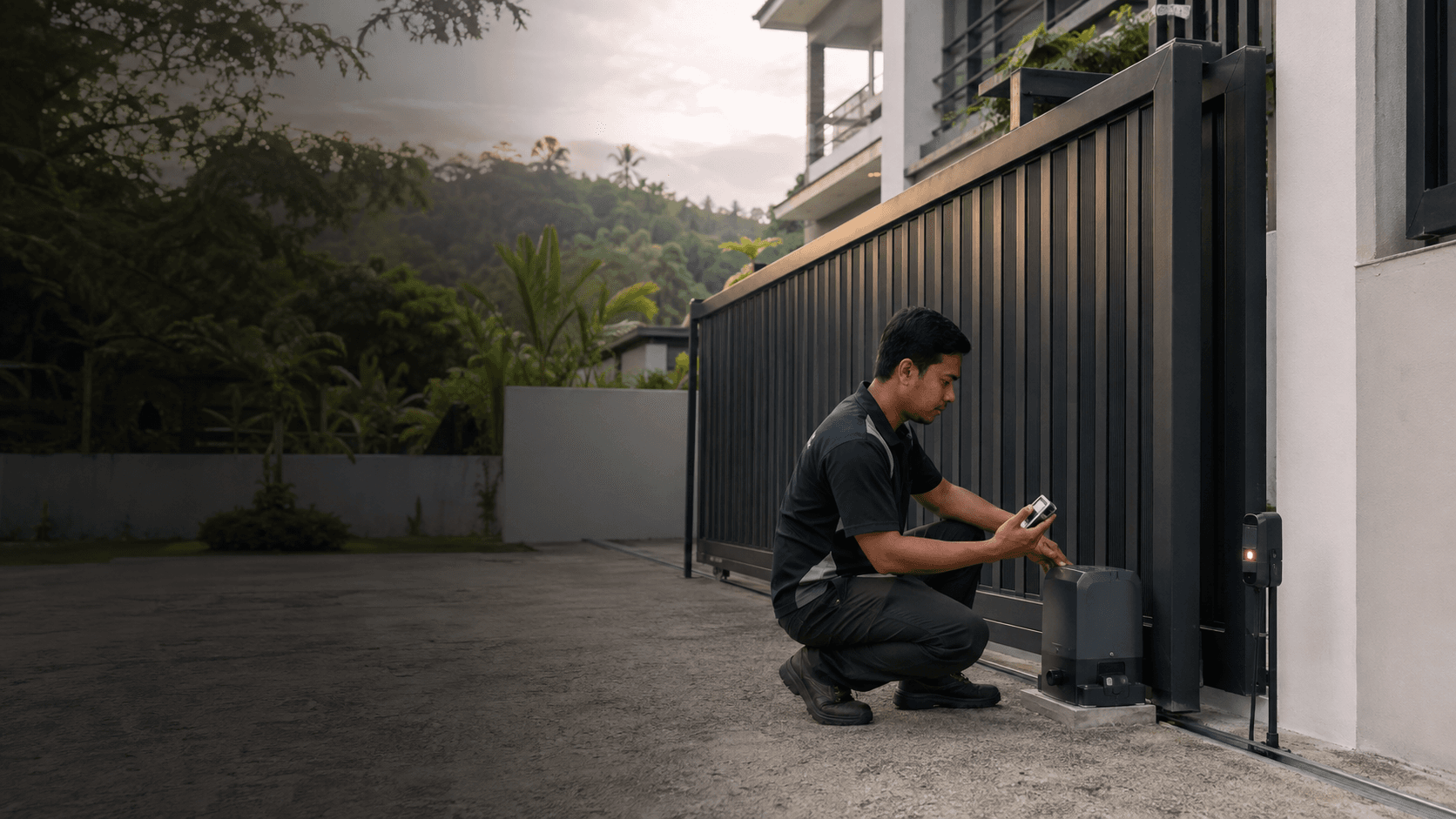
Automatic Gate Installation. What Matters Before You Choose
Before committing to automatic gate installation, property owners should assess the physical site and the gate itself. A motor cannot compensate for a poorly hung gate, weak posts, or an uneven track. The gate structure must move freely by hand first; automation then adds the motor, control board, and access devices. The decision sequence below reflects how a professional installer approaches the work:- Survey the entrance to measure the opening width, gate weight, and available space for the motor.
- Confirm the gate type, since swing and sliding gates require different operators and mounting hardware.
- Check power availability at the gate location and plan cable routing for the motor and control system.
- Select an access method such as remote control, keypad, intercom, or smartphone integration.
- Arrange for professional installation, testing, and a handover that explains daily operation.
Choosing the Right Automatic Gate Installation
The right automatic gate installation depends on the property type and how the entrance is used. Residential driveways typically suit swing gates when space allows the gate to arc inward or outward. Sliding gates work better where the driveway is short or slopes toward the road, because the gate moves sideways along a track instead of swinging into the drive. Commercial and public sites add another layer. Eyonic completed a project for the Kuching Immigration Office that focused on arrival flow, staff areas, visitor movement, and dependable daily operation. That project shows how entry systems must handle predictable traffic patterns and keep working through peak periods. An automatic gate installation for a busy office needs a heavier-duty operator and reliable access control compared with a single-home driveway. Gate weight is a core constraint. A lightweight aluminum gate needs a smaller motor than a heavy steel or wrought iron gate. Undersizing the operator leads to slow movement, frequent breakdowns, and premature wear. Oversizing wastes money and can move the gate too aggressively, creating a safety hazard.What is automatic gate installation?
Automatic gate installation is the process of fitting a motorized operator, control system, and safety devices to a gate so it opens and closes without manual effort. The work includes mounting the motor, running power and signal cables, programming the control board, and testing safety features such as obstacle detection. Eyonic supplies and installs autogate packages in Sarawak, with the package priced at RM 1599.Practical Considerations for Automatic Gate Installation
Power supply sits at the center of any automatic gate installation. Most residential gates use a standard electrical connection, but remote locations may need solar panels with battery backup. Solar systems add cost and complexity but remove the need for trenching cable to the gate. Safety features are not optional extras. Photoelectric sensors stop the gate if something crosses the path while it closes. Obstacle detection reverses the gate when it meets resistance. Manual release mechanisms let the gate open by hand during a power failure. These features protect people, vehicles, and the gate mechanism itself. Access control choices affect daily convenience. Remote controls suit single-family homes. Keypads work well for households with multiple drivers. Intercom systems let visitors call the property before entry. Eyonic also supplies keyphone intercom installation services in Sarawak, which can integrate with an automatic gate installation for screened visitor access.Gate Types and Their Trade-Offs
Swing gates pivot on hinges and come in single or double leaf configurations. They need clearance for the arc of the gate, and the ground must be reasonably level. Sliding gates run on a track or cantilever system and suit properties with limited driveway depth. Cantilever sliding gates need no ground track, which helps where gravel or paving makes a track impractical. The table below compares common automatic gate configurations:| Gate Type | Best Fit | Key Trade-Off |
|---|---|---|
| Swing gate | Residential driveways with side clearance | Requires space for the gate arc; ground should be level |
| Sliding gate | Short or sloped driveways | Needs lateral space beside the opening for the gate to retract |
| Cantilever sliding gate | Gravel or uneven surfaces | Higher cost but no ground track to maintain |